


Dyson Alternative for Travel Styling: 2026 Comparison
Table of Contents
- Why Travelers Are Ditching Single-Function Styling Tools
- What to Look for in a Travel-Friendly Hair Styler
- The Best Travel Hair Dryer for International Voltage: What Actually Works
- All-in-One Air Styler for Travel: One Tool, Three Functions
- How to Pack Hair Tools for Travel Without Wasting Suitcase Space
- Voltage Converters vs. Plug Adapters: What You Need to Know
- Hair Health During Travel: Protecting Your Strands on the Road
- Conclusion
- Frequently Asked Questions
Last Updated: September 14, 2026
Why Travelers Are Ditching Single-Function Styling Tools
Packing for a trip used to mean checking a bag full of heat tools or accepting whatever the hotel bathroom offered. A dyson alternative for travel styling now needs to do what three separate tools used to handle, and travel styling now means one device covering drying, straightening, and curling.
This guide breaks down what matters when shopping for a travel styler: voltage compatibility, weight, attachment range, and whether the tool protects your hair or just dries it faster.
The shift is simple economics. One compact styler takes up less suitcase space than a dryer, a flat iron, and a curling wand combined, and it removes the risk of frying a device the moment you plug it into a foreign outlet.
What to Look for in a Travel-Friendly Hair Styler
A travel-ready styler earns that label through three things: dual voltage support, low weight, and attachments that pull double duty.
Voltage, Wattage, and Safety Shut-Off
Dual voltage means the tool adjusts to 120V or 240V outlets, so it works at home or abroad without a bulky converter. Single-voltage tools will underperform or fail outright on the wrong outlet.
Wattage determines drying power, but higher wattage draws more current, which matters with a converter. A safety shut-off cuts power if the tool overheats, a detail that matters on unfamiliar outlets.
Barrel Attachments and Styling Versatility
Barrel attachments are where travel stylers win or lose. Interchangeable barrels for curling, a concentrator nozzle for targeted drying, and a smoothing brush for straightening give you a full routine in one case.
Ionic technology and ceramic coating matter too. Ionic airflow reduces static for easier frizz control in humid climates, while ceramic-coated plates distribute heat evenly to lower heat damage risk.
The Best Travel Hair Dryer for International Voltage: What Actually Works
The best travel hair dryer for international voltage is a dual-voltage model with a safety shut-off and enough wattage to dry hair in under 10 minutes. But "dual voltage" doesn't always mean automatic switching, some tools require flipping a physical switch between 120V and 240V, and forgetting that step means you'll hear a pop.
When comparing options, check three things:
- Does the tool switch voltage automatically or manually?
- What's the wattage at each voltage setting?
- Does it include a cool shot button to set the style?
A cool shot button matters more than people realize: locking the shape with cool air after heat helps the style hold longer, especially in humid conditions.
All-in-One Air Styler for Travel: One Tool, Three Functions
An all-in-one air styler for travel replaces a blow dryer, flat iron, and curling wand with a single device, and for most travelers, that's enough.
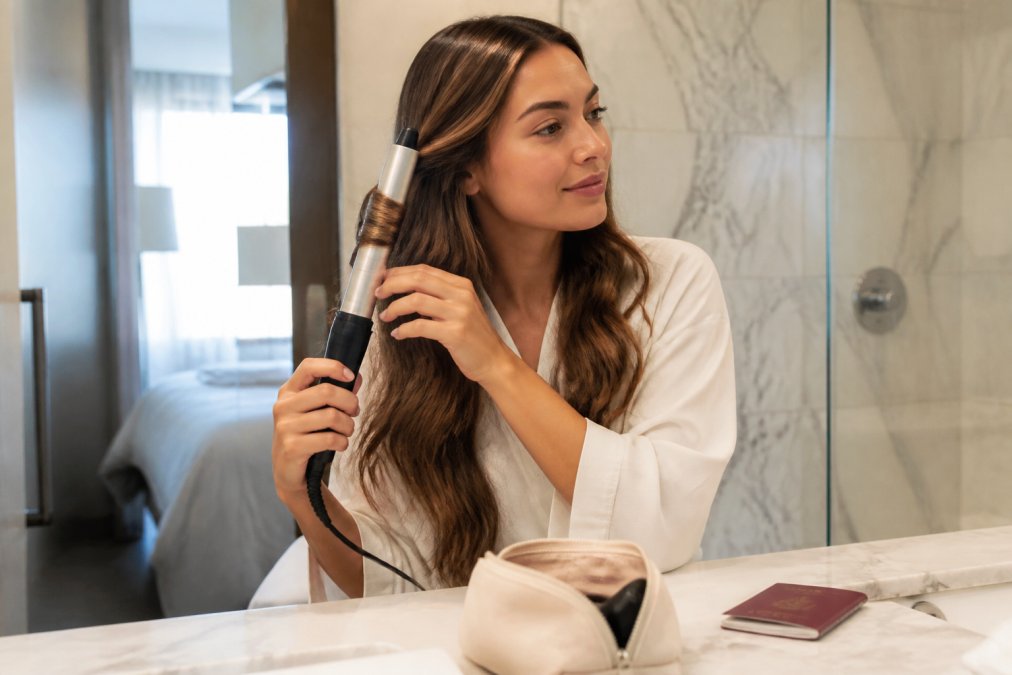
The CHASKA Air Styler from The Chaska Life uses twin turbo fans inside the plates to double drying power, and a patented heat plate handles drying, straightening, and curling in one pass. Priced at $249.00, it works across hair types.

For anyone who's found multi-function tools mediocre at everything, the difference is airflow design: tools that route air through the barrel rather than around it dry faster.
How to Pack Hair Tools for Travel Without Wasting Suitcase Space
Packing a styling tool isn't just about space, it's about clearing security, protecting the tool in transit, and knowing what's allowed in a carry-on.
The Lithium-Ion Battery Rule Most Travelers Don't Know
Cordless styling tools fall under the same federal rules as power banks and spare laptop batteries. Under TSA's carry-on rules, lithium-ion batteries must travel in your carry-on, not checked luggage, so a cordless flat iron or styler with a non-removable battery generally cannot go in a checked bag (tsa.gov).
There's a second wrinkle: many cordless styling tools exceed the 100-watt-hour (Wh) threshold TSA and the FAA treat as the standard carry-on limit. Tools above 100Wh but under 160Wh require airline approval, and anything above 160Wh is prohibited in carry-on (faa.gov). Most cordless stylers sit well under 100Wh, but the rating is printed on the tool or battery, worth checking before you fly.
A corded styler sidesteps the entire issue. No battery, no watt-hour math, no risk of a gate agent asking you to surrender the tool at the security checkpoint.
Carry-On vs. Checked: A Quick Rule of Thumb
- Corded styling tools (dryers, flat irons, curling wands): allowed in both carry-on and checked bags. No battery restrictions apply.
- Cordless styling tools with removable lithium-ion batteries: carry the tool in either bag, but the battery itself must go in your carry-on.
- Cordless styling tools with non-removable lithium-ion batteries: carry-on only, and check the watt-hour rating against the 100Wh threshold.
- Butane-powered styling tools (some cordless curling irons): generally prohibited in both carry-on and checked bags because they contain a flammable gas cartridge.
If you're not sure whether your tool qualifies, the safest move is to leave it home and travel with a corded dual-voltage styler instead.
Packing the Tool So It Survives the Trip
Once security is settled, packing comes down to a few moves:
- Wrap the cord around the handle and secure it with a velcro tie, not a rubber band, which cracks and leaves residue over time.
- Use a padded pouch or a clean sock to protect the barrel and plates from scratches and from knocking against other items.
- Pack the styler in the center of soft clothing, not against the hard shell of the suitcase, where impact transfers directly to the tool.
- Keep the plug adapter in the same pouch so it never gets separated from the tool it powers.
- If the tool has a locking switch or a travel lock, engage it so the plates don't open in transit.
Suitcase space disappears fast when tools are loose. A compact styler with a cord length under 3 meters takes up roughly the footprint of a folded shirt, small enough for a packing cube alongside your toiletries.
What to Leave Home
Every tool you pack is a trade-off against space, weight, and security friction. A full-size hair dryer, flat iron, and curling wand together can eat a third of a carry-on. If your styler handles drying, straightening, and curling in one pass, the other three stay home, and so does the lithium-battery question, as long as it's corded.
Voltage Converters vs. Plug Adapters: What You Need to Know
Most travelers use "adapter" and "converter" interchangeably. They don't mean the same thing, and the confusion is the most common way people destroy a styling tool on the first morning of a trip.
A plug adapter does one job: it changes the shape of the prongs so they fit a foreign wall outlet. It does not change the voltage. A power converter (also called a transformer) changes the voltage itself, stepping 240V down to 120V, or in some cases stepping 120V up to 240V.
If your styler is dual voltage (labeled something like "120-240V" or "100-240V"), you only need a plug adapter. The tool's internal circuitry handles the voltage. If your styler is single voltage ("120V only"), you need a converter rated for the tool's wattage, and that's where most people get into trouble.
The Wattage Math That Trips People Up
Heating tools draw far more power than phones or laptops. A travel hair dryer can pull 1,200-1,600 watts, a flat iron 30-60 watts, and a curling wand somewhere in between (energy.gov). Most inexpensive travel converters are rated 50-200 watts, fine for a phone, nowhere near enough for a hair dryer.
Plug a 1,500-watt dryer into a 200-watt converter and one of three things happens: the fuse blows, the converter overheats and shuts down mid-dry, or, worst case, it fails and sends full line voltage into the tool, burning out heating elements and creating a fire risk in a hotel room.
A common pattern: travelers buy a cheap "universal travel adapter" kit online, assume it converts voltage, and wonder why their dryer died in ten seconds. It was an adapter, never a converter.
How to Read the Label Before You Buy Anything
Check the tool's rating plate, usually on the handle or near the cord, for three things:
- Voltage range. "120V" means single voltage. "120-240V" or "100-240V" means dual voltage. "120V/240V" with a small switch means manual dual voltage.
- Wattage or amperage. Watts (W) or amps (A) tell you how much current the tool draws. Multiply amps by voltage to get watts if only amps are listed.
- Frequency. Most U.S. tools are rated 60Hz. Many overseas outlets run 50Hz. Dual-voltage tools usually tolerate both, but single-voltage motors can run hot or slow on the wrong frequency.
If the label says "120V only," you need a step-down converter rated at least 1.5x the tool's wattage to leave headroom. If it says "120-240V," a plug adapter is enough, but confirm whether the tool switches automatically or requires you to slide a physical switch. Forgetting that switch is the second most common way people fry a styler.
A Quick Decision Table
| Scenario | What You Need | Why |
|---|---|---|
| Dual-voltage styler, overseas outlet | Plug adapter only | Tool handles voltage internally |
| Single-voltage styler, overseas outlet | Step-down converter rated above the tool's wattage | Converts 240V to 120V safely |
| Dual-voltage styler with a manual switch, overseas outlet | Plug adapter + flip the switch to 240V | Manual tools don't auto-adjust |
| Dual-voltage styler, domestic outlet | Nothing extra | Standard outlet works |
| Single-voltage styler, domestic outlet | Nothing extra | Matches home voltage |
What to Buy Before Your Trip
For most travelers, the simplest answer is to buy a dual-voltage styler and carry only a plug adapter. That removes the converter from your packing list entirely, eliminates the wattage math, and means one less thing to forget at 5 a.m. before a flight. If you already own a single-voltage tool you love, budget for a properly rated step-down converter, and check that its wattage ceiling is at least 50% above your tool's draw.
A plug adapter costs a few dollars. A converter rated for heating tools costs more, and a burned-out styler costs more than both. The label on your tool tells you which one you actually need.
Hair Health During Travel: Protecting Your Strands on the Road
Travel wrecks hair in ways most people don't connect to their styling routine. Dry cabin air, hard hotel water, and unfamiliar humidity all change how hair responds to heat.
Lower your heat setting abroad, hair stressed by dry air and chlorine doesn't need the temperature it gets at home. Use the cool shot button to set the style instead of adding heat.
Thermal protection sprays help, but they aren't a license to crank the temperature. If you're using one tool instead of two, you're already cutting total heat exposure.
Conclusion
The hardest part of traveling with hair tools isn't space, it's finding one device that handles voltage, drying, and styling without compromising on all three.
The Chaska Life built the CHASKA Air Styler around that problem: twin turbo fans for faster drying, a patented heat plate for straightening and curling, and a design that works across hair types so you pack one tool instead of three. At $249.00, it replaces the cost and clutter of separate devices.
Get started with The Chaska Life and simplify what goes in your bag before your next trip.
Frequently Asked Questions
Is there a travel version of the Dyson Airwrap?
Dyson does not sell a dedicated travel version of the Airwrap. The full-size Airwrap works internationally on dual voltage, but it is bulky for carry-on luggage. Several compact multi-stylers now rival it for travel, including the CHASKA Air Styler ($249), which combines drying, straightening, and curling in one tool with twin turbo fans built into the plates for faster styling on the go.
Can I use my hair styling tools internationally with a converter?
Only if your tool is single-voltage and you pair it with a proper power converter, not just a plug adapter. A plug adapter only changes the shape of the plug; it does not change voltage. If your styler is dual voltage, you typically only need a plug adapter. Check the label on your tool before you travel to avoid frying it or tripping a hotel breaker.
What features should I look for in a travel-friendly hair styler?
Prioritize dual voltage (100-240V), a compact design under 12 inches, and multiple heat settings with a cool shot button for setting styles. Look for ceramic coating or ionic technology to reduce frizz, an ergonomic handle, and a safety shut-off. If you want one tool for everything, an all-in-one air styler for travel saves suitcase space and styling time.
How do I pack hair tools for travel without damaging them?
Wait for tools to cool completely, then wrap the cord loosely around the handle and secure it with a velcro tie. Place the tool in a padded travel case or roll it inside a towel. Keep it in your carry-on if it is expensive or hard to replace, and confirm it meets TSA carry-on rules. Never pack a hot tool in a checked bag.