


Maintain Hair Health While Traveling: 7 Essential Steps
Table of Contents
- Step 1: Assess Your Hair Needs Before You Leave
- Step 2: Choose the Best Compact Hair Tools for Travel
- Step 3: Pack Hair Products for Air Travel Correctly
- Step 4: Prepare Your Hair Before Travel
- Step 5: Protect Hair from Humidity While Traveling
- Step 6: Adapt Your Routine to Water Quality and Climate
- Step 7: Maintain Hair Health During and After Your Trip
- Frequently Asked Questions
Last Updated: September 30, 2026
Step 1: Assess Your Hair Needs Before You Leave
Before packing, understand what your hair needs to maintain hair health traveling. Different climates, water quality, and flight conditions stress hair differently, fine, straight hair faces different challenges than coiled or textured hair.
Identify your hair type and current condition (dry, oily, or balanced) and any issues like breakage, frizz, or buildup. This baseline helps you predict how travel will affect it.
Research your destination's climate: humid environments cause frizz, dry climates pull moisture, cold weather makes hair brittle, and sun exposure causes UV damage.
Water quality significantly affects hair. Hard water leaves mineral deposits (dull, difficult to style); soft water makes hair feel limp. Different water than home may require routine adjustments.
Trip length determines preparation needs. Weekend getaways require different prep than month-long journeys, where hair stress accumulates.
Step 2: Choose the Best Compact Hair Tools for Travel
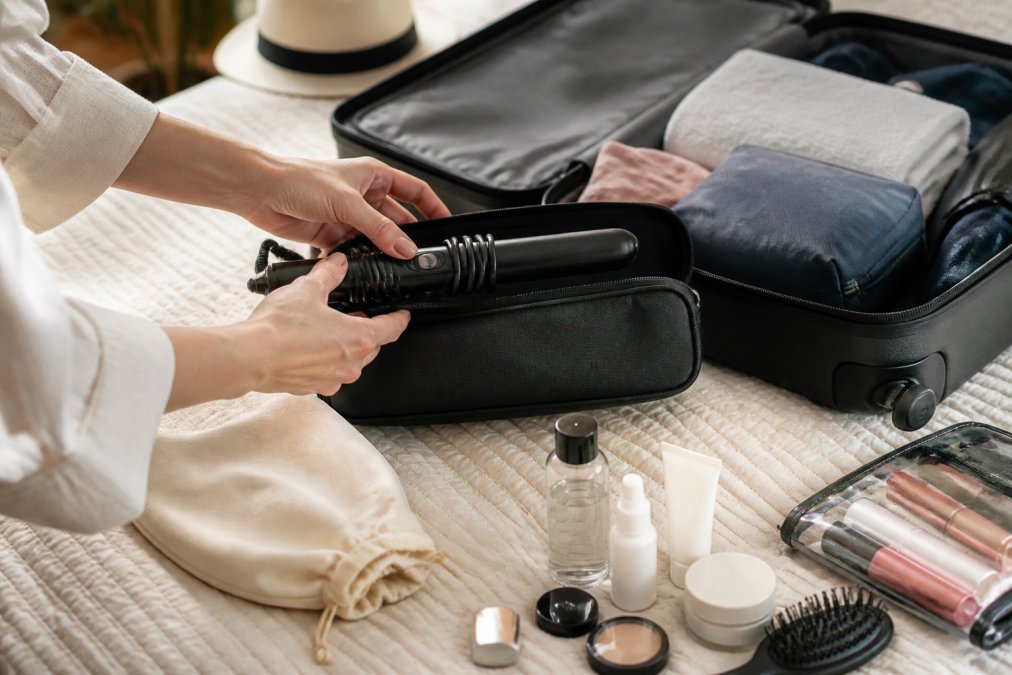
Pack compact tools that do multiple jobs. You need something that dries, straightens, and curls without consuming luggage space.
All-in-one tools eliminate choosing between a blow dryer, flat iron, and curling iron. The Chaska Life Air Styler combines all three with twin turbo fans and plasma technology, delivering salon-quality results while saving space and weight.

Look for tools with these essential features:
- Compact size: Should fit in a standard toiletry bag
- Multiple heat settings: Adjustable temperature protects different hair types
- Fast drying: Twin fans or ionic technology cut drying time
- Lightweight: Under 2 pounds is ideal for travel
- Dual voltage: Works in international destinations with different electrical standards
The Chaska Life Air Styler's direct airflow and plasma ions seal the hair cuticle, reducing frizz when humidity and environmental stress are highest.
Avoid multiple single-purpose tools. One versatile tool saves space, weight, and simplifies your routine.
Step 3: Pack Hair Products for Air Travel Correctly
TSA limits liquids to 3.4 ounces per container in carry-on bags. This includes shampoo, conditioner, leave-in conditioner, hair oil, and heat protectant spray.
Pack liquids in checked luggage to eliminate size restrictions and prevent spills. If carrying on, use travel-sized containers in a clear plastic bag.
Solid alternatives (shampoo bars, conditioner bars, solid oils) skip TSA restrictions, take minimal space, and last longer than liquids, ideal for extended trips.
Packing strategies: place liquids in a waterproof pouch in checked luggage, prioritize solid products, pack travel-sized heat protectant for touch-ups, and bring only products you'll use.
The CHASKA Moisture Rich Heat Protectant protects hair during styling while providing smoothness and shine. Apply it before using your styling tool to minimize heat damage during travel when your hair is already stressed.

Step 4: Prepare Your Hair Before Travel
Pre-trip preparation depends on your hair type to prevent damage effectively.
For coiled and textured hair (3C-4C):
Start 5-7 days before with a moisture-rich deep conditioning treatment. Textured hair loses moisture faster due to its spiral structure. Apply a mask for 20-30 minutes and repeat 2-3 times before travel.
Two days before, apply a leave-in conditioner and seal with hair oil (argan, jojoba, or coconut oil) to create a moisture barrier against humidity and hard water.
Trim 10-14 days before travel only if you have significant breakage or split ends; fresh trims feel vulnerable during travel.
Braid or twist your hair the night before travel. This protective style reduces manipulation during your journey and prevents moisture loss. Braids also maintain curl definition better than loose hair during flights and climate changes.
For fine, straight, or thin hair:
Start 3-4 days before with a lightweight deep conditioning treatment. Heavy masks weigh fine hair down; use a hydrating conditioner for 10-15 minutes instead.
One day before, apply a volumizing leave-in conditioner to damp hair. Avoid oils; use a lightweight silicone-based serum on ends only.
Trim 5-7 days before if you have split ends; fine hair shows damage visibly, and a fresh cut removes vulnerability.
Wash hair the morning of travel. Clean fine hair holds styles better and feels fresher. Avoid heavy styling products before flying, they accumulate and look greasy by day two.
For all hair types:
Apply a heat protectant treatment the night before departure. This creates a barrier against heat styling, UV exposure, and humidity during your trip. The CHASKA Moisture Rich Heat Protectant works across all hair types and can be applied to damp hair before bed.
CHASKA Moisture Rich Heat Protectant →
Test any new products or techniques at home before traveling. The worst time to discover a product doesn't work is when you're three time zones away from home with no backup options. If you're trying a new deep conditioner or leave-in treatment, use it at least twice at home first.
Stay hydrated and sleep well for 3-5 nights before travel. Hair health reflects overall hydration and rest; dehydration makes hair brittle and prone to breakage.
Step 5: Protect Hair from Humidity While Traveling
Humidity causes frizz by allowing moisture to penetrate the hair cuticle. Seal the cuticle before moisture enters to maintain your style.
Apply heat protectant before styling to reduce frizz and lock in moisture. The CHASKA Moisture Rich Heat Protectant contains silicones and argan oil that smooth the cuticle.
Humidity-fighting techniques: apply heat protectant before blow-drying, use a concentrator nozzle, finish with light oil or serum, sleep in a protective style, and use microfiber towels.
Silk or satin pillowcases reduce friction and frizz. Cotton pillowcases cause breakage and frizz, this simple swap makes a noticeable difference.
Avoid touching your hair throughout the day. Hand oils and moisture disrupt your style and increase frizz.
Step 6: Adapt Your Routine to Water Quality and Climate
Assessing and Managing Water Quality:
Water quality significantly impacts hair health. Hard and soft water require different responses; test your destination's water before arrival.
Hard water leaves mineral deposits on hair, dulling color and creating buildup. If your home water is soft and destination is hard, your usual shampoo won't remove deposits effectively.
Test your destination's water hardness before travel. Hotels often provide water quality reports, or search online by postal code. Anything above 120 ppm is considered hard (Hardness of Water).
For hard-water areas (3+ days), bring a chelating shampoo with citric acid or EDTA to remove mineral deposits. Use once weekly; overuse strips natural oils.
For extended trips (2+ weeks) to hard-water areas, consider a portable shower filter ($20-$50, under 4 ounces) that removes chlorine, sediment, and minerals.
Soft water makes hair feel limp and weighed down. Use a volumizing shampoo and skip heavy conditioners. A light leave-in conditioner works better than thick creams.
Climate-Specific Hair Protocols:
Climate determines which products and routines prevent damage; humidity, temperature, and UV intensity create different problems.
Hot, sunny climates (80°F+, high UV index):
UV exposure damages hair protein, causing fading, brittleness, and breakage. Apply UV-protective products with avobenzone or zinc oxide before sun exposure and reapply after swimming.
Wear a hat, scarf, or swim cap when possible. Physical barriers are more effective than products; a wide-brimmed hat reduces UV exposure by 75%.
Deep condition every other day in sun.
Dry climates (humidity below 30%, elevation above 5,000 feet):
Cold climates (below 40°F):
Humid climates (humidity above 60%):
Step 7: Maintain Hair Health During and After Your Trip
To maintain hair health traveling, simplify your routine during your trip. Use your all-in-one tool to dry and style in one step, reducing heat exposure.
Frequently Asked Questions
How do I maintain hair health while traveling without access to my regular products?
Focus on the essentials: a heat protectant, leave-in conditioner, and a travel-sized shampoo or shampoo bar. Apply heat protectant before using any heat styling tools to seal moisture and prevent damage. A leave-in conditioner provides hydration without needing a rinse, making it ideal for travel. Choose sulfate-free options to avoid stripping natural oils from your scalp and hair.
What should I pack for air travel that complies with TSA liquid requirements?
TSA allows liquids in containers of 3.4 ounces (100 milliliters) or smaller in a single quart-sized clear bag. Pack travel-sized heat protectant, conditioner, and serums in this bag. Consider shampoo bars instead of liquid shampoo to save space and avoid liquid limits entirely. Solid products like bars don't count as liquids, making them perfect for carry-on luggage.
How can I protect my hair from humidity and frizz while traveling?
Apply a heat protectant with frizz-control ingredients before styling. The CHASKA Moisture Rich Heat Protectant uses silicones and argan oil to create a protective barrier against humidity. Sleep on a silk pillowcase to reduce friction and frizz overnight. Style hair into protective hairstyles like braids or buns in humid climates to minimize exposure. Use a microfiber towel instead of cotton to reduce breakage and frizz when drying.
Will using an all-in-one styling tool like the CHASKA Air Styler damage my hair more than separate tools?
No. The CHASKA Air Styler uses plasma technology that generates negatively charged ions to seal the hair cuticle and retain moisture, actually protecting against damage. The key is using a heat protectant before styling, this creates a barrier between heat and your hair regardless of the tool. Applied correctly with proper heat protection, an all-in-one tool delivers the same results as separate tools with less time spent styling, reducing overall heat exposure.