


What Is Dual Voltage and Why It Matters for Hair Tools
Table of Contents
- What Is Dual Voltage and Why It Matters for Hair Tools
- How Dual Voltage Works in Styling Devices
- Voltage Converter vs Plug Adapter: What's the Difference?
- How to Check Hair Dryer Voltage on Any Styling Tool
- Wattage vs Voltage: Why Both Matter for Your Hair Tools
- Frequency (Hz) Compatibility: The Spec Most Travelers Ignore
- Best Travel Hair Tools for International Travel
- What Happens When You Use the Wrong Voltage (and How to Recover)
- Frequently Asked Questions
Last Updated: September 27, 2026
What Is Dual Voltage and Why It Matters for Hair Tools
Dual voltage is a design feature that lets a styling tool run on two different electrical supply ranges, typically 100-120V and 220-240V, so it can operate in more than one country without a bulky transformer. This guide explains why that single specification decides whether your hair dryer survives a trip or dies in a hotel bathroom.

Most people pack a plug adapter, plug in their straightener, and hear a pop. The tool is gone. The adapter did its job, and that was never the job that needed doing.
Below, we'll show you exactly how to read a voltage label in ten seconds, why wattage and hertz matter just as much, and what to do when a tool has already taken the hit. The stakes are real: a styling device built for one power grid and plugged into another can overheat, short circuit, or fail outright, and most travel blogs never mention it.
How Dual Voltage Works in Styling Devices
Dual voltage works in one of two ways, and the difference matters more than the label suggests.
The first is a manual dual-voltage switch. You slide it to 120V or 240V before plugging in. Forget the switch and the tool receives roughly double its rated input voltage, which is how heating elements and thermal fuses fail. The switch is a physical selector wired into the primary side of the power supply; it reconfigures the input path so the heating element and motor see the voltage they were designed for. There is no sensing, no safety net, the tool trusts you to set it correctly every single time.
The second is automatic adjustment, where the device senses the incoming supply and regulates itself.
The wattage ceiling nobody warns you about
Voltage and wattage are different measurements, and the converter you buy has to satisfy both. Voltage is the electrical pressure pushing current into the device; wattage is how much power the device actually draws to do its work. A full-size hair dryer rated at 1,600W needs that wattage to produce meaningful airflow and heat, regardless of what voltage it runs on.
Frequency (Hz) is a separate spec
Electrical systems run at either 50Hz or 60Hz, and frequency is independent of voltage. A motor-driven appliance like a blow dryer is tuned to one frequency. Run a 60Hz motor on 50Hz and it spins slower and runs hotter; run a 50Hz motor on 60Hz and it can overspeed. Heating elements are less sensitive, which is why straighteners and curling irons tolerate frequency mismatches better than dryers do.
Voltage Converter vs Plug Adapter: What's the Difference?
Here's the practical split:
- Plug adapter: changes prong shape. Costs a few dollars. Does nothing to the electricity.
- Converter: steps voltage down or up. Bulkier, heavier, and rated for a maximum wattage.
- Transformer: a heavier-duty converter for high-wattage appliances, usually too large for a hair dryer.
If your tool is dual voltage, you need an adapter and nothing else. That is the entire point of the feature.
How to Check Hair Dryer Voltage on Any Styling Tool
Knowing how to check hair dryer voltage takes about ten seconds and saves you a ruined tool.
CHASKA Air Styler - 3-in-1 Hair Dryer →
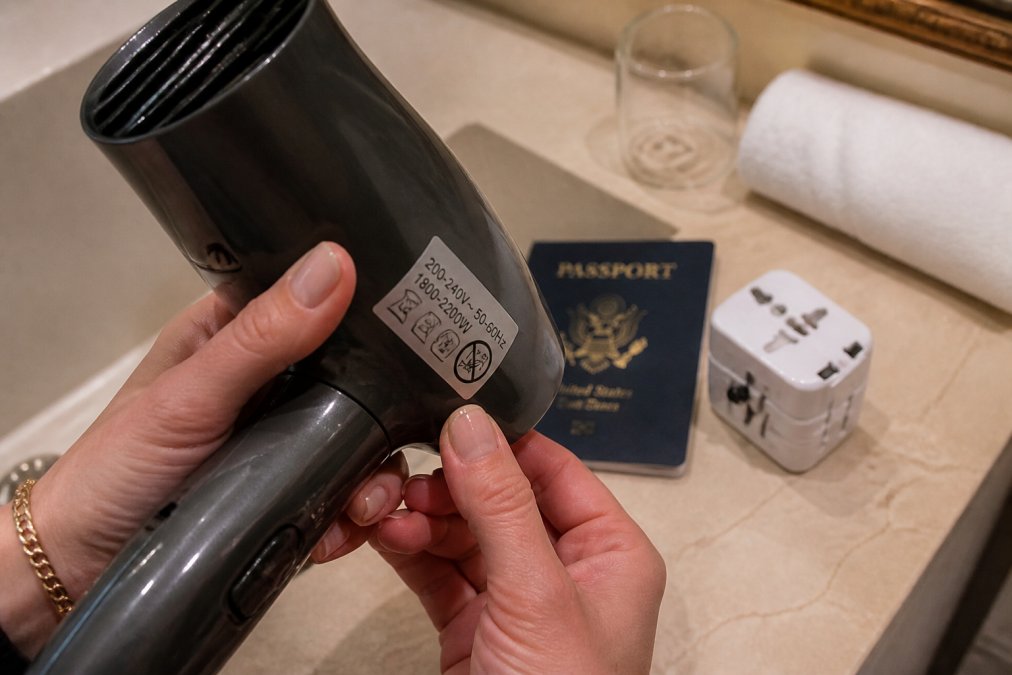
- "100-240V" or "110-240V": dual voltage. Travel-ready with an adapter only.
- "120V" or "110V" alone: single voltage. You need a converter, or leave it home.
- "220-240V" alone: built for other power grids. Do not plug it into a standard household outlet here.
Wattage vs Voltage: Why Both Matter for Your Hair Tools
Wattage and voltage are not the same measurement, and confusing them is where most guides stop being useful.
| Tool Type | Typical Power Draw | Voltage Converter Needed? | Notes |
|---|---|---|---|
| Hair dryer | High | Usually yes, if single voltage | Most converters can't handle full-size dryers |
| Flat iron / straightener | Low to moderate | Sometimes | Often manageable with a rated converter |
| Curling iron | Low to moderate | Sometimes | Check the appliance label first |
| Dual-voltage styler | Varies | No | Adapter only, if voltage range covers the outlet |
| Travel blow dryer | Moderate | No, if dual voltage | Built for the purpose |
Frequency (Hz) Compatibility: The Spec Most Travelers Ignore
Frequency is the specification almost nobody checks, and it can degrade a tool even when the voltage is correct.
Best Travel Hair Tools for International Travel
The best travel hair tool is one that is dual voltage, covers the full 100-240V range, and does more than one job so you pack less. That combination solves voltage, plug configuration, and luggage space at once, but "dual voltage" on the box is not enough. Here is the checklist that actually separates a travel-ready tool from one that will disappoint you abroad.
The five-point buying checklist
- Voltage range. Look for "100-240V" or "110-240V" on the label. A tool marked only "120V" or only "220-240V" is single voltage, no matter what the marketing copy says.
- Wattage. A travel blow dryer in the 1,200-1,600W range gives usable airflow without demanding a converter that can't supply it. Lower-wattage travel dryers exist, but they trade drying speed for portability.
- Frequency tolerance. If the label lists "50/60Hz," the tool is designed to tolerate either grid frequency. If it lists only "60Hz," expect slower motor speed and more heat buildup on a 50Hz grid.
- Adapter-only operation. A true dual-voltage tool needs only a plug adapter abroad, no converter. If the manual says "use with a converter," it is not the travel tool you want.
- Plug type and cord. A folding or short cord saves space; a grounded plug may not fit every outlet, so a small adapter set is still worth packing.
What to look for in a multi-function styler
A 3-in-1 tool that dries, straightens, and curls replaces the blow dryer, flat iron, and curling iron you'd otherwise be checking voltage labels on individually. Fewer tools means fewer power ratings to verify and fewer things to leave behind. When evaluating one, ask:
- Does it list a full 100-240V range and 50/60Hz on the label?
- Does the drying element use a motor-driven fan? If so, frequency tolerance matters more than it does for a pure heating tool.
- Does the manufacturer state adapter-only operation, or does it require a converter?
- What is the actual wattage draw at the low end of the voltage range? A tool that performs well at 120V may feel weaker at 100V.
What to skip
- Single-voltage dryers with a "travel" label. Many are travel-sized, not travel-voltage. Check the label.
- Cheap adapter kits marketed as converters. They reshape prongs; they do not change voltage.
- High-wattage single-voltage dryers paired with a small converter. The converter will trip or overheat before the dryer finishes.
What Happens When You Use the Wrong Voltage (and How to Recover)
Using the wrong voltage usually ends one of three ways, and only one of them is recoverable.
Recovery checklist if a tool has already failed abroad:
- Unplug it and let it cool completely before touching the barrel or housing.
- Check the thermal fuse first. A dead tool with no burn smell often just needs a fuse.
- If there's a burn smell, discoloration, or a tripped outlet, retire the tool. Do not keep using it.
- Replace with a dual-voltage model so the problem can't repeat.
Frequently Asked Questions
How do I know if my hair tool is dual voltage or not?
Check the label on the handle or cord. Look for a voltage range like 100-240V or 110-240V. If it shows a single number such as 120V or 220V, it is not dual voltage and needs a converter for international travel. Some tools also have a small switch labeled 120V/240V that you must set manually before plugging in.
What is the difference between a voltage converter and a plug adapter?
A plug adapter only changes the shape of the plug so it fits a foreign electrical outlet. It does not change voltage. A voltage converter or transformer actually changes the electrical current from 220V to 120V, or the reverse. Hair tools with heating elements draw high wattage, so they typically need a heavy-duty converter, not just an adapter. Using only an adapter with a non-dual-voltage tool will damage it.
Can I use a 120V hair tool in a 220V outlet?
No. Plugging a 120V hair tool into a 220V outlet will cause overheating, trigger the thermal fuse, or burn out the heating element. In some cases it can create a short circuit or fire hazard. If your tool is not dual voltage, you must use a step-down voltage converter rated for the wattage of your device. Even then, many manufacturers advise against it for high-wattage styling tools.
Why do hair tools burn out when used with the wrong voltage?
Hair tools contain heating elements designed for a specific input voltage. When you feed 220V into a 120V device, the element receives nearly double the intended current, causing rapid overheating. This can melt internal wiring, blow the thermal fuse, or destroy the power rating components. Most tools are not repairable after this happens because the damage reaches the circuit board, not just the fuse.
The real challenge with travel styling isn't finding an outlet, it's finding one tool that works on every power grid without a converter, a voltage switch, or a gamble. The Chaska Life built the CHASKA Air Styler for exactly that problem: dual-range voltage compatibility, all-in-one drying, straightening, and curling, and plasma ion technology that reduces frizz while you style. Get started with The Chaska Life and pack one tool instead of three.