


How to Choose Barrel Size for Curls: 2026 Guide
Table of Contents
- Why Barrel Size Decides Your Curl Pattern
- Curling Iron Barrel Size Chart: Small, Medium, and Large Explained
- Match Barrel Size to Hair Length and Style Goals
- Best Curling Iron Barrel Size for Long Hair
- How to Get Barrel Curls: Step-by-Step
- Hair Type, Heat Settings, and Curl Longevity
- Wand vs. Clamp Iron: Which Barrel Tool Works Best for You
- Conclusion: Pick Your Barrel with Confidence
- Frequently Asked Questions
Last Updated: October 15, 2026
Why Barrel Size Decides Your Curl Pattern
The barrel size for curls is the single biggest factor in the kind of curl you get. A curling iron barrel is the round heated cylinder hair wraps around, and its diameter sets the width of every curl: small barrel, tight curl; large barrel, loose wave.
Here is how to choose barrel size for curls the right way.
How Barrel Diameter Affects Curl Size and Shape
Barrel diameter is the width of the round cylinder, measured across its middle. A smaller diameter wraps hair into a tighter, springier curl; a larger diameter relaxes it into a wave.
Curl tightness is proportional to barrel size. Cut the diameter in half and you roughly double the tightness. That is why a half-inch barrel makes ringlets and a two-inch barrel makes beach waves.
How to Measure a Curling Iron Barrel Accurately
Measuring a curling iron barrel is easy: use a ruler across the widest point, not the tip or the clamp.
Here is the quick method:
- Lay the iron flat on a counter
- Place the ruler across the middle of the barrel
- Measure from one outer edge to the other
Most irons print the size on the handle or barrel, but printed sizes are not always exact. If the label says one inch and your ruler says 1.25, trust the ruler.
Curling Iron Barrel Size Chart: Small, Medium, and Large Explained
A curling iron barrel size chart groups irons into three bands: small barrels make tight curls, medium barrels make bouncy curls, and large barrels make loose waves. Match the band to your goal, then fine-tune.
| Barrel Size | Curl Result | Best For | Hair Length |
|---|---|---|---|
| 0.5 to 1 inch | Tight curls, ringlets | Defined, springy looks | Short to medium |
| 1.25 to 1.5 inches | Bouncy curls, volume | Everyday polish | Medium to long |
| 1.75 to 2 inches | Loose waves, beach waves | Soft, relaxed styles | Long |
Small Barrels (0.5 to 1 Inch) for Tight Curls and Ringlets
Small barrels are the tightest option. A half-inch barrel makes true ringlets; a one-inch barrel makes defined curls that still hold shape.
These sizes work best on short hair and the ends of layered cuts. On long, heavy hair, small curls can clump and look frizzy by midday, so use smaller sections and a firm-hold product.
Medium Barrels (1.25 to 1.5 Inches) for Bouncy Curls and Volume
The medium barrel is the workhorse size we recommend most often. A 1.25-inch barrel gives bouncy curls with real volume; a 1.5-inch barrel softens that into a relaxed, polished curl.
This band suits most hair lengths and everyday styles. If you only own one curling iron, make it a 1.25-inch.
Large Barrels (1.75 to 2 Inches) for Loose Waves and Beach Waves
Large barrels create loose curls and beach waves, not defined ringlets: a 1.75-inch barrel gives soft movement, a 2-inch barrel that effortless, windblown look.
Large barrels need length to work. On short hair, the wrap is too wide and the curl falls out fast. On long hair, they shine.
Match Barrel Size to Hair Length and Style Goals
Hair length narrows your options fast, but length alone is not enough. Two people with shoulder-length hair can need different barrels because density and texture change how hair wraps and how long the shape lasts. Use length as a starting filter, then adjust.
Here is the quick decision guide by length and desired result:
| Hair Length | Desired Result | Starting Barrel | Adjustments |
|---|---|---|---|
| Short (above chin) | Tight curls, ringlets | 0.5 to 0.75 inch | Go smaller for very short layers; larger barrels cannot complete a wrap |
| Short (above chin) | Soft waves | 1 to 1.25 inches | Fine hair can use 1.25; thick hair may need 1 inch to hold |
| Medium (chin to shoulder) | Bouncy curls | 1.25 inches | Dense hair: smaller sections, same barrel |
| Medium (chin to shoulder) | Loose waves | 1.5 inches | Fine hair holds this well; coarse hair may drop it |
| Long (past shoulders) | Defined curls | 1 to 1.25 inches | Start one size smaller than your target because gravity stretches curls |
| Long (past shoulders) | Beach waves | 1.75 to 2 inches | Works best on thick hair; fine long hair may need 1.5 |
How Density Changes the Recommendation
Density is how many strands sit on your head, not how thick each strand is. Dense hair packs more hair into every section, so the fix is smaller sections, not a different barrel: a 1.25-inch barrel with one-inch sections reads tighter than the same barrel with two-inch sections.
Low-density hair has the opposite problem: sections spread out, wraps loosen, and curls fall flat. Use slightly smaller sections than you think you need and keep tension even.
How Texture Changes the Recommendation
Fine hair holds a curl easily, so a larger barrel still gives shape, but it scorches faster, use a lower heat setting. Thick, coarse hair fights the curl, so go one size smaller than the chart suggests and give each section a few extra seconds.
Naturally textured hair (wavy, curly, or coily) already has a pattern. A barrel close to your natural pattern size blends with it; a barrel far from it creates a mixed look.
A Note on Wrap Direction and Parting
Length and density decide the barrel; wrap direction decides the finish. Wrapping every section the same direction creates uniform, editorial curls; alternating directions creates a blended, natural look.
If your hair wraps more than once around the barrel, overlap the wraps instead of stacking them side by side. Overlapping produces one continuous curl; side-by-side wraps produce a kinked, uneven shape.
Best Curling Iron Barrel Size for Long Hair
The best curling iron barrel size for long hair depends on the look you want, but most people land on 1.25 inches for curls and 1.75 inches for waves.
On long hair, gravity stretches the curl, so if you want a medium curl at 5 p.m., start with a smaller barrel at 8 a.m.
CHASKA Air Styler - 3-in-1 Hair Dryer Straightener & Curler with Plasma →
For long, thick hair, a 1.25-inch barrel gives bouncy curls that still look full after a few hours. For long, fine hair, a 1.5-inch barrel is often enough.
How to Get Barrel Curls: Step-by-Step
Getting barrel curls comes down to section size, wrap direction, and heat control.
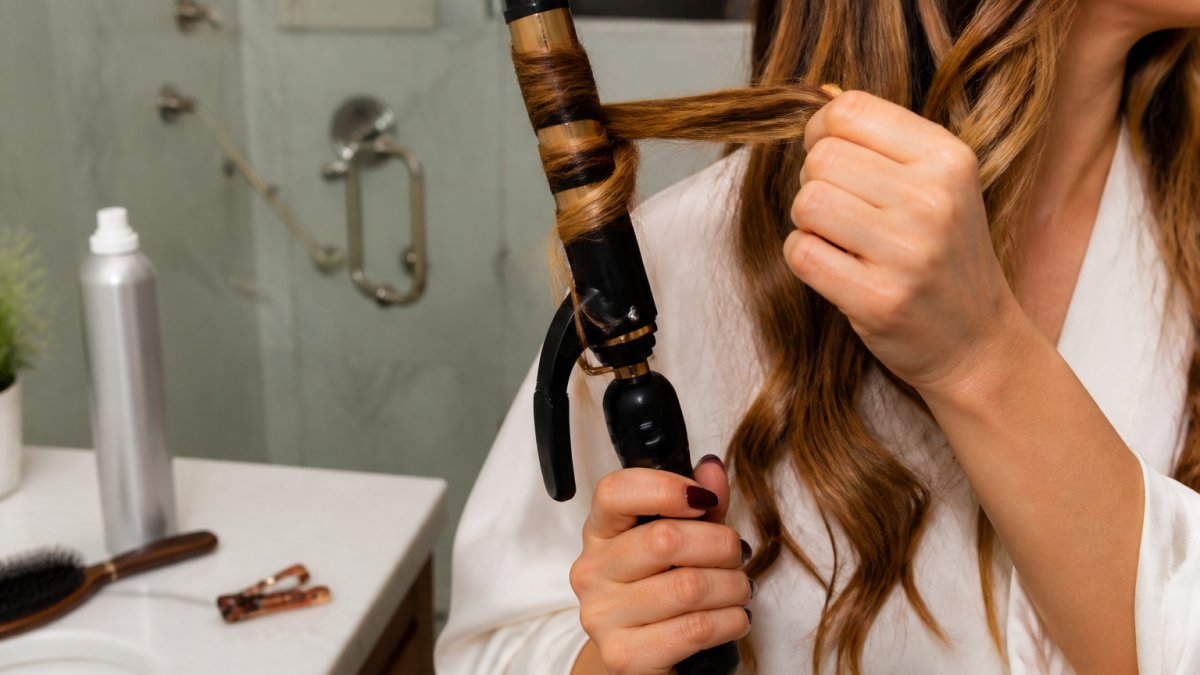
Total Time: 20 to 30 minutes Difficulty: Beginner
What You'll Need:
- Curling iron in your chosen barrel size
- Heat protectant
- Clips to section hair
Step 1: Prep your hair [Time: 2 minutes] Apply heat protectant to damp or dry hair before any heat touches it. The Chaska Life's Moisture Rich Heat Protectant uses argan oil and vitamin E to smooth strands before styling.

Step 4: Hold, then release [Time: 5 minutes] Hold each section for 8 to 10 seconds.
Step 5: Finish with light hold [Time: 2 minutes] Mist with light-hold spray and tousle with your fingers.
Expected Result: Even, defined curls with movement that lasts through the day.
Hair Type, Heat Settings, and Curl Longevity
Hair type decides your heat setting, and the wrong setting ruins a good curl: fine hair scorches at high heat, thick hair barely curls at low heat. The right number depends on strand thickness, hair condition, and how much heat protectant you applied.
Temperature Starting Points by Hair Type
These are starting points, not rules. Begin at the low end, test one section, and move up only if the curl does not hold.
- Fine or damaged hair: 250 to 300 degrees Fahrenheit
- Medium hair: 300 to 350 degrees Fahrenheit
- Thick, coarse, or resistant hair: 350 to 400 degrees Fahrenheit
If your iron does not display a temperature, it likely runs at a fixed setting around 350 to 400 degrees Fahrenheit, too hot for fine hair and often too cool for coarse hair, which is why a variable-temperature tool pays off.
Why Prep Decides Longevity More Than Heat
Curl longevity comes from prep, not just heat. Clean, dry hair holds curl better than day-two hair with product buildup, and a light mist before wrapping helps more than a heavy spray after. Here is the sequence that most consistently produces curls that last:
- Start on dry hair. Damp hair steams under the barrel and the curl collapses as it dries.
- Apply heat protectant evenly. Work it from mid-length to ends, then comb through so no section is overloaded.
- Add a light styling product if your hair is slippery. Fine, silky hair benefits from a light mousse or texture spray before wrapping; coarse hair usually does not need it.
- Keep sections consistent. Two-inch sections are a good default. Smaller sections curl tighter and hold longer; larger sections look softer but drop faster.
- Cool each curl completely before releasing. This is the step most people skip. Hair sets as it cools, not as it heats. If you drop the curl while it is still warm, it relaxes within minutes.
- Finish with light-hold spray, not heavy spray. Heavy spray weighs curls down and makes them look stiff by afternoon.
How to Make Curls Last Through the Day
A few habits extend wear time without extra product:
- Pin each curl while it cools. A small clip or pin holds the shape until the hair is cool, then release and finger-comb.
- Avoid brushing. Brushing breaks the curl pattern and turns defined curls into frizz. Use fingers or a wide-tooth comb.
- Sleep on a satin or silk pillowcase. Less friction means less flattening overnight.
Matching Heat to Barrel Size
Small barrels concentrate heat into a smaller area, so they scorch faster than large barrels at the same setting. With a half-inch or three-quarter-inch barrel, drop your temperature by about 25 to 50 degrees Fahrenheit versus a 1.25-inch barrel. Large barrels spread heat over more surface area, so they often need a slightly higher setting for thick hair, but they are gentler on fine hair.
Wand vs. Clamp Iron: Which Barrel Tool Works Best for You
Wands and clamp irons both use a barrel but work differently. A clamp iron has a spring-loaded clip that holds hair against the barrel; a wand has no clamp, so you wrap hair by hand.
Clamp irons are easier for beginners: the clamp keeps hair in place for even tension and consistent curls. Wands give a more natural, blended look but take practice and carry a higher risk of burns.
This is where a multi-function tool changes the math. The CHASKA Air Styler dries, straightens, and curls in one device, so you are not juggling a blow dryer, a flat iron, and a curling iron on the same morning.

Conclusion: Pick Your Barrel with Confidence
Choosing the right barrel size is not complicated once you know the rule. Small barrel, tight curl. Large barrel, loose wave.
The harder problem is owning three tools to cover three sizes. The Chaska Life built the Air Styler to solve exactly that.
Get started with The Chaska Life and cut your styling time without giving up salon-quality results.
Frequently Asked Questions
How do you measure a curling iron barrel?
Measure the barrel diameter across the widest part of the cylinder, not the clamp or handle. Use a ruler or measuring tape to check the distance from one side of the barrel to the other. Most curling irons list the barrel size in inches, such as 1 inch or 1.5 inches. If you are unsure, place the barrel against a ruler and read the number directly across the center. Knowing the exact barrel size for curls helps you match your tool to the look you want.
What barrel size is best for tight curls?
A small barrel between 0.5 and 1 inch creates tight curls and ringlets. The smaller the barrel diameter, the tighter the curl pattern. For very tight curls, start with a 0.5-inch barrel. If you want curls that are defined but slightly looser, a 0.75-inch or 1-inch barrel works well. Keep in mind that tight curls hold their shape longer on most hair types, but they also require smaller sections of hair for even results.
Does hair length affect which curling iron barrel size to choose?
Yes, hair length matters. Short hair (above the shoulders) works best with small to medium barrels, usually 0.5 to 1 inch, because there is less hair to wrap. Medium-length hair (shoulder to mid-back) suits 1 to 1.5 inch barrels for bouncy curls. Long hair (mid-back or longer) can handle large barrels of 1.5 to 2 inches to create loose waves and beach waves without the curls pulling straight under their own weight.
How can you curl your hair with less heat damage?
Start by applying a heat protectant before styling. Choose a tool with adjustable heat settings and keep the temperature under 400°F for most hair types; fine or damaged hair should stay below 350°F. Work in small sections and avoid holding the iron on one spot for more than a few seconds. A multi-function styler like the CHASKA Air Styler ($249.00) uses plasma technology and direct airflow to dry, straighten, and curl with less concentrated heat, which can help reduce damage compared to separate high-heat tools.