


How to Simplify Your Hair Care Routine: 2026 Guide
Table of Contents
- Start With Your Hair Type and Texture
- How to Audit Your Current Product Stash
- Essential Hair Care Products for Beginners
- A Minimalist Wash and Condition Routine That Works
- How to Avoid Heat Styling Damage
- How to Reduce Hair Styling Time
- Build Consistency Without Overthinking It
- Conclusion: Your Simplified Routine Starts Now
- Frequently Asked Questions
Last Updated: September 13, 2026
Start With Your Hair Type and Texture
Knowing your hair type and texture is the foundation of every minimalist routine, because it tells you which products you actually need and which you can drop. Hair type describes your natural pattern (straight, wavy, curly, or coily); texture describes strand thickness (fine, medium, or coarse). Fine straight hair and coarse curly hair have almost nothing in common when it comes to cleansing, conditioning, or styling.
Most people buy products based on marketing rather than their own hair, then wonder why their routine keeps growing. "Damaged" hair usually needs fewer, gentler products, not more.
Here's a quick way to identify what you're working with:
- Strand test: Roll a single shed strand between your fingers. Barely feel it? Fine. Feels like sewing thread? Medium. Feels like a wire? Coarse.
- Pattern check: Let hair air-dry with no product. Straight falls flat, wavy forms loose S-shapes, curly forms spirals, coily forms tight zigzags.
- Porosity check: Drop a clean strand in a glass of water. If it sinks fast, you likely have high porosity; if it floats, low porosity.
Once you know your type, texture, and porosity, the rest of this guide from The Chaska Life becomes a filter: anything that doesn't serve your combination gets cut.
How to Audit Your Current Product Stash
A product audit is the single fastest way to simplify hair care: pull everything out, group it by function, and keep only what you used in the last 30 days. Most people find duplicates, expired bottles, and products bought for a hair type they don't have.
Do it in one sitting: empty the shelf, shower caddy, and travel bag onto a towel.
Then sort into four piles:
- Cleanse: shampoo, co-wash, clarifying wash
- Condition: conditioner, deep mask, leave-in treatment
- Style: heat protectant, curl cream, mousse, serum
- Tools: dryer, flat iron, curling wand, brushes
Now apply the audit rules:

- Toss anything past its period-after-opening date printed on the label
- Toss anything you haven't touched in 30 days
- Keep one product per function, two at most
- Set aside duplicates for travel, not for daily use
What most guides miss is the emotional layer: people keep products out of guilt about money spent, not because they work. Box those items for a month, if you don't reach for them, they're gone.
Essential Hair Care Products for Beginners
A workable minimalist routine needs only five things: a gentle shampoo, a conditioner suited to your texture, one leave-in or heat protectant, one styling tool, and a wide-tooth comb. Everything else is optional.
Beginners are tempted to buy a twelve-product "starter kit." Resist it, start with the five essentials and add only when a specific problem appears.
| Function | What to Buy | Skip |
|---|---|---|
| Cleanse | Sulfate-free shampoo for your scalp type | Multiple shampoos for different days |
| Condition | One conditioner matched to texture | Separate masks and daily conditioners |
| Protect | Moisture Rich Heat Protectant | Three different serums |
| Style | One multi-function tool | Separate dryer, straightener, curler |
| Detangle | Wide-tooth comb | Multiple brush types |
The Budget Case for Fewer, Better Products
Most simplification guides tell you to cut products but never do the math. The real financial argument for a minimalist routine isn't buying less, it's buying once instead of five times.
A typical routine accumulates fast: shampoo, clarifying shampoo, conditioner, deep mask, leave-in, heat protectant, curl cream, mousse, serum, finishing oil. Even at modest prices that shelf costs hundreds of dollars, and much of it expires before it's finished.
A five-item routine changes the math in three ways:
- Lower total spend. One multi-use product that replaces three single-purpose ones usually costs less than the three combined, even when the single product is priced higher per bottle.
- Less waste. Products you actually finish don't get thrown out half-used. The money you spent converts to results instead of landfill.
- Fewer replacement cycles. When you own one heat protectant instead of three serums, you replace one bottle, not three, and you replace it on a predictable schedule.
The trade-off is real: a quality multi-use product costs more up front, but the break-even comes over the replacement cycle. If you finish a bottle every two to three months, the multi-use option usually wins within the first year.
How to Spot a Genuine Multi-Use Product
Not every product labeled "multi-use" actually replaces anything. Three checks separate the real ones from the marketing:
- Does it do two jobs in one step, or two jobs in two steps? A heat protectant that also primes and finishes is one step. A "2-in-1" that requires you to apply it twice is two steps wearing one label.
- Does it work across your hair type? A product that only performs on one texture isn't multi-use; it's single-use with a broad label.
- Does it replace a tool or a bottle? The biggest simplification wins come from replacing devices, not just liquids. One tool that dries, straightens, and curls removes two devices, two cords, and the counter space they occupy, a bigger cut than dropping any single bottle.
The tool choice matters most: instead of a dryer, flat iron, and curling wand, one all-in-one styler handles drying, straightening, and curling for every hair type, removing two devices, two cords, and their counter space.
For the protect-and-style slot, CHASKA Moisture Rich Heat Protectant works as both a pre-styling primer and a finishing touch, which means one bottle replaces two.
A Minimalist Wash and Condition Routine That Works
A minimalist wash routine follows a simple order: cleanse the scalp, condition the ends, detangle wet, then protect before any heat. Wash frequency depends on your scalp, not a fixed schedule. Oily scalps often need washing every one to two days; drier or coily hair can go a week or longer.
The steps:
- Wet thoroughly with lukewarm water. Hot water strips moisture and irritates the scalp.
- Shampoo the scalp only. Massage with fingertips, not nails. Let the suds rinse through the ends.
- Condition mid-length to ends. Skip the roots unless your hair is very dry.
- Detangle in the shower with conditioner still in, using a wide-tooth comb from ends to roots.
- Rinse cool to help seal the hair cuticle and improve shine.
- Apply heat protectant on damp hair before any drying or styling.
Scalp health drives everything else. If your scalp is flaky or itchy, no amount of styling product will fix the look of your hair. According to American Academy of Dermatology guidance on hair care, gentle cleansing and avoiding harsh sulfates protect both the scalp and the hair shaft.
How to Avoid Heat Styling Damage
Heat styling damage comes from three things: too much heat, too much repetition, and no protection. You can style daily and keep hair healthy if you control all three, the fix isn't quitting heat, it's using it efficiently.
Rules that actually protect hair:
- Always use a heat protectant. This is non-negotiable. A dermatologist-reviewed overview of heat damage to hair notes that unprotected heat exposure weakens the hair cuticle over time.
- Lower the temperature. Most hair types style well below the maximum setting. Fine hair needs far less heat than coarse hair.
- Limit passes. One or two passes per section beats five or six. Repeated passes on the same strand cause the most damage.
- Dry before you style. Styling soaking-wet hair with a hot tool traps steam inside the strand and causes breakage.
- Keep tools clean. Product buildup on plates transfers to hair and reduces efficiency.
Here's the counterintuitive part: one tool instead of two or three often means less total heat exposure, because you're not drying with one device and re-heating the same hair with another. Fewer passes, less cumulative damage.
For a multi-function option, the CHASKA Air Styler combines drying, straightening, and curling with a patented heat plate and twin turbo fans built into the plates, so you dry and style in a single pass rather than two.

How to Reduce Hair Styling Time
Cutting styling time comes down to three levers: fewer tools, faster drying, and a repeatable order of operations. Most people lose time switching devices, re-sectioning, and redoing sections that didn't take.
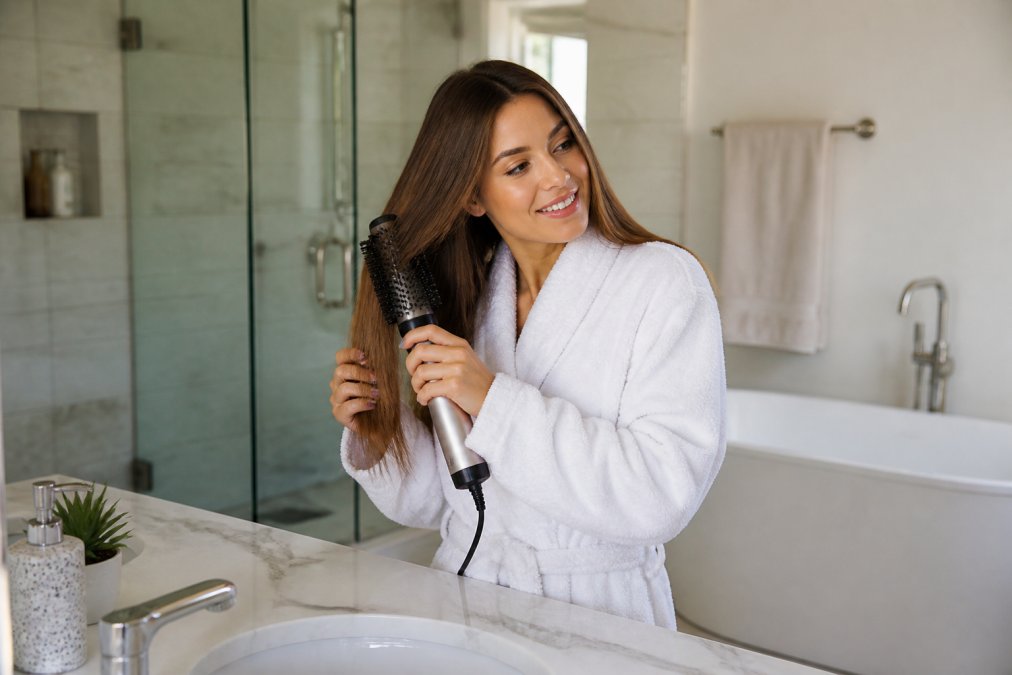
A faster routine looks like this:
- Apply heat protectant to damp hair while it's still towel-damp.
- Rough-dry for 60 seconds to remove the bulk of the water.
- Section hair into four parts and clip the rest out of the way.
- Work section by section with one tool, drying and styling in the same pass.
- Finish with a cool shot to set the shape and add shine.
The biggest time sink is tool-switching: every swap costs setup time, and re-heating styled sections adds more. A single device that dries and styles at once removes that step entirely.
Build Consistency Without Overthinking It
Consistency beats intensity in hair care: a simple routine you repeat daily outperforms an elaborate one you do twice a month. Make the routine automatic so it stops being a decision.
Three habits make consistency easy:
- Same order, every time. Protectant, dry, style, finish. No variation means no thinking.
- One tool, one place. Keep your styler and protectant together so setup takes seconds.
- Weekly reset. Once a week, do a clarifying wash if you use styling products, and clean your tool plates.
The Transition Period Nobody Warns You About
When you cut from a heavy, multi-product routine to a minimalist one, your hair and scalp go through an adjustment phase. Most guides skip this, which is why so many people abandon simplification in the first month and assume it "didn't work."
What actually happens:
- Your scalp rebalances. If you were washing daily with a strong shampoo, cutting back can leave hair feeling oilier for one to three weeks while oil production adjusts. This is temporary and normal.
- Your hair may feel different, not worse. Buildup from silicones and heavy creams takes a few washes to clear. Until it does, hair can feel drier or rougher than you expect, that's the old product leaving, not the new routine failing.
- Your styling results shift. A single multi-use tool styles differently than a dedicated flat iron or curling wand. Give yourself two to three weeks of practice before deciding it doesn't work.
The practical rule: commit to the simplified routine for a full month before you judge it. If you quit at day ten, you're judging the transition, not the routine.
Match the Routine to Your Lifestyle, Not Just Your Hair
Lifestyle shapes the routine more than hair type does. A traveler's version is one compact tool and a travel-size protectant; a parent's version is a five-minute routine that works on autopilot. Both are minimalist; neither is wrong.
A few common patterns:
- Gym-goers. Sweat and frequent washing strip the scalp. A gentle shampoo used more often beats a harsh one used less. Keep the routine to cleanse, condition, protect, skip styling on wash days you're heading straight back to the gym.
- Swimmers. Chlorine is the variable. Rinsing hair with plain water before and after a swim reduces how much chlorine the strand absorbs. A leave-in or protectant before swimming adds a barrier.
- Busy professionals. The constraint is time, not products. One tool that dries and styles in a single pass removes the tool-switching that eats the most minutes.
- Frequent travelers. The constraint is space. One compact multi-use tool and a travel-size protectant replace a toiletry bag full of single-purpose bottles.
When to Break the Routine
A minimalist routine isn't rigid. Two situations justify temporarily adding a step back:
- After a clarifying wash. If you use styling products, a weekly clarifying wash removes buildup, but it also strips moisture. Follow it with your conditioner or a leave-in.
- After heat-heavy weeks. If you've styled more than usual, a leave-in treatment for a few days restores moisture before you return to the baseline.
The point of consistency isn't rigidity. It's having a default you can return to, so a busy week doesn't turn into a lost routine.
According to consumer hair care guidance from the U.S. Food and Drug Administration, reading product labels and following usage directions helps you avoid irritation and get the results the formula was designed to deliver. That advice applies doubly in a minimalist routine, where every product you keep has to earn its place.
Conclusion: Your Simplified Routine Starts Now
The hard part of simplifying hair care isn't knowing what to cut; it's trusting that less will work. It does, once your products match your hair type and your tool count drops to one. The Chaska Life built the CHASKA Air Styler to dry, straighten, and curl all hair types in a single pass, with a patented heat plate and twin turbo fans built into the plates. Pair it with the Moisture Rich Heat Protectant and your entire routine fits in one drawer. Get started with The Chaska Life and replace the clutter with one tool that does the work of three.
Frequently Asked Questions
What is the most basic hair care routine?
A basic routine needs just three steps: cleanse, condition, and protect. Wash with a sulfate-free shampoo two to three times a week, apply conditioner from mid-length to ends, and use a leave-in treatment or heat protectant before styling. That covers scalp health, moisture retention, and daily protection without a shelf full of products. Most people see better results from doing these three steps consistently than from adding more products.
How can I make my hair care routine faster?
Cut drying and styling time by using one multi-functional tool instead of separate dryer, flat iron, and curler. The CHASKA Air Styler dries, straightens, and curls with twin turbo fans built into the plates, so you skip the blow-dry-then-style two-step. Air-dry when possible, detangle in the shower with conditioner still in, and keep your routine to three products maximum.
How many hair products do I actually need?
Three to five products cover almost every hair type: a sulfate-free shampoo, a moisturizing conditioner, a leave-in treatment, a heat protectant, and optionally a light oil for sealing ends. Everything else, like serums, mousses, and masks, is a bonus, not a requirement. If you have not used a product in 30 days, it is not part of your routine. Fewer products also means less product buildup on your scalp.
How do I simplify my hair care routine for natural hair?
Focus on moisture retention and gentle handling. Wash with a sulfate-free cleanser once a week, deep condition every other wash, and seal damp ends with a light oil or leave-in. Detangle with a wide-tooth comb while hair is wet and coated in conditioner. Skip daily restyling; instead, refresh with water and a leave-in mist. Protective styles like braids or twists reduce manipulation and give your hair a break between wash days.
Can using fewer hair products improve hair health?
Yes. Fewer products mean less product buildup on the scalp and hair cuticle, which can block moisture and weigh hair down. A stripped-back routine also makes it easier to spot what actually works for your hair type. When you use three products consistently instead of ten sporadically, you can track results and adjust. Many people find their hair feels cleaner and holds styles better after downsizing.
Do I need a heat protectant if I only style once a week?
Yes. Heat damage is cumulative, and even one weekly session with a hot tool above 350°F can weaken the hair cuticle over time. A moisture-rich heat protectant creates a barrier that reduces moisture loss and breakage. Apply it to damp hair before drying and again lightly before touching up with a straightener or curler. It takes seconds and protects the work your routine is doing.