


Natural Oils for Heat Protection: A Science-Backed Guide
Table of Contents
- Why Natural Oils Matter for Heat Styling
- Understanding the Smoke Point of Hair Oils
- Best Natural Oils for Heat Protection
- How to Prevent Heat Damage Naturally
- How to Apply Oil Before Heat Styling
- DIY Hair Heat Protectant Spray Recipes
- Layering Oils with Professional Heat Protectants
- Frequently Asked Questions
Last Updated: September 26, 2026
Why Natural Oils Matter for Heat Styling
Natural oils for heat protection serve as a critical barrier between your hair and the thermal damage that comes with blow dryers, flat irons, and curling tools. When you apply the right oil before heat styling, you're not just adding shine, you're creating a protective layer that helps preserve moisture and minimize structural damage to your hair shaft.
Most people reach for whatever oil is available without considering smoke point, hair porosity, or thermal behavior. The difference between damaged, brittle hair and healthy, resilient strands comes down to preparation and product selection.
Heat styling tools expose hair to temperatures exceeding 400°F, breaking down the lipid barrier and causing moisture loss and split ends. Natural oils form a protective barrier and regulate heat distribution. Penetrating oils absorb into the hair shaft; sealing oils coat the surface. Understanding this distinction determines how you apply them.
Understanding the Smoke Point of Hair Oils
The smoke point is the temperature at which an oil breaks down and stops protecting hair. Oils with higher smoke points remain stable under intense heat; lower smoke points cause scorching or stickiness.
Blow dryers operate at 140°F-180°F, while flat irons and curling irons reach 350°F-450°F. Match your oil's smoke point to your styling temperature.
Cold-pressed oils retain more nutrients but have lower smoke points. Refined oils have higher smoke points but fewer beneficial compounds. For heat styling, thermal stability matters more than nutrient content.
Thermal conductivity affects protection: oils with better thermal conductivity distribute heat evenly, preventing hotspots that cause localized damage.
Best Natural Oils for Heat Protection
Coconut Oil and Fractionated Coconut Oil
Regular coconut oil has a smoke point around 350°F (marginal for flat irons) and is a sealing oil that coats rather than penetrates, causing buildup and greasiness with repeated use.
Fractionated coconut oil removes longer-chain fatty acids, raising the smoke point to 450°F and enabling even distribution without buildup. It absorbs into hair while providing surface protection, making it superior for heat styling.
Coconut oil's essential fatty acids and lauric acid maintain the hair's lipid barrier, reducing moisture loss and improving shine. It works best for medium to fine hair; coarser hair needs additional oils.
Argan Oil for Thermal Conductivity and Shine
Argan oil offers exceptional thermal conductivity and high vitamin E and essential fatty acid content. With a 420°F smoke point, it remains stable under flat irons and curling irons. As a penetrating oil, it strengthens hair from within rather than just coating the surface.
Argan oil reinforces internal hair structure by filling micro-gaps and maintaining protein bonds weakened by heat. For textured or curly hair, it provides thermal protection while enhancing curl definition and reducing frizz.
Argan oil works well as a finishing oil after styling, adding shine without heaviness. The CHASKA Moisture Rich Heat Protectant contains organic argan kernel oil with vitamin E and keratin for comprehensive thermal protection.

Jojoba Oil and Hair Porosity
Jojoba oil's composition mirrors natural scalp sebum, making it exceptional for maintaining cuticle balance. With a 450°F smoke point, it provides reliable high-heat protection.
The real advantage of jojoba oil emerges when you consider hair porosity. Hair porosity determines how readily oils penetrate and how well moisture is retained. Low-porosity hair has a tightly sealed cuticle and resists oil penetration, while high-porosity hair has a raised cuticle that absorbs oil readily but struggles to retain moisture. Jojoba oil works effectively across all porosity types because it can both penetrate and seal depending on your hair's needs.
For high-porosity hair that loses moisture quickly, jojoba oil's ability to penetrate while also creating a sealing layer makes it ideal. For low-porosity hair, jojoba oil doesn't cause buildup the way heavier oils might. This versatility makes jojoba oil one of the most reliable choices for natural oils for heat protection across diverse hair types.
How to Prevent Heat Damage Naturally
Preventing heat damage starts before you ever pick up a styling tool. The foundation is a healthy hair care routine that keeps your hair's lipid barrier intact and your strands hydrated. Using sulfate-free shampoos and deep conditioning treatments regularly helps maintain the moisture balance that makes hair more resilient to heat.
CHASKA Moisture Rich Heat Protectant →
The second layer of prevention is strategic oil application. Apply oil to damp hair about 10 minutes before styling, focusing on the mid-shaft and ends where heat damage concentrates. Avoid applying oil to your roots, which can make your hair look flat and greasy. Use a wide-toothed comb to distribute the oil evenly from roots to ends, ensuring no dry spots remain.
Temperature control matters as much as the products you use. Lower heat settings take longer but cause significantly less damage than maximum temperatures. Most hair types can achieve excellent results at 300°F to 350°F rather than the 400°F+ that many tools allow. If you're styling thick or coarse hair, you may need higher temperatures, but even then, using the minimum effective temperature reduces cumulative damage.
Limiting heat styling frequency is the most powerful prevention strategy. Hair that's heat-styled once per week sustains far less damage than hair styled daily. If you style daily, consider alternating heat styling with air-drying or heatless styling methods. This gives your hair recovery time between heat exposure.
How to Apply Oil Before Heat Styling
The application method determines whether your oil protects or weighs down your hair. Start by shampooing and conditioning as usual, then gently squeeze excess water from your hair without wringing it out. Your hair should be damp, not dripping wet and not completely dry.
Dispense a small amount of oil into your palm, for shorter hair, 2-3 drops is typically sufficient; for longer hair, use about a coin-sized amount. Rub your hands together to distribute the oil evenly across both palms, then run your hands through your hair starting at the mid-shaft and working toward the ends. Avoid the scalp and roots entirely, as oil applied here will make your hair look greasy and flat.
Use a wide-toothed comb to comb through your hair, which distributes the oil evenly and detangles simultaneously. This step is critical because it ensures the oil reaches all sections of hair rather than concentrating in certain areas. Pay special attention to the ends, which are the oldest part of your hair and most prone to damage.
Wait 5-10 minutes before beginning heat styling. This allows the oil to fully absorb and settle into your hair rather than being immediately displaced by the heat. If you begin styling immediately, the oil hasn't had time to form its protective barrier.
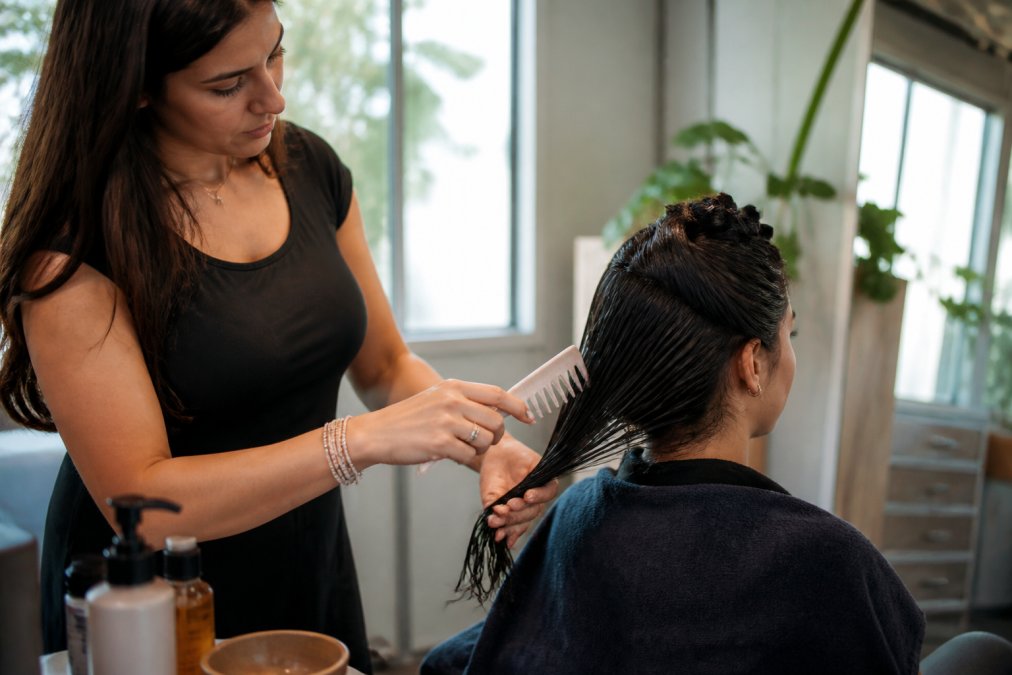
For different hair types, adjust your approach slightly. Fine or thin hair benefits from lighter oils like jojoba or fractionated coconut oil applied sparingly. Thick or coarse hair can handle richer oils like argan oil in slightly larger quantities. Curly or textured hair often needs more oil for adequate protection, especially at the ends where curl patterns create more surface area.
DIY Hair Heat Protectant Spray Recipes
Creating your own heat protectant spray gives you complete control over ingredients and allows you to customize the formula for your hair type. A basic DIY formula combines an oil, water, and a light emulsifier to help them blend.
Simple Heat Protectant Spray:
- 2 tablespoons of fractionated coconut oil or jojoba oil
- 1 cup of distilled water
- 1 tablespoon of vegetable glycerin (acts as emulsifier and adds slip)
- 5-10 drops of your preferred essential oil (optional, lavender or rosemary work well)
Combine all ingredients in a spray bottle and shake vigorously before each use.
Enhanced Formula for Damaged Hair:
- 1 tablespoon of argan oil
- 1 tablespoon of jojoba oil
- 1 cup of distilled water
- 1 tablespoon of vegetable glycerin
- 1 teaspoon of aloe vera gel (adds soothing properties)
Layering Oils with Professional Heat Protectants
Combining natural oils with professional heat protectants creates a more comprehensive protection system than either alone. Professional heat protectants typically contain silicones or polymers that form a durable protective coating, while natural oils provide internal nourishment and moisture retention.
Frequently Asked Questions
Which oil is best for heat protectant?
Argan oil and fractionated coconut oil are among the most effective natural oils for heat protection because they have higher smoke points and don't solidify at room temperature. Argan oil is particularly valued for its essential fatty acids and ability to seal the hair cuticle, while fractionated coconut oil absorbs into the hair shaft without leaving residue. The best choice depends on your hair porosity and styling temperature, higher heat requires oils with higher smoke points.
How can I make my own natural heat protectant?
You can create a DIY heat protectant by mixing carrier oils with heat-stable ingredients. Always test on a small section first, and store in a cool, dark place to maintain the protective barrier these ingredients create.
Do natural oils actually prevent heat damage or just add shine?
Natural oils do both, but the protection mechanism depends on the oil type. Penetrating oils like argan oil absorb into the hair fiber and provide internal hydration, reducing moisture loss during heat styling. Sealing oils like coconut oil coat the hair shaft and create a protective barrier against thermal damage. However, no oil is a complete substitute for proper heat styling technique, using lower temperatures, keeping tools moving, and applying oils correctly all work together to minimize split ends and hair breakage.
What temperature should I use with natural oils in my hair?
Most natural oils used for heat protection perform best at temperatures below 400°F. Fractionated coconut oil has a smoke point around 350-375°F, while argan oil tolerates up to 460°F. For everyday blow drying (around 140-180°F) and flat ironing (up to 350°F), standard natural oils provide excellent protection. Higher porosity hair benefits from lower heat settings regardless of oil type, as it absorbs moisture more easily but loses it faster, making thermal protection more critical.