


Shark Beauty Alternative for Thick Hair: A Real Comparison
Table of Contents
- Why Thick Hair Needs a Different Approach to Multi-Stylers
- Best Heat Settings for Thick Hair
- How to Style Thick Hair with an Air Styler
- The Chaska Air Styler: A Shark Beauty Alternative for Thick Hair
- What Sets a Shark Beauty Alternative Apart
- Weight, Wrist Fatigue, and Long-Term Maintenance
- Conclusion
Last Updated: August 30, 2026
Why Thick Hair Needs a Different Approach to Multi-Stylers
Styling thick hair demands tools engineered for density and volume, not generic solutions designed for average hair types. A shark beauty alternative for thick hair isn't just about finding a cheaper option, it's about finding a tool that actually handles the weight, heat requirements, and styling time that comes with thick strands.
Most standard hair dryers and stylers were built for fine to medium hair. They lack the airflow power, heat consistency, and ergonomic design needed to dry and style thick hair efficiently. When you're working with high-density hair, a lightweight, underpowered tool becomes exhausting. Your wrist fatigues. Styling takes twice as long. The results disappoint because the tool simply wasn't engineered for your hair type.
The real difference between a mediocre styler and one that works for thick hair comes down to three factors: sufficient airflow technology to move moisture through dense strands, consistent heat settings that won't damage while still processing thickness, and weight distribution that won't leave your arm aching after 15 minutes. A shark beauty alternative for thick hair that checks these boxes transforms your entire styling routine.
Best Heat Settings for Thick Hair
Thick hair can tolerate higher temperatures than fine hair, but tolerance doesn't mean you should max out the heat dial. The optimal range for thick hair sits between 350°F and 400°F for straightening and 300°F to 350°F for curling, depending on your specific texture and whether your hair is color-treated (the American Academy of Dermatology).
Understanding why thick hair behaves differently at high heat is essential to protecting it. Thick strands have a denser protein structure and higher moisture content in the cortex (peer-reviewed research). This density means heat takes longer to penetrate to the core of the hair shaft, which is why thick hair can withstand higher surface temperatures without immediate damage. However, this same density traps moisture deeper inside the strand. If you apply excessive heat repeatedly, that trapped moisture eventually turns to steam inside the hair shaft, causing internal fracturing that leads to breakage weeks or months later, long after the styling session ends.
The key insight most people miss: heat damage isn't just about temperature, it's about exposure time, moisture level, and how evenly that heat distributes across the hair shaft. A tool with poor heat distribution will create hot spots that damage even at moderate temperatures. A tool with consistent, even heat can work safely at higher temperatures without compromising hair health.
For thick hair, start at the lower end of these ranges and increase only if needed. Thick strands take longer to heat, so patience matters more than cranking the temperature. A common pattern among stylists is to use the 350°F setting as a baseline for first passes through thick hair, then increase to 375°F or 400°F only if the hair isn't responding after a full pass. This staged approach prevents the cumulative heat damage that comes from assuming you need maximum temperature from the start.
Many stylists recommend using a cool shot button at the end of each section to seal the cuticle and lock in moisture. This step is non-negotiable for thick hair because it reduces frizz and extends style longevity. The cool shot also helps set the style faster, which means you can move to the next section sooner without waiting for the hair to cool naturally.
Temperature control becomes especially important if you're using a multi-functional tool. A shark beauty alternative for thick hair that offers granular temperature adjustment lets you dial in the exact heat needed for different sections. Some areas of thick hair may be coarser than others; you need the flexibility to adapt. For example, hair around the nape and crown is often coarser and can handle 375°F-400°F, while hair at the sides and face-framing layers may be finer and benefit from 325°F-350°F.
If you notice your thick hair becoming dull, brittle, or prone to breakage, heat damage is likely the culprit. The recovery process is slow: you'll need to trim damaged ends and reduce heat styling frequency for 4-6 weeks while new healthy growth emerges (the American Academy of Dermatology). Prevention through proper temperature selection is far more effective than recovery. A tool that maintains consistent heat and allows precise temperature control prevents this damage before it happens.
How to Style Thick Hair with an Air Styler
Styling thick hair with an air styler requires sectioning discipline and the right technique. The difference between a mediocre result and a salon-quality finish comes down to understanding how to manage density and ensure complete moisture removal before heat-styling begins.

Start by dividing your hair into four quadrants using clips. This prevents you from missing sections and ensures even drying before you move into straightening or curling. With thick hair, you can't rush the drying phase; moisture trapped in the interior of dense strands will cause frizz later and make heat-styling less effective.
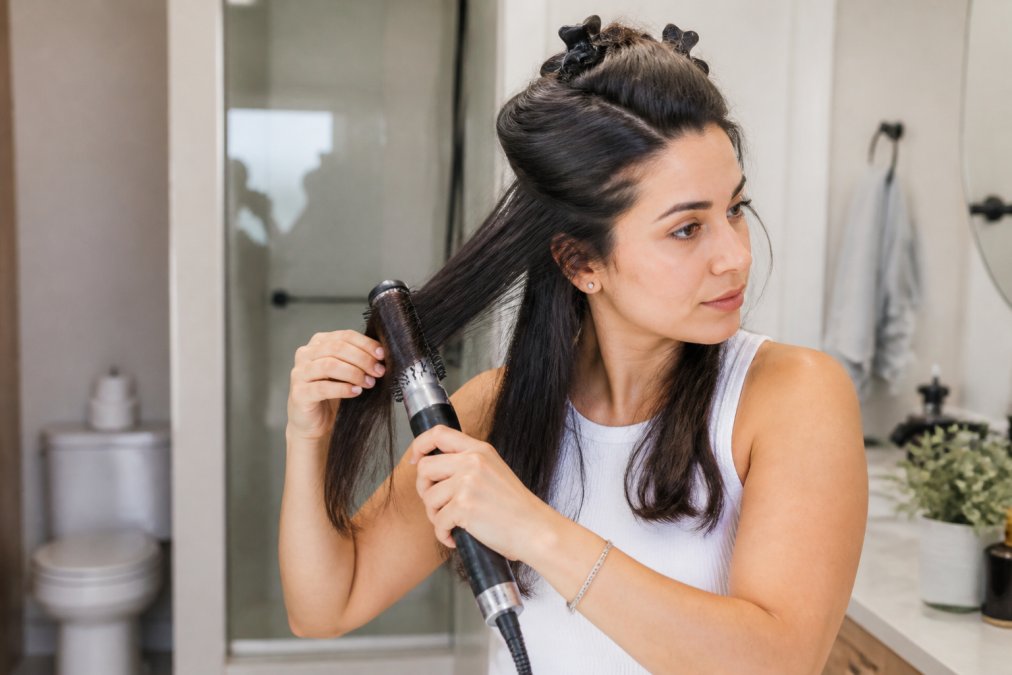
Work from the nape upward, taking 1-inch subsections. Thicker hair requires smaller subsections than fine hair; trying to process a 2-inch section of dense hair at once leaves the interior damp. The interior dryness is the critical factor most people overlook. You can feel the surface of a section and think it's dry, but the core, the hair closest to the scalp within that subsection, is still holding moisture. This is why thick hair requires smaller subsections: you need the airflow to penetrate all the way through the strand, not just dry the outer layer.
Use the concentrator attachment first to direct airflow and dry faster. Hold the concentrator nozzle about 6 inches from the hair and move it in one direction, downward, following the cuticle, to avoid frizz. Work through each 1-inch subsection until it feels completely dry to the touch and no moisture releases when you squeeze it gently. This test, the squeeze test, is more reliable than visual inspection. If water beads form when you squeeze, that section needs more drying time.
Once a section is completely dry, switch to a volumizing brush or barrel attachment for styling. This two-step approach (dry first, then style) is essential for thick hair. Attempting to straighten or curl damp thick hair requires multiple passes, which increases heat exposure and damage risk. A single pass through completely dry hair is far more effective.
For straightening thick hair, take your time. Move the straightening plates slowly through each section, about 1 inch per second, to ensure even heat distribution. Rushing creates uneven results and can cause heat damage from repeated passes. The goal is one smooth pass per section, not multiple attempts to get it right. If a section doesn't straighten on the first pass, it's usually because it wasn't completely dry, not because you need more heat.
When curling, use a larger barrel (1.5 inches or wider) to create loose waves or curls that won't look tight or artificial on thick hair. Thick hair can handle larger barrel sizes without looking limp. Wrap the subsection around the barrel, hold it for 10-15 seconds to set the curl, then release. The longer hold time ensures the curl sets properly in the denser hair structure. For maximum longevity, use the cool shot button on your air styler after releasing each curl; this seals the curl and makes it last significantly longer.
Tension matters more than most people realize. As you work through each subsection, maintain gentle, even tension on the hair. Too much tension can cause breakage in thick hair, especially if the hair is already damaged or color-treated. Too little tension means the tool can't process the section effectively. The right tension feels like you're gently stretching the hair without pulling it away from the scalp.
The styling time for thick hair typically ranges from 20-40 minutes depending on length and desired finish. A shark beauty alternative for thick hair with strong airflow and efficient heat technology cuts this time significantly by drying faster and processing sections more effectively in fewer passes. If your styling time consistently exceeds 45 minutes, your tool likely lacks sufficient airflow power for your hair density, and you're compensating by taking multiple passes through sections, a sign of heat damage risk.
The Chaska Air Styler: A Shark Beauty Alternative for Thick Hair
The Chaska Air Styler represents a different category of multi-functional styling tool, one built specifically for efficiency rather than trying to replicate every feature of dedicated single-purpose tools. At The Chaska Life, we engineered this device to handle all hair types, with particular attention to the challenges thick hair presents.
Why It Works for Thick Hair
The Chaska Air Styler combines a high-powered dryer, straightener, and curler in one device. For thick hair, this matters because the drying phase is where most time gets lost. Standard blow dryers often lack the airflow power to move moisture through dense strands quickly. The Chaska's Twin Turbo fan system doubles the drying power, which means you're not fighting your tool, you're working with it.
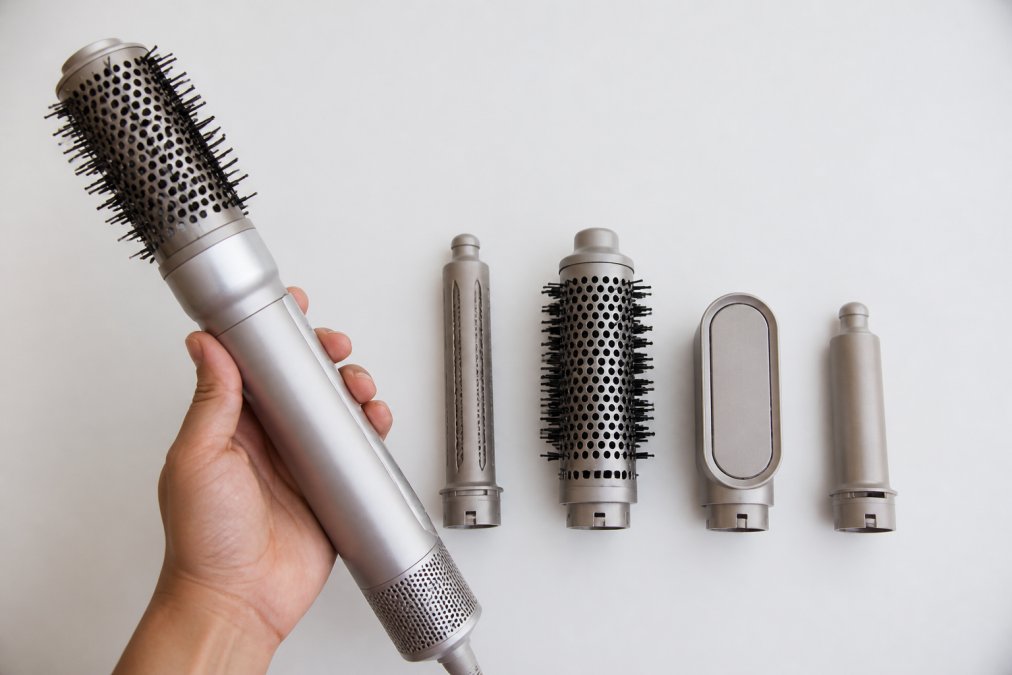
The straightening plates heat evenly and maintain consistent temperature throughout styling, which prevents the hot spots that damage thick hair. The curling barrel accommodates larger sections, letting you work faster without sacrificing results. The device weighs less than comparable multi-stylers, which reduces wrist fatigue during longer styling sessions, a critical factor for thick hair that takes 20-40 minutes to style completely.
The Chaska Air Styler includes multiple heat settings and a cool shot button, giving you the control thick hair requires. You're not locked into one temperature; you adjust based on your specific texture and the section you're working on.
Pricing and Value
The Chaska Air Styler is priced at $249.00. This sits in the mid-range for multi-functional styling tools. To understand the value, consider what you'd spend buying separate tools: a quality blow dryer ($80-150), a flat iron ($60-120), and a curling iron ($50-100) would easily total $200-350 and take up three times the space.
The real value isn't just the price, it's the time savings and the reduced learning curve. You're not switching between three different tools with different heat settings and cord management. You're learning one device thoroughly, which means better results faster.
What Sets a Shark Beauty Alternative Apart
A true shark beauty alternative for thick hair isn't just a cheaper knockoff, it's a tool designed with different engineering priorities. The distinction matters.
Most premium multi-stylers prioritize brand prestige and marketing spend over actual performance for thick hair. A shark beauty alternative worth considering prioritizes functionality: stronger airflow, better heat distribution, lighter weight, and thoughtful attachment design. These are the engineering choices that actually change how the tool performs on dense hair.
The best alternatives also simplify your routine without forcing you to compromise. You shouldn't have to choose between drying speed and styling precision. A well-engineered alternative delivers both. The Chaska Air Styler achieves this through the Twin Turbo fan system for faster drying and the dual heat plates for even straightening.
Versatility matters, but only if each function actually works. A tool that does three things adequately beats a tool that does one thing perfectly but the other two poorly. For thick hair especially, you need a tool that doesn't force you to switch between devices mid-styling because one function isn't powerful enough.
Weight, Wrist Fatigue, and Long-Term Maintenance
This is where many reviews fall short. They focus on performance and ignore the physical reality of using a styling tool for 20-40 minutes at a time.
Thick hair takes time to style. If your tool weighs more than 1.5 pounds, your wrist will fatigue before you finish. Fatigue leads to inconsistent technique, which leads to uneven results. It also leads to skipping sections because you're tired, which defeats the purpose of having a multi-functional tool.
The Chaska Air Styler's weight distribution is designed to reduce fatigue during extended use. The barrel and handle are balanced so you're not fighting gravity while holding the device. This matters more than specifications suggest.
Long-term maintenance is the second factor reviews ignore. Multi-functional tools have more moving parts than single-purpose tools. Attachments wear out. Barrel surfaces degrade. The question isn't whether maintenance is needed, it's whether replacement parts are available and reasonably priced.
Quality alternatives include easy-to-replace barrels and attachments. You shouldn't need to buy a whole new device because the straightening plates lost their smooth finish after six months of heavy use. The Chaska Air Styler's modular design means you can replace individual components, extending the tool's lifespan and protecting your investment.
Check what the warranty covers and what parts are available separately. A two-year warranty that only covers manufacturer defects is less valuable than a one-year warranty that includes wear-and-tear coverage on attachments.
Thick hair requires a tool engineered for density, not a generic solution marketed to everyone. The Chaska Air Styler delivers the airflow power, heat control, and ergonomic design that thick hair demands, without the premium price tag of brands built more on reputation than performance. With consistent heat settings, strong airflow technology, and modular replacement parts, it simplifies your styling routine while protecting your hair health. Start with the Chaska Air Styler and experience how the right tool transforms thick hair styling from a frustrating chore into an efficient, repeatable process that delivers salon-quality results at home.
Frequently Asked Questions
Is a Shark Beauty alternative actually as effective as the original for thick hair?
Yes, when engineered specifically for thick hair. The key is airflow power, heat distribution, and barrel design. Multi-stylers with twin turbo fans and plasma technology can deliver results comparable to premium brands. The Chaska Air Styler uses patented heat plates and dual fans to handle dense hair without the premium price tag. What matters is wattage, temperature range (ideally 300-400°F for thick hair), and whether the tool maintains consistent heat under load.
What heat settings should I use for thick hair with an air styler?
Start at 350-375°F for straightening thick hair and 325-350°F for curling. Thick hair requires sustained heat to penetrate the hair shaft, but excessive heat increases damage risk. Use a cool shot button after styling to seal the cuticle and reduce frizz. Most quality multi-stylers offer 3-5 heat settings; choose the highest that doesn't cause sizzling or smoke. Always apply thermal protection spray first, this reduces the effective heat needed by 20-30°F while protecting your hair health.
How do I prevent heat damage when using one tool instead of separate tools?
Multi-stylers don't inherently cause more heat damage if used correctly. In fact, they can reduce exposure time because you're not blow-drying, then flat-ironing, then curling separately. The risk comes from overusing high heat. Limit styling to 2-3 times per week, use a heat protectant spray every time, and never pass the tool over the same section more than twice. Choose a tool with plasma technology, which reduces frizz and heat damage by smoothing the hair cuticle.
Do I need styling experience to get professional results with an air styler on thick hair?
No. The most important skill is sectioning. Divide thick hair into 4-6 sections using clips, then work one section at a time. Start with the dryer function to remove moisture (thick hair holds water longer), then straighten or curl from roots to ends. Most multi-stylers have intuitive heat and speed controls; even beginners see salon-quality results within 2-3 uses. Watch one tutorial on sectioning technique, and you'll be set. The tool does most of the work if your hair is properly prepped.
This article was written using GrandRanker