


Silk Pillowcases and Hair Health: What the Evidence Shows
Quick Summary
A silk pillowcase hair routine reduces friction, which is the mechanism most linked to fewer overnight tangles and less breakage. Silk also absorbs far less moisture than cotton, so conditioning treatments and leave-ins stay in the hair. The evidence is mostly mechanical and observational rather than large clinical trials.
- Silk's smooth fiber surface lets strands slide rather than snag against the pillow.
- Silk absorbs significantly less moisture than cotton, so nighttime treatments stay on the strand.
- Polyester satin reduces friction versus cotton but traps heat and does not absorb moisture vapor.
- Sleeping on wet hair increases breakage risk, so dry hair fully before bed.
- Test one silk pillowcase for four to six weeks and track morning tangles, frizz, and breakage.
Table of Contents
- How Silk Reduces Friction and Hair Breakage
- Moisture Retention: Why Silk Keeps Hair Hydrated
- Silk vs. Satin Pillowcase for Hair: What Actually Differs
- How to Prevent Hair Breakage While Sleeping
- Benefits for Curly, Coily and Textured Hair
- Silk Pillowcase Maintenance and Care
- Is a Silk Pillowcase Worth the Investment for Your Hair?
- Frequently Asked Questions
How Silk Reduces Friction and Hair Breakage
Silk pillowcases reduce friction, and reduced friction is the mechanism most often linked to fewer tangles and less breakage overnight, which is why silk pillowcase hair care has become a popular overnight habit. Hair that rubs against a rough surface for seven or eight hours loses cuticle integrity, and that damage accumulates.
Silk's smooth fiber surface lets strands slide rather than snag. Reviewers at TRI Princeton's analysis of friction-based hair damage describe this reduction in contact stress as the main reason silk may help prevent friction-related damage to hair and skin. The evidence is largely mechanical and observational rather than from large clinical trials, so treat it as a strong rationale rather than a settled result.
Consumer feedback points the same direction. In a Consumer Reports overview of silk pillowcases, users who switched from cotton reported fewer morning tangles and less breakage. Independent lab testing cited by Mulberry Park Silks claims silk reduces hair friction by 34% compared to other materials, though that figure comes from a brand-affiliated source and should be read with that in mind.
Moisture Retention: Why Silk Keeps Hair Hydrated
Silk absorbs significantly less moisture than cotton, which matters most for hair that has been conditioned or treated before bed. Cotton draws oils and humectant products out of the strand, while silk leaves more of that hydration in place.
This is why moisture retention is the second benefit people notice. Hair that keeps its nighttime treatment is easier to manage the next morning, with less dryness at the ends.
The absorbency difference is well documented in fiber comparisons, including analysis from Moonchild Sleep's review of silk fiber properties. Less absorption means the scalp and strands stay hydrated rather than wicking moisture away, which supports hair elasticity over time.
Silk vs. Satin Pillowcase for Hair: What Actually Differs
Silk and satin are not competing materials, they are different categories of thing, and conflating them is the single most common error in pillowcase advice. Silk is a natural protein fiber spun by silkworms, composed mainly of fibroin and coated with sericin. Satin is a weave structure, a warp-faced weave with long floating threads that produces a glossy face and a dull back. Satin can be woven from silk, polyester, nylon, or blends. Most satin pillowcases sold at mass-market prices are polyester satin, not silk satin.
That distinction matters for hair because the two materials behave differently at the fiber level. Silk's fibroin surface is naturally smooth and has a low coefficient of friction against hair keratin, and the fiber is hygroscopic, it can absorb moisture vapor without feeling wet, which lets it buffer humidity at the scalp. Polyester is hydrophobic: it repels water and does not absorb moisture vapor, so a polyester satin pillowcase can trap heat and perspiration against the scalp on warm nights. That trapped moisture and warmth is the opposite of the cool, dry scalp environment that reduces frizz and microbial overgrowth.
Breathability follows the same split. Silk's fiber cross-section and natural crimp allow air movement through the fabric, while tightly woven polyester satin is effectively a barrier. Kerarganic's analysis of thermal properties in bedding reports this breathability difference as a factor in scalp comfort, though it is a brand-published comparison rather than peer-reviewed research. The practical consequence: polyester satin still reduces friction compared to cotton, its smooth weave is a genuine improvement over a standard pillowcase, but it does not deliver silk's moisture buffering or heat dissipation.
There is also a durability and care trade-off. Polyester satin is machine-washable, cheap to replace, and holds its sheen through repeated washing. Silk requires cool hand or gentle-cycle washing, mild detergent, and air drying, and it degrades faster with heat and friction in the wash. A well-cared-for silk pillowcase can last years; a neglected one can pill and lose its smooth face within months, at which point the friction benefit erodes.
For a buyer, the decision comes down to what you are optimizing for. If your goal is purely friction reduction on a budget, polyester satin is a reasonable compromise and a clear step up from cotton. If your goal is the full set of hair-health mechanisms, friction reduction plus moisture buffering plus heat dissipation, silk is the material that delivers all three, and the price premium reflects that. Watch out: labels that say "satin" without specifying fiber content are almost always polyester, so check the fiber tag, not the product name, before you buy.
The article draws a clear line between silk and satin, and the differences that matter for hair show up in a few key properties.
| Property | Silk | Polyester satin |
|---|---|---|
| Material type | Natural protein fiber | Weave structure, usually polyester |
| Moisture absorption | Hygroscopic, absorbs moisture vapor | Hydrophobic, repels water |
| Heat and breathability | Breathable, dissipates heat | Traps heat and perspiration |
| Friction reduction | Smooth, low friction | Smooth weave, improves on cotton |
| Care | Cool hand or gentle wash, air dry | Machine-washable, durable |
| Lifespan | Years with proper care | Replaced sooner |
How to Prevent Hair Breakage While Sleeping
Breakage while sleeping usually comes from three things: friction against the pillow, tension from tight hairstyles, and tangling that gets pulled out in the morning. A silk pillowcase addresses the first, and small changes address the other two.
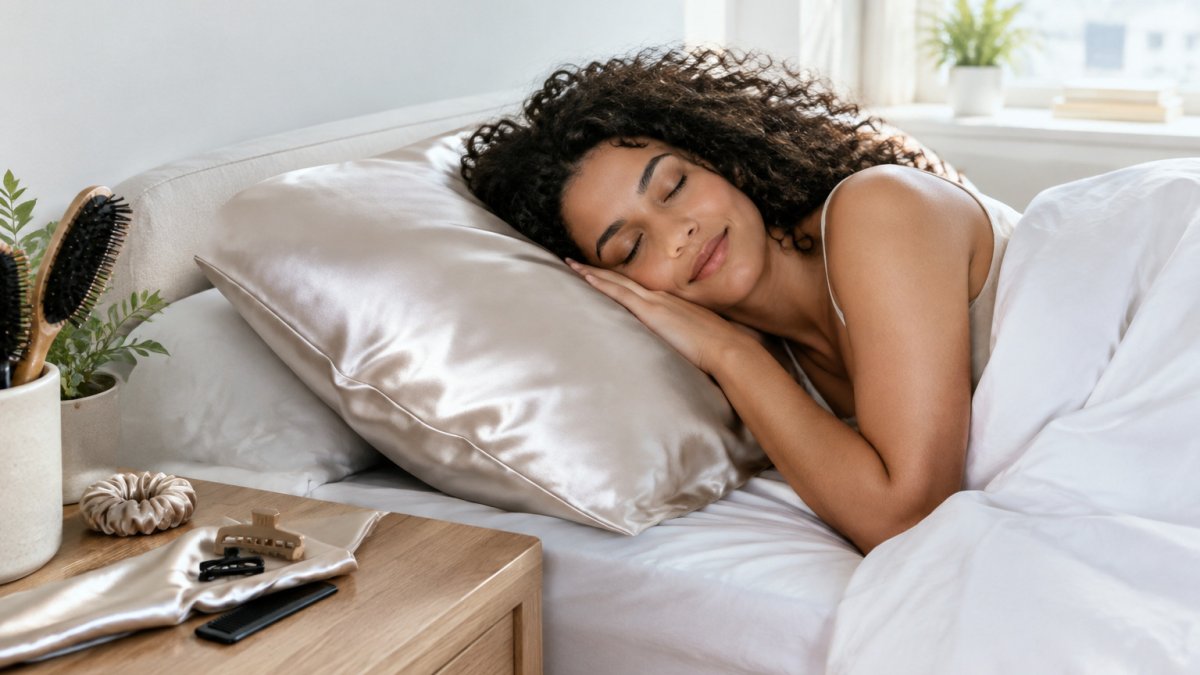
Start with the pillowcase, then adjust your nighttime routine. Learn a simple overnight routine to prevent frizz that builds on these nighttime habits. Loosely braid or wrap longer hair, use a satin or silk scrunchie instead of an elastic that pulls, and apply your leave-in before bed so the strands are protected while you sleep.
Watch out: sleeping with wet hair on any pillowcase increases breakage risk, so dry hair fully before bed. Explore the Moisture Rich Heat Protectant to add moisture and heat protection to your routine.

Benefits for Curly, Coily and Textured Hair
Textured hair, curls, coils, and waves, has a structural disadvantage at night that straight hair does not: the curl pattern forces the strand into a helix, which means the hair cannot lie flat against the pillow. Every turn of the head drags the helix across the fabric at an angle, and that angled contact is where friction damage concentrates. The tighter the pattern, the more surface area of cuticle is exposed to the pillowcase and the more opportunities for snagging.
Sebum distribution compounds the problem. Natural oils produced at the scalp have to travel down a curved, often tightly coiled strand, and in type 3 and type 4 hair that travel is slow and uneven. The result is a scalp that can be oily while the mid-lengths and ends are dry and brittle. A cotton pillowcase wicks away the small amount of moisture and product that does reach the ends; a silk pillowcase absorbs far less, so conditioning treatments and leave-ins stay on the strand rather than in the fabric. That is the moisture-retention mechanism doing specific work for textured hair, not a generic benefit.
Porosity changes how much this matters. Low-porosity curls hold moisture but are prone to product buildup and friction-induced frizz; high-porosity curls lose moisture quickly and are more vulnerable to breakage at the ends. For high-porosity hair, the silk pillowcase's reduced absorbency is the more valuable property. For low-porosity hair, the friction reduction and the cooler scalp environment matter more, because heat and perspiration can disrupt a wash-and-go or twist-out overnight.
Style retention is the benefit textured-hair users notice first. A pineapple, a loose braid, or a satin-lined bonnet paired with a silk pillowcase reduces the mechanical disruption that turns a defined twist-out into a frizzy cloud by morning.
A common pattern among textured-hair practitioners is to layer protections rather than rely on one: a silk pillowcase underneath, a silk or satin bonnet or scarf on top, and a leave-in or oil applied to the ends before bed. The pillowcase handles the contact surface; the bonnet handles the style; the product handles the moisture. If you travel with textured hair, keeping that layered routine consistent matters as much on the road as at home. Our guide to [maintaining hair health while traveling | page:4] covers the steps that carry over. For styling tools that suit curly hair, see our [best hair styler for curly hair guide | page:5]. Watch out: sleeping on wet or damp textured hair on any pillowcase increases breakage risk and disrupts curl definition, so dry hair fully, or dry it on a cool setting, before bed.
Silk Pillowcase Maintenance and Care
A silk pillowcase only delivers its benefits if it is cared for properly. Wash it on a gentle or hand-wash cycle in cool water with a mild detergent, and avoid fabric softeners, which coat the fibers and reduce their smoothness.
Air dry it away from direct heat, since high temperatures can weaken silk fibers over time. Store it flat or folded rather than crumpled, and expect a well-kept silk pillowcase to last for years rather than months.
Rotate two or three pillowcases so one is always clean. Replace the case when the fabric starts to pill, thin, or lose its sheen, because a worn surface loses the friction benefit.
Is a Silk Pillowcase Worth the Investment for Your Hair?
Silk costs more than cotton or polyester satin, so the question is whether the benefits justify the price for your hair. For many people with fragile, curly, or frizz-prone hair, the answer is yes, particularly because the case lasts for years with proper care.
Our recommendation is to start with one silk pillowcase and run it alongside your current routine for four to six weeks, noting tangles, frizz, and breakage in the morning. If you see a clear change, the investment pays for itself in fewer damaged strands and less time spent detangling.
Pair the pillowcase with the rest of your routine rather than treating it as a standalone fix. Discover the Chaska Air Styler's features to see how one tool can dry, straighten, and curl your hair. Use a heat protectant on styling days, and style with a tool that protects rather than strips the hair. Get started with The Chaska Life's All-In-1 Air Styler to dry, straighten, and curl without stacking multiple heat tools.
Frequently Asked Questions
Do silk pillowcases actually prevent hair breakage?
Silk pillowcases reduce friction between the hair and the fabric, which is the main mechanical cause of breakage during sleep. Silk's smooth surface reduces the friction that causes damage to hair during sleep. Silk is not a cure for breakage caused by heat styling or chemical treatments, but it removes one ongoing source of damage.
Is there a real difference between silk and satin pillowcases for hair?
Yes. Silk is a natural protein fiber, while satin is a weave that can be made from polyester or nylon. Silk is breathable and absorbs less moisture than cotton, which helps hair keep its natural hydration. Polyester satin is smooth and low-friction too, but it traps heat and moisture more than silk does. Check the label: 100% mulberry silk is the material with the research behind it.
Can sleeping on a silk pillowcase help reduce morning frizz?
Silk's smooth surface reduces the friction that roughs up the hair cuticle overnight, which is a common cause of frizz. Pairing silk with a loose braid or a satin-lined hair wrap can further reduce tangles.
