


T3 Micro vs Dyson Hair Tools: Which Is Right for You?
Table of Contents
- T3 Micro vs Dyson: How the Two Brands Differ
- Price and Value Comparison
- Dyson Airwrap Alternatives That Actually Deliver
- How to Curl Hair With Air (No Hot Barrel Required)
- Best Air Styling Tools for Hair Health
- Hair Type Specificity: Thick, Curly, Fine, and Coily
- Long-Term Maintenance, Repairability, and Build Quality
- Frequently Asked Questions
Last Updated: September 15, 2026
T3 Micro vs Dyson: How the Two Brands Differ
Choosing between t3 micro vs dyson hair tools comes down to one question: do you want a conventional hot-tool system with premium finishes, or an air-based system built around airflow? This guide from The Chaska Life breaks down the real differences so you can match a tool to your hair, not to a marketing page.
T3 Micro built its reputation on traditional styling: ceramic and tourmaline flat irons, curling wands, and high-output dryers. Dyson took the opposite route, using a digital motor to move air through the barrel rather than heating a plate against your hair. That single design decision shapes everything else, including price, drying speed, and how much heat your strands actually absorb.
A common mistake is assuming both brands solve the same problem. They don't. One styles with contact heat; the other styles with airflow and the Coanda effect, which wraps hair around the barrel using moving air.
| Feature | T3 Micro | Dyson | The Chaska Life Air Styler |
|---|---|---|---|
| Core method | Contact heat plates and barrels | High-speed airflow | Airflow plus heated plates |
| Heat exposure | Direct, concentrated | Indirect, air-based | Indirect, with thermal protection |
| Attachments | Fixed barrels, multiple tools | Interchangeable barrels | Dry, straighten, curl in one |
| Best for | Fine hair needing fast hold | Frizz control and volume | All hair types, one tool |
Airflow Technology and Heat Settings
Airflow technology is the dividing line. Dyson's digital motor pushes a high-velocity stream of air, so hair dries and shapes without a plate resting against it. T3 tools rely on adjustable heat settings, often with multiple temperature steps, to set a style through direct contact.

The trade-off is control versus speed. Contact heat gives you precision styling and a hold that lasts, but it concentrates thermal exposure on the section you're working. Airflow spreads that exposure across a moving stream, which most stylists consider gentler on the hair cuticle (the American Academy of Dermatology).
Price and Value Comparison
Price is where these two brands separate most sharply, and the gap is wide enough that it should drive the decision more than any spec sheet. Dyson's air styling systems sit at the top of the market, with its flagship multi-styler and its cordless straightener both landing in the premium tier. T3's irons, wands, and dryers sit one rung below, and its entry-level tools cost a fraction of a Dyson multi-styler. Neither brand is inexpensive, so the honest question isn't which is cheaper, it's what you're paying for.
Here's the framing most reviews skip: compare cost per tool replaced, not sticker price.
| Purchase path | What you get | Relative outlay |
|---|---|---|
| Dyson multi-styler alone | One air-based system, multiple attachments | Highest single-tool cost |
| T3 dryer + flat iron + wand | Three separate contact-heat tools | Adds up fast; three cords, three storage spots |
| Hybrid 3-in-1 air styler | Drying, straightening, curling in one device | Mid-tier single-tool cost |
The price-to-performance ratio flips depending on what you already own. If you have a dryer, a flat iron, and a curling wand that all still work, adding a premium air styler means buying a fourth tool, and the marginal gain is convenience, not capability. If you're starting fresh or replacing a dead tool, a multi-styler that covers three jobs can cost less in total than buying each piece separately, and it frees counter space.
Attachment pricing is the hidden cost nobody budgets for. Dyson sells barrels and brushes individually, and replacing a lost or worn attachment is a real line item. T3 sells replacement barrels and plates for its irons, which keeps a working tool alive longer. Before you buy either brand, price the two or three attachments you'll actually use, that number often changes the verdict.
The Chaska Life Air Styler is priced at $249 and combines drying, straightening, and curling in one device, which is the value argument for consolidating rather than adding. Run the math against your own cabinet: if a single $249 tool replaces two devices you were about to buy, the per-use cost drops every month you own it.
current manufacturer pricing and attachment availability
current manufacturer pricing and replacement parts
Dyson Airwrap Alternatives That Actually Deliver
Dyson Airwrap alternatives fall into two groups: air-only stylers that mimic the Coanda effect, and hybrid tools that pair airflow with a heated plate. The hybrids tend to deliver more reliable hold, especially for thick or coarse hair that resists air-only shaping.
Weight distribution matters here. A barrel that's front-heavy tires your wrist during a full blowout, and cord length limits where you can stand relative to an outlet. A 360-degree swivel cord and balanced body make a bigger daily difference than most spec sheets suggest.
How to Curl Hair With Air (No Hot Barrel Required)
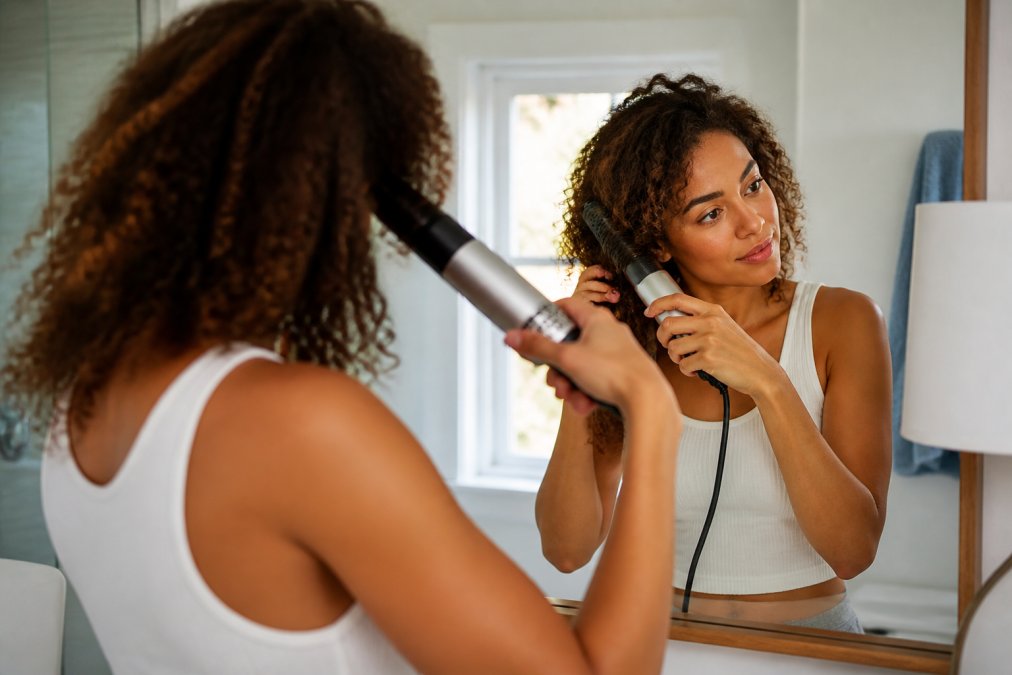
Learning how to curl hair with air takes about three attempts to get right. The method is the same across air stylers: start on damp, roughly 80 percent dry hair, section it, and let the airflow wrap the strand rather than twisting it yourself.
- Rough-dry hair to about 80 percent, keeping the nozzle pointed down the shaft for frizz control.
- Section hair into two-inch pieces and clip the rest out of the way.
- Hold the barrel near the mid-length, let the airflow catch the ends, and guide the strand up.
- Hold for a few seconds, then hit the cool shot button to set the shape.
- Release and repeat, working from the bottom of the head upward.
The cool shot button is the step most people skip, and it's the one that makes a curl last. Cooling the hair while it's still wrapped sets the cuticle in its new shape.
Best Air Styling Tools for Hair Health
The best air styling tools for hair health share three traits: adjustable heat settings, negative ion technology for frizz control, and a design that keeps the hottest surface away from the cuticle. Air-based styling generally exposes hair to less concentrated heat than a flat iron pressed against the same section. Maintaining this level of thermal protection requires a gentle approach to knots and tangles, which is why incorporating the best detangling brushes into your routine helps prevent the mechanical breakage that often accompanies styling.
Negative ion technology helps here. Ions neutralize the static that makes hair frizz and fly, which means you spend less time re-styling the same section and less total heat on your hair.
Hair Type Specificity: Thick, Curly, Fine, and Coily
Hair texture decides which tool wins, and no single brand is best for everyone.
| Hair type | What the strand does | Best tool behavior | Attachment to reach for |
|---|---|---|---|
| Fine | Dries and sets fast; scorches easily | Low heat, high airflow, short contact time | Smoothing brush or small round brush |
| Medium | Holds shape with moderate effort | Balanced heat and airflow | Round brush, then barrel to finish |
| Thick | Resists airflow; needs sustained heat to shape | Higher airflow plus a heated surface for hold | Heated-plate hybrid or large barrel |
| Curly | Needs drying without disrupting pattern | Airflow to dry, barrel to define | Diffuser, then a smooth barrel |
| Coily | Maximum density; heat damage is cumulative | Maximum airflow, thermal protection essential | Diffuser with wide-tooth sectioning |
Long-Term Maintenance, Repairability, and Build Quality
Frequently Asked Questions
Is a T3 hair dryer better than Dyson?
It depends on your priority. T3 dryers focus on fast drying with negative ion technology and a range of heat settings, often at a lower price than Dyson. Dyson dryers use a digital motor and airflow technology that dries with less heat. For hair health, both work; for budget, T3 usually costs less. Neither is universally better, so match the tool to your hair texture and styling time.
Is T3 as good as the Dyson Airwrap for styling?
T3's air-styling tool competes on curl retention and fast drying, while the Dyson Airwrap is known for its Coanda effect that wraps hair automatically. T3 tends to suit users who want a more traditional curling experience; Dyson suits those who prefer hands-free wrapping. Neither wins outright. Your hair texture and how much time you have each morning decide which is better for you.
What are the main differences in technology between T3 and Dyson tools?
T3 uses negative ion technology and ceramic or tourmaline heating to reduce frizz and seal the hair cuticle. Dyson uses a digital motor with airflow technology and intelligent heat control that measures temperature many times per second. T3 focuses on heat styling with ion conditioning; Dyson focuses on air-driven styling with less direct heat. Both aim to limit heat damage, but through different mechanisms.
Which hair styler offers the best value compared to Dyson?
Value depends on how many tools you replace. A multi-styler that dries, straightens, and curls in one device often costs less than buying a Dyson dryer plus a Dyson Airwrap separately. The CHASKA Air Styler at $249 is a 3-in-1 option. If you want one tool for multiple styles, that price-to-performance ratio is hard to beat.