


Best Air Styler for Fine Hair: 2026 Buying Guide
Table of Contents
- What Makes an Air Styler Safe and Effective for Fine Hair
- Key Features to look for in the Best Air Styler for Fine Hair
- How to Avoid Heat Styling Damage on Fragile Strands
- The Best Heat Protectant for Fine Hair: What to Apply First
- How to Get Volume in Fine Hair Without Weighing It Down
- CHASKA Air Styler Review: A 3-in-1 Solution for Fine Hair
- Styling Fine Hair with Extensions and Travel Considerations
- Final Verdict: Choosing Your Air Styler
- Frequently Asked Questions
Last Updated: September 4, 2026
Fine hair is notoriously difficult to style. It tangles easily, falls flat within hours, and is highly susceptible to heat damage because the strands are thinner and more fragile than other hair types. The best air styler for fine hair balances airflow, heat control, and gentle tension to create volume without compromising the integrity of your strands.

Fine hair needs heat to hold a style, but it burns faster than coarse hair. The best air styler uses lower, consistent temperatures and ionic technology to reduce frizz while sealing the cuticle.
What Makes an Air Styler Safe and Effective for Fine Hair
An air styler combines a blow dryer, round brush, and curling iron into a single device, using airflow to shape hair rather than relying solely on direct heat. For fine hair, its effectiveness hinges on heat distribution and airflow velocity.
Ceramic and tourmaline coatings provide even heat distribution, preventing hot spots that can singe fine hair. Ionic airflow breaks down water molecules faster, reducing drying time and smoothing the cuticle for shine. Look for variable heat settings and a cool shot button to set your style without adding more heat.
Key Features to look for in the Best Air Styler for Fine Hair
The best air styler for fine hair gives you control over heat and tension while minimizing mechanical stress. Focus on the specific components below rather than attachments you will rarely use.
Barrel Size and Bristle Tension
Barrel diameter directly determines volume and curl. For fine hair, a smaller barrel, typically around 1 to 1.5 inches, is ideal because it allows you to wrap smaller sections, creating tighter tension at the root for lasting lift. Larger barrels stretch the hair and often fail to create enough friction to hold a curl.
Mixed bristles, nylon pins for grip and boar bristles for distributing natural oils, provide the right amount of pull to smooth the cuticle without snapping delicate strands.
Heat Settings and Cool Shot Button
Fine hair should never be styled at the highest heat setting (the American Academy of Dermatology). The best air styler offers multiple temperature zones, usually starting around 140°F, allowing you to use the lowest effective heat. A cool shot button is non-negotiable; it blasts room-temperature air to set the style and close the cuticle, locking in volume and shine without additional heat exposure.
How to Avoid Heat Styling Damage on Fragile Strands
Heat styling damage is cumulative, and for fine hair, the signs often appear as brittleness, dullness, and increased tangling. The primary way to avoid it is to reduce the number of passes you make over each section.
Hair should be completely dry before any heat styling begins, as water inside the strand turns to steam and causes swelling that weakens the hair structure (the NIH). Sectioning your hair into four to six clips ensures you don't have to go over the same area repeatedly.
The Best Heat Protectant for Fine Hair: What to Apply First
The best heat protectant for fine hair is a lightweight, water-based spray or mist rather than a heavy cream or oil. Heavy products coat the strand and can make fine hair look greasy and limp before you even begin styling. A lightweight protectant creates a barrier between the heat and the hair shaft, preventing moisture loss and protein damage.
For fine hair, you want a protectant that delivers heat defense without leaving a visible residue or causing buildup that flattens the root.
Ingredient Breakdown: What Actually Protects Fine Hair
The most effective heat protectants rely on one of two primary mechanisms: film-forming polymers or hydrolyzed proteins. Film-forming polymers, such as PVP or polyquaternium-70, create an invisible shield over the hair shaft that absorbs and disperses heat before it reaches the cortex. Hydrolyzed proteins, like hydrolyzed wheat protein or keratin, penetrate the cuticle to reinforce the hair's internal structure, making it more resilient to thermal stress.
Silicones are a third category that often appears in protectant formulas. While dimethicone and cyclopentasiloxane provide excellent slip and shine, they can be problematic for fine hair if used in high concentrations. If you choose a silicone-based protectant, look for water-soluble versions like PEG-modified dimethicone, which rinse out more easily and are less likely to cause buildup.
Avoid protectants that list oils like coconut oil, argan oil, or shea butter as primary ingredients. While these oils are excellent for thick or coarse hair, they are too heavy for fine strands. They coat the hair and create a barrier that prevents moisture from entering, which paradoxically makes fine hair more brittle over time.
Application Technique: How to Get Even Coverage Without Overloading
How you apply the protectant is just as important as what you apply. The most common mistake is spraying directly onto the hair and then brushing through, which distributes the product unevenly.
Apply the protectant to damp, towel-dried hair before blow drying, focusing on the mid-lengths and ends where the hair is oldest and most fragile. The roots typically don't need as much product. Here is the technique that works best for fine hair:
- Divide your damp hair into four sections using clips.
- Hold the spray bottle 8 to 10 inches away from your head.
- Mist each section lightly, then use a wide-tooth comb to distribute the product from mid-length to ends.
- Use your fingers to gently work the product into the ends, where the cuticle is oldest and most vulnerable.
The Role of Thermal Tolerance and Reapplication
Most heat protectants are rated for temperatures between 300°F and 450°F (PubMed). For fine hair, you should be styling at the lower end of that range, typically between 300°F and 350°F. If your protectant is rated for 450°F but you are styling at 320°F, you have a safety margin. However, if you are using a tool that reaches 400°F or higher, you need a protectant that is explicitly rated for that temperature.
Heat protectants are not permanent. Each pass of a hot tool degrades the protective barrier. If you are styling in multiple passes, for example, rough drying first, then using the air styler, you may need to reapply a light mist before the final styling pass.
How to Test If Your Protectant Is Working
A simple way to evaluate whether your heat protectant is doing its job is to pay attention to how your hair feels after styling. If your hair feels rough, straw-like, or has visible flyaways immediately after styling, the protectant may not be providing adequate coverage.
Another test is to examine your brush or comb after styling. If you notice short, broken strands with white dots at the ends, that is a sign of heat damage that your protectant failed to prevent.
The Bottom Line on Heat Protectants
The best heat protectant for fine hair is one that you can apply evenly, that dries quickly, and that does not leave visible residue. It should contain film-forming polymers or hydrolyzed proteins, and it should be rated for the temperature you actually use. It should not contain heavy oils as primary ingredients. And you should be willing to reapply it if you are doing multiple passes with your styling tool.
A lightweight, water-based spray with hydrolyzed proteins and a temperature rating of at least 350°F is a solid starting point for most fine-haired users. From there, you can adjust based on how your hair responds. The goal is not to find the most expensive product on the shelf; it is to find the one that disappears into your hair while doing its job.
How to Get Volume in Fine Hair Without Weighing It Down
Getting volume in fine hair is about creating structure at the root, not about piling on product. The secret is to dry the roots in the opposite direction of their natural growth pattern.
Volume is also about how you prepare the hair, how you section it, and how you finish the style.
Why Fine Hair Falls Flat: The Mechanical Explanation
Fine hair has a smaller diameter than medium or coarse hair, which means it has less structural support. Each strand is thinner and more flexible, so it cannot hold itself up against gravity for long periods. When you curl or lift fine hair, the style relies on the tension created during styling and the set achieved when the hair cools.
This is why the direction of airflow and the angle of the barrel matter so much. If you dry the roots in their natural growth direction, the hair lies flat against the scalp. If you lift the hair perpendicular to the scalp and dry the root in that lifted position, you are essentially training the hair to stand up.
The Complete Step-by-Step Technique for Lasting Root Lift
Using the correct technique with your tool matters more than any mousse or spray. Here are the practical steps to build lasting volume:
- Start with clean, completely dry hair and apply a lightweight root-lifting spray directly to the roots.
- Section the top of your hair into one-inch horizontal partings, working from the back to the front.
- Take a one-inch section and lift it straight up, perpendicular to your scalp. Lifting at 90 degrees gives more volume than 45 degrees.
- Place the barrel under the section, close to the root, with bristles facing down toward the scalp.
- Hold for 5 to 10 seconds to let the heat set the lift.
- Glide down the length slowly, keeping tension on the section to smooth the cuticle and prevent frizz.
- Finish each section with a blast of cool air to lock in the volume.
- Once the entire head is styled, do not touch the roots. Let the hair cool completely for 2 to 3 minutes before running your fingers through it or applying any finishing products.
The Role of Product: What to Use and What to Skip
The goal is weightless volume, which means avoiding heavy pomades or waxes that flatten the hair shortly after styling. A texturizing spray applied at the roots after styling can add grip and help the style last longer.
Here is a breakdown of product categories and how they interact with fine hair:
| Product Type | How It Works | Best Use for Fine Hair |
|---|---|---|
| Root-lifting spray | Adds grip and texture at the root before styling | Apply to damp roots before blow drying |
| Volumizing mousse | Provides body and structure through the mid-lengths | Use a golf-ball-sized amount on damp hair, avoid the roots |
| Texturizing spray | Adds grit and matte finish after styling | Mist lightly on roots after the style is set |
| Dry shampoo | Absorbs oil and adds roughness for grip | Apply to roots on day two or three for a volume refresh |
| Hairspray | Holds the style in place | Use a flexible-hold spray, not a stiff one |
Avoid heavy pomades, waxes, and styling creams. These products coat the strand and add weight, which pulls fine hair down. They also tend to make hair look greasy within a few hours, especially if you have an oily scalp.
Common Mistakes That Flatten Fine Hair
Even with the right tool and technique, several mistakes can sabotage your volume. The most common is touching the hair too much after styling. Running your fingers through the roots immediately after styling breaks the set and flattens the lift.
Another mistake is using too much product. Fine hair does not need much, a light mist of root-lifting spray and a small amount of texturizing spray at the end is usually sufficient.
A third mistake is styling hair that is not completely dry. If there is any moisture left in the hair, the heat will create steam, which causes the cuticle to swell and the style to fall faster.
How to Refresh Volume on Day Two
Fine hair often loses volume overnight, but that does not mean you need to wash and restyle every day. To refresh volume on day two, spray dry shampoo at the roots and let it sit for 2 to 3 minutes. Then, use the air styler on a low heat setting to re-lift the roots. Take small sections, lift them perpendicular to the scalp, and apply heat for 3 to 5 seconds. Finish with a cool shot.
This technique works because the dry shampoo absorbs oil and adds texture, giving the hair more grip. The heat then re-sets the lifted position.
The Bottom Line on Volume for Fine Hair
Volume for fine hair is a combination of three factors: the angle of lift during styling, the temperature and airflow of your tool, and the products you use before and after. If you lift the hair at 90 degrees, use a low-to-medium heat setting, and finish with a cool shot, you can achieve volume that lasts through the day.
CHASKA Air Styler Review: A 3-in-1 Solution for Fine Hair
For those looking to simplify their routine without sacrificing results, the CHASKA Air Styler offers a compelling solution. This 3-in-1 tool is engineered to dry, straighten, and curl all hair types with professional ease, eliminating the need for a separate blow dryer, flat iron, and curling wand. For fine hair, its key advantage is the patented heat plate and Twin Turbo fans that double the drying power.
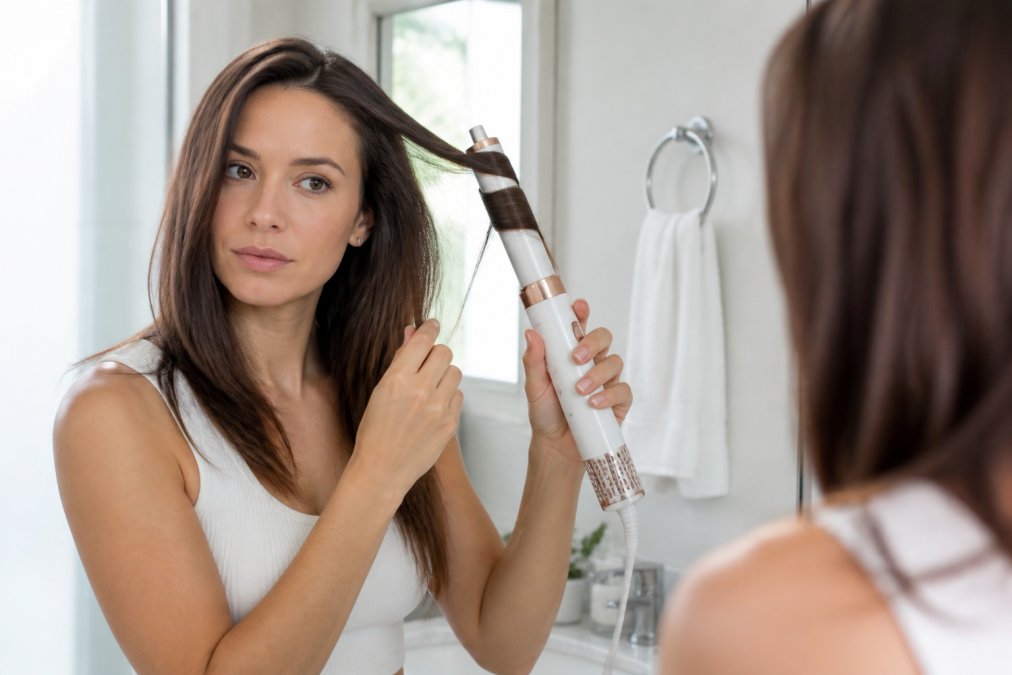
What makes this tool particularly effective for fine hair is its all-in-one functionality. You can dry your hair 80% with the fan, then use the heated plates to smooth and curl, which is a gentler process than using a high-heat flat iron on fully dried hair. The design allows you to style with the airflow, reducing the direct plate contact that causes damage.
The price point of $249.00 reflects the cost of replacing three separate tools with one high-performance device. For busy working mothers or frequent travelers, the convenience of a single tool that delivers a professional blowout is a significant time-saver.
Styling Fine Hair with Extensions and Travel Considerations
If you wear clip-in extensions, you need a styler that can handle the heat without melting the bonds or damaging the human hair. The best air styler for fine hair with extensions is one that offers precise temperature control. Avoid applying high heat directly to the bonds or wefts where the hair is attached.
Travel is another scenario where the choice of styling tool makes a significant difference. Hotel irons are a gamble, and packing a full-size dryer, straightener, and curler eats into your luggage allowance. A compact 3-in-1 air styler simplifies the packing process and ensures you have your trusted tools with you.
| Consideration | Why It Matters for Fine Hair | Best Practice |
|---|---|---|
| Heat Settings | Fine hair burns at lower temps | Use lowest setting; cool shot to finish |
| Barrel Size | Smaller barrels create more root lift | Choose 1 to 1.5-inch diameter |
| Styling Extensions | Heat can damage bonds and wefts | Lower heat on extensions; avoid bonds |
| Travel | Multiple tools are bulky and risky | Pack one 3-in-1 tool to save space |
Final Verdict: Choosing Your Air Styler
Selecting the best air styler for fine hair ultimately comes down to understanding your hair's specific needs and matching them to the tool's capabilities. Prioritize a styler that offers low, consistent heat, ionic technology for frizz reduction, and a barrel size that lets you create tension for volume.
The CHASKA Air Styler stands out by combining drying, straightening, and curling into one tool, which directly addresses the fragility of fine hair by reducing total heat exposure time. It simplifies your beauty routine while delivering the professional-grade results you would expect from a salon visit.
Frequently Asked Questions
What is the best air styler for fine hair?
The best air styler for fine hair combines adjustable low-heat settings, ionic airflow for frizz reduction, and a smaller barrel diameter (around 1 to 1.5 inches) for better control. Look for a tool with a cool shot button to set styles without heat. The CHASKA Air Styler is a strong option because its 3-in-1 design and plasma technology help create volume and smoothness without subjecting fragile strands to the damage of multiple separate tools.
How do I add volume to fine hair without heat damage?
To add volume to fine hair without heat damage, start with a lightweight volumizing mousse on damp roots. Use the air styler's concentrator nozzle to dry hair upside down, lifting at the root. Then, use a round brush attachment or the styler's barrel to curl sections away from the face. Always finish with a cool shot to lock in the lift. Never skip a heat protectant, and keep the heat setting on low or medium to prevent damage.
Is a 3-in-1 air styler less damaging than using separate tools?
A 3-in-1 air styler can be less damaging because you are styling hair that is already dry, rather than using a high-heat flat iron on freshly dried hair. Using one tool with controlled airflow and heat settings reduces the total heat exposure time. The CHASKA Air Styler uses twin turbo fans to dry hair faster, which means less time applying heat to fragile fine strands compared to a traditional blow dryer followed by a separate straightener.
What is the best heat protectant for fine hair?
The best heat protectant for fine hair is a lightweight mist or spray rather than a heavy cream or oil. Look for formulas that offer thermal protection up to 450 degrees Fahrenheit without leaving residue. Apply it evenly to damp hair before blow drying and again before using any hot tools. This creates a barrier that helps prevent moisture loss and keeps the hair cuticle smooth, reducing the risk of breakage and split ends.
Choosing the right tool is the first step, but pairing it with the correct technique and protection is what keeps your hair looking its best. The Chaska Life's All-In-1 Air Styler simplifies your routine with its versatile drying, straightening, and curling capabilities, designed to work with all hair types and reduce the risk of heat damage. Get started with The Chaska Life and cut your styling time while protecting the long-term health of your hair.
This article was written using GrandRanker