


Is an Efficient Hair Drying Method Worth It?
Table of Contents
- The Real Cost of Wet Hair: Why Drying Method Matters
- Air Dry vs Blow Dry for Hair Health: What the Evidence Shows
- Is an Efficient Hair Drying Method Worth It? A Time-Cost Analysis
- How to Avoid Heat Styling Damage Without Giving Up Speed
- Time-Saving Hair Styling Tools That Actually Cut Minutes
- Energy Use and Environmental Impact of Drying Methods
- Conclusion
- Frequently Asked Questions
Last Updated: September 22, 2026
The Real Cost of Wet Hair: Why Drying Method Matters
Most people assume air drying is always safer. That deserves a closer look.
How Long Wet Hair Stays Vulnerable
Hair can stay damp for two to three hours after washing, depending on thickness and room conditions. During that window, the hair shaft is swollen, weaker, and stretches more, making it prone to breakage from brushing, towel rubbing, or resting against a pillow.
Hygral Fatigue and Hair Porosity
Hygral fatigue is the damage that happens when hair repeatedly swells with water and shrinks as it dries, wearing down the protein structure inside each strand.
Hair porosity plays a role:
- High porosity: dries faster but damages more easily
- Low porosity: holds moisture longer, needs more drying time
- Medium porosity: the easiest to manage with either method
Air Dry vs Blow Dry for Hair Health: What the Evidence Shows
Neither method is automatically better, the outcome depends on how you do it.
When Air Drying Causes More Damage Than Heat
Air drying backfires in a few specific situations:
- You sleep on wet hair, creating friction against the pillowcase for hours
- You brush wet hair to speed things up, stretching strands past their limit
- You live in a humid climate where hair never fully dries
- You have thick hair that stays damp near the scalp, which can affect scalp health
So "natural" drying isn't automatically kind to your hair or scalp.
Is an Efficient Hair Drying Method Worth It? A Time-Cost Analysis
An efficient hair drying method is worth it when the time you save outweighs the extra care it requires. For most people, that math favors faster drying.
Fine Hair vs Thick Hair: Different Math
| Hair Type | Air Dry Time | Blow Dry Time | Best Approach |
|---|---|---|---|
| Fine, thin | 30-60 min | 5-8 min | Quick low-heat dry |
| Medium | 1-2 hours | 10-15 min | Medium heat, moving air |
| Thick, straight | 2-3 hours | 15-20 min | Sectioned drying |
| Thick, curly | 3+ hours | 20-30 min | Diffuser on low heat |
Fine hair dries fast enough that air drying is often fine. Thick or curly hair can stay damp for hours, shifting the risk toward prolonged wetness. If you fall into the bottom two rows, an efficient method saves real time and reduces the window of vulnerability.
How to Avoid Heat Styling Damage Without Giving Up Speed
You can dry hair fast without frying it. The controls are temperature, distance, motion, and the type of dryer you're holding.
What Heat Actually Does to a Hair Strand
A hair strand has three layers: the medulla (a soft core, sometimes absent in fine hair), the cortex (the bulk of the fiber, made of keratin bundles), and the cuticle (overlapping scales on the outside).
Temperature, Distance, and Motion
These three factors matter more than brand name. A budget dryer used well beats a premium one used carelessly.
- Temperature: Most consumer dryers run between roughly 120°F and 200°F at the nozzle. The sweet spot is the low-to-medium range, hot enough to evaporate water, cool enough that you can hold your hand in the airstream at six inches without pulling away.
- Distance: Six inches is the working minimum. Closer creates hot spots; further than about eight inches and you're just moving room-temperature air around.
- Motion: Constant motion spreads heat across the strand instead of cooking one spot.
Ionic, Ceramic, and Tourmaline: What Actually Changes Drying Efficiency
These aren't just marketing labels, each changes how the dryer behaves.
- Ceramic heaters distribute heat more evenly than bare metal coils, reducing hot spots. They don't affect drying speed on their own.
- Tourmaline is a mineral coated onto ceramic heating elements that produces negative ions and far-infrared heat. The far-infrared component penetrates the hair shaft rather than just heating the surface, so tourmaline dryers often dry faster at the same temperature setting.
- Ionic dryers emit negative ions that bind to the positive charges on water droplets, breaking large droplets into smaller ones that evaporate faster. This is the single biggest lever on drying speed, an ionic dryer at medium heat can beat a non-ionic dryer at high heat, meaning less total heat exposure for the same result.
The Cool Shot Isn't a Gimmick
A blast of cool air at the end of drying contracts the cuticle scales back down after heat has lifted them, locking in smoothness and shine, and sets the style so it holds longer. Most people skip it because it feels like wasted time, but it determines whether the previous ten minutes of careful drying look polished or frizzy an hour later.
CHASKA Air Styler - 3-in-1 Hair Dryer →
Thermal Protection: What It Can and Can't Do
A heat protectant spray forms a thin film over the cuticle that slows heat transfer and adds a sacrificial layer. It reduces damage, it doesn't prevent it. Think of it as a seatbelt, not a force field.
Towel Drying Mistakes That Set You Up for Damage
Towel drying is where a lot of damage starts, before heat even enters the picture. Rubbing hair vigorously with a regular towel roughens the cuticle, wet hair is fragile, and friction is the enemy.
- Don't rub. Squeeze or blot instead
- Skip the heavy bath towel; use a microfiber towel
- Never brush wet hair from the roots down
- Detangle with a wide-tooth comb, starting at the ends
Time-Saving Hair Styling Tools That Actually Cut Minutes
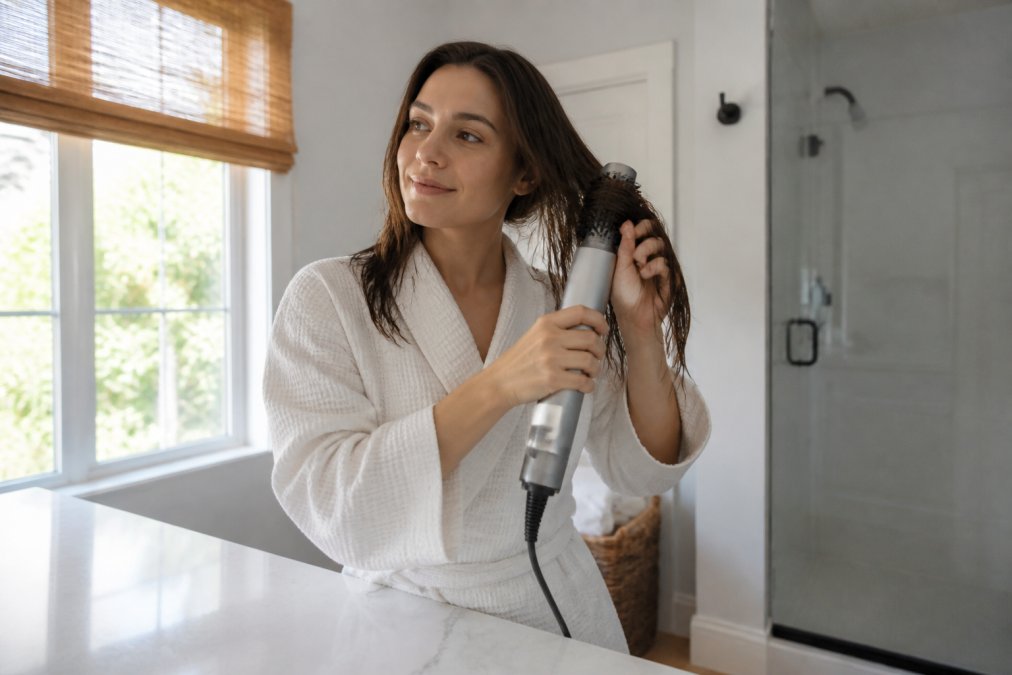
The biggest time saver isn't a faster dryer. It's fewer steps.
Energy Use and Environmental Impact of Drying Methods
The drying method you choose affects your electricity bill and household energy footprint, not just your hair.
The Wattage Reality
A typical handheld blow dryer draws between 1,200 and 1,875 watts on high, one of the highest-draw small appliances in a home, comparable to a microwave or space heater.
Where the Real Energy Cost Hides
Three variables drive the actual energy use of any drying routine:
- Heat setting. High heat draws more power and dries faster, but the relationship isn't linear. Medium heat for slightly longer often uses less total energy than high heat for a shorter burst.
- Pre-drying. Every minute of water you remove with a towel is a minute the dryer doesn't run. A 30-second microfiber blot can cut drying time by a meaningful fraction, pure energy saved.
- Number of tools. A routine that chains a dryer, flat iron, and curling iron runs three separate heating elements. An all-in-one tool runs one, meaning less electricity, less standby draw, and less manufacturing footprint per tool.
Air Drying's Hidden Energy Bill
Air drying isn't automatically the low-energy choice. In humid climates, hair can stay damp for hours, and many people compensate with ceiling fans, box fans, or dehumidifiers running the whole time. A dehumidifier can draw 300 to 700 watts continuously, far more than a blow dryer used for 15 minutes.
The Manufacturing and Materials Angle
Energy use during drying is only part of the footprint. The tools themselves carry embodied energy, the electricity, water, and raw materials used to make them.
How to Cut Energy Use Without Slowing Down
- Blot with a microfiber towel for 30 seconds before turning anything on
- Dry on medium rather than high, the time difference is small, the wattage difference isn't
- Use one multi-function tool instead of three separate devices
- Turn the tool off between sections instead of leaving it running
- Skip the compensating fan or dehumidifier when you can dry efficiently instead
The U.S. Department of Energy's appliance energy guidance notes that small changes in how you use household devices add up over time, and small appliances used daily are exactly where those changes compound.
Conclusion
The real challenge isn't choosing between air drying and blow drying. It's controlling how much time your hair spends wet and how much heat it absorbs. You don't have to accept damage to save time, you just need the right tool and technique.
Frequently Asked Questions
Does blow drying damage hair more than air drying?
It depends on technique and timing, not the method itself. Air drying keeps hair wet for hours, and prolonged wetness causes the hair shaft to swell and stretch, a condition called hygral fatigue that weakens the protein structure over time. Blow drying with controlled heat and continuous motion removes water faster and limits that swelling window. The damage comes from concentrated heat on damp hair, not from using a dryer at all. Keep the dryer moving, use a moderate heat setting, and hold it several inches from the hair.
Is it healthier to let hair air dry or use a dryer?
For most hair types, a fast, controlled blow dry is gentler than hours of wetness. Hair is most fragile when wet because the cuticle lifts and the shaft stretches. Leaving it wet for two or more hours increases breakage risk and can leave the scalp damp, which affects scalp health. Air drying works well for fine hair in dry climates. Thick or low-porosity hair that stays wet for hours usually benefits from a quick, low-heat dry followed by air drying the rest of the way.
Can an efficient drying method reduce styling time?
Yes, and the gap is larger than most people expect. A standard dryer takes 15 to 25 minutes on thick hair, then another 10 to 15 minutes with a flat iron or curling wand. A tool that dries and styles in one pass, like the CHASKA Air Styler ($249.00), combines both steps. For busy mornings, that often means cutting a 40-minute routine down to 15 or 20 minutes. The savings come from eliminating the dry-then-style sequence, not from using higher heat.
What features should I look for in a high-quality hair dryer?
Look for adjustable heat and speed settings so you can match the tool to your hair texture, a cool shot button to set the cuticle and lock in shape, and a diffuser attachment if you wear curls. Ionic or plasma technology helps reduce frizz by neutralizing static. Weight matters too, since you are holding the tool overhead for minutes at a time. For multi-step routines, consider whether one tool can dry and style, which cuts both time and the number of styling tools on your counter.