


How to Use Universal Plug Adapters for Hair Tools
Table of Contents
- Understanding Plug Adapters vs. Voltage Converters for Hair Tools
- How to Check if Your Hair Tool Is Dual Voltage
- Reading Voltage Labels and Wattage on Hair Styling Tools
- Dual Voltage Hair Tools: What They Are and Why They Matter
- Hair Dryer Wattage and Travel Adapters: Matching Power to Adapter Capacity
- Step-by-Step: How to Use a Type C Plug Adapter with Your Hair Tools
- Common Mistakes and Safety Considerations
- Choosing the Right Universal Plug Adapter for Your Hair Tool
- Frequently Asked Questions
Last Updated: October 19, 2026
Understanding Plug Adapters vs. Voltage Converters for Hair Tools
When you travel internationally with hair tools, understanding how to use universal plug adapters for hair tools and voltage converters is essential, as these two terms come up constantly. They're not the same thing, and confusing them can damage your tools or create a safety hazard.
A plug adapter is a physical connector that lets you plug your tool into a different outlet shape. It changes the shape of your plug to fit the wall outlet. It does NOT change the electrical power flowing through it.
A voltage converter actually transforms the electrical power itself. It takes the wall voltage (which varies by country) and converts it to match what your tool needs. Most converters can step voltage up or down.
Here's the critical difference: A plug adapter alone won't protect a hair tool designed for 120V if you plug it into a 220V outlet in another country. The tool will likely burn out or catch fire. A voltage converter will handle that conversion safely.
Most hair tools fall into one of two categories: dual voltage or single voltage. If your tool is dual voltage, a simple plug adapter might be all you need.
Understanding which one you need starts with reading your tool's label. That's where the voltage information lives.
How to Check if Your Hair Tool Is Dual Voltage
Finding out whether your hair tool is dual voltage takes 30 seconds. Look at the tool itself.
Most hair tools have a small label or plate printed directly on the handle or near the power cord. This label lists the electrical specifications. Look for text that says something like "Input: 110-240V" or "Dual Voltage."
If you see a voltage range like 110-240V, 100-240V, or 120-240V, your tool is dual voltage. That means it automatically adjusts to work with any voltage in that range. You only need a plug adapter for the outlet shape.
If the label shows a single voltage like "120V only" or "110V," your tool is single voltage. You'll need both a plug adapter and a voltage converter to use it safely in another country.
Can't find the label on the tool itself? Check the original box or manual. The specifications are always listed somewhere. If you've lost both, search the manufacturer's website with your tool's model number.
One more tip: if your tool has a manual voltage switch (a small toggle on the handle marked "110-240"), you can manually select the voltage. This is different from automatic dual voltage, but it still means the tool can handle both voltages safely.
Reading Voltage Labels and Wattage on Hair Styling Tools
Your hair tool's label contains three key pieces of information: voltage, frequency, and wattage. You need all three to make the right decision about adapters and converters.
Voltage is listed as "Input" or "Rated Voltage." It tells you what electrical power the tool expects.
Frequency is usually listed as "50/60 Hz." The United States uses 60 Hz (Electricity 101). Most of Europe and many other countries use 50 Hz. Many modern tools work with both, but some older tools don't.
Wattage is the power rating. Hair dryers typically range from 1200-1800 watts. Flat irons and curling irons use 200-500 watts. Wattage matters because it determines what size voltage converter you need (if you need one at all).
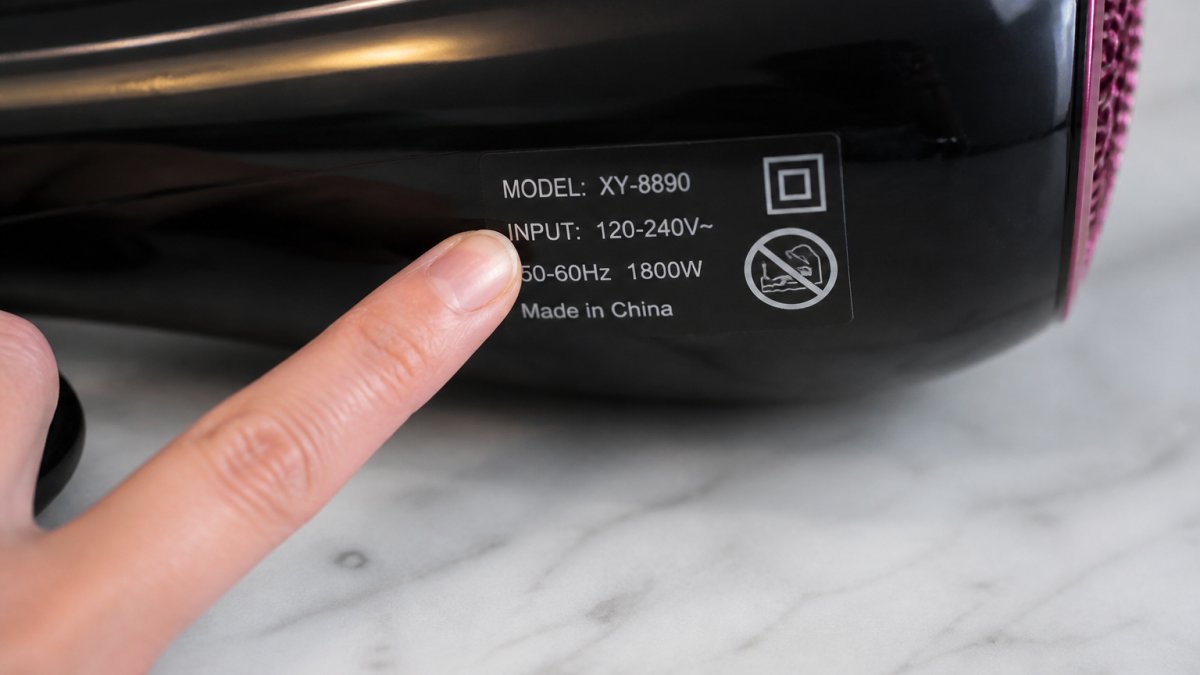
Write down all three numbers before you travel. Take a photo of the label with your phone. This information is your safety baseline.
Here's what to do with that information: If your tool is dual voltage (100-240V range) and works with both 50 and 60 Hz, you only need a plug adapter.
Dual Voltage Hair Tools: What They Are and Why They Matter
Dual voltage hair tools automatically adjust their internal circuitry to work with any voltage between their rated range (usually 100-240V). You don't flip a switch. You don't adjust anything. Plug it in, and it works.
This is why dual voltage tools are the gold standard for travel. They eliminate one entire variable from the equation. You only need to solve the plug shape problem, not the power problem.
Most modern hair tools are dual voltage. That includes most professional-grade flat irons, curling irons, and hair dryers sold in the United States in the last 10 years. Budget tools and older models are more likely to be single voltage.
Why does dual voltage matter? Because it's the difference between traveling with one adapter and traveling with an adapter plus a converter. It's the difference between one small item in your bag and two items that add bulk and weight.
The Chaska Life Air Styler is engineered as a versatile 3-in-1 tool designed to dry, straighten, and curl all hair types.

For frequent travelers, dual voltage is non-negotiable. Check your tool's label before you buy. If you're shopping for a new travel tool, prioritize dual voltage models.
Hair Dryer Wattage and Travel Adapters: Matching Power to Adapter Capacity
Hair dryers are the most power-hungry tools you'll travel with. Most use 1200-1800 watts. This matters because not all voltage converters can handle that much power.
Here's the rule: A voltage converter must have a wattage rating at least equal to your tool's wattage. If your hair dryer uses 1800 watts, your converter must be rated for at least 1800 watts.
Most travel converters max out at 1000-1500 watts. They're designed for small devices like phone chargers and laptop adapters. A high-wattage hair dryer will overload them. The converter gets hot. It shuts down. Your tool stops working.
The solution is simple: buy a converter rated for high-wattage appliances. They cost more but they're necessary. Look for converters labeled "1800W" or "2000W" or higher.
But here's the better solution: if your hair dryer is dual voltage, skip the converter entirely. Just use a plug adapter. Dual voltage hair dryers work on any voltage without a converter. No overload risk.
CHASKA Air Styler - 3-in-1 Hair Dryer Straightener & Curler with Plasma →
If your hair dryer is single voltage and high-wattage, consider leaving it at home and buying a dual voltage hair dryer for travel instead. It's cheaper than buying a high-wattage converter, and it solves the problem permanently.
Check your tool's wattage on the label. Match it to your converter's capacity. When in doubt, buy a converter rated higher than your tool's wattage, not lower.
Step-by-Step: How to Use a Type C Plug Adapter with Your Hair Tools
Type C plugs are the most common adapter type needed for European outlets. Here's how to use one safely with your hair tools.
Step 1: Check your tool's voltage. Before you plug anything in, confirm your tool is dual voltage (100-240V range) or that you have a converter.
Step 2: Inspect the plug adapter. Make sure it's in good condition. Look for cracks, burn marks, or loose connections. If it looks damaged, don't use it.
Step 3: Plug the adapter into the wall outlet. Insert the adapter into the European Type C outlet. It should fit snugly. If it's loose or requires force, you have the wrong adapter type.
Step 4: Plug your hair tool into the adapter. Connect your tool's plug to the adapter's socket. Again, it should fit snugly without forcing.
Step 5: Turn on your tool. Switch it on and let it run for a few seconds. Listen and feel for any unusual sounds or heat. If everything feels normal, you're good to go.
Step 6: Monitor during use. Keep an eye on the adapter and cord while you're using the tool. If the adapter gets hot to the touch (beyond warm), unplug immediately.
The key is paying attention. A properly functioning adapter should be cool or barely warm. If it's hot, something is wrong.
Common Mistakes and Safety Considerations
The biggest mistake is assuming a plug adapter is enough for any tool in any country. It's not. Many people have damaged expensive hair tools this way.
Another common error is buying a cheap converter without checking its wattage rating. A $10 converter that maxes out at 500 watts will fail with a 1800-watt hair dryer. It won't work. It might damage your tool or the converter itself.
Don't assume your tool works in a country just because you have an adapter. Always verify the destination voltage. Different countries use different voltages. The United States uses 120V (Electricity 101). Most of Europe uses 220-240V. Some countries use 110V. If you get this wrong, your tool burns out.
Never leave an adapter plugged in with your tool running unattended. Step away, and you don't see if the adapter starts overheating or smoking.
Don't use an adapter with a damaged cord or plug. The risk isn't worth it. Buy a new one.
Here's the safety rule: if your tool is single voltage and you're traveling to a country with different voltage, buy a proper converter rated for your tool's wattage. Don't improvise. Don't take shortcuts. Electrical safety isn't negotiable.
Choosing the Right Universal Plug Adapter for Your Hair Tool
Not all universal adapters are created equal. Some work in multiple countries. Others are designed for specific regions.
Learning how to use universal plug adapters for hair tools means understanding that a true universal adapter works in most countries around the world. It has multiple plug configurations built in.
Regional adapters work in specific areas. A European adapter set works in Europe but not Asia. These are cheaper ($8-15) but less flexible.
For hair tools specifically, you want an adapter that:
- Fits snugly in the destination outlet
- Has a solid connection with no wiggle
- Doesn't get hot during use
- Has a grounding pin if your tool's plug has one (most do)
Check reviews before buying. Look for adapters with high ratings and comments about durability. Cheap adapters fail quickly.
If you use the Chaska Life Air Styler or any other dual voltage tool, a universal adapter is all you need. The tool's dual voltage circuitry handles the power conversion automatically.
For single-voltage tools, you still need the adapter plus a converter. Don't try to save money by skipping the converter. The cost of replacing a damaged hair tool far exceeds the converter's price.
Buy your adapter before you travel. Don't wait until you arrive at your destination. Airports sell adapters at inflated prices, and selection is limited.
Traveling with hair tools doesn't have to mean sacrificing your styling routine.
If you're shopping for a travel-ready styling tool, the Chaska Life Air Styler is engineered for exactly this scenario. One versatile device that delivers salon-quality results whether you're at home or traveling internationally.
Frequently Asked Questions
Can I use a universal plug adapter with my hair dryer?
Yes, if your hair dryer is dual voltage and the adapter supports the wattage. Check your tool's label for "100-240V" or similar voltage range. Hair dryers typically draw 1200-1800 watts, so verify your universal plug adapter is rated for that power. If your dryer is single voltage only (e.g., 120V), you'll need a voltage converter in addition to the adapter.
How do I know if my hair tool is dual voltage?
Look at the label on the back or bottom of your hair tool. Dual voltage tools display a range like "100-240V" or "110-240V." Some also show "50/60 Hz." Single voltage tools list only one voltage (typically 120V).
What's the difference between a travel adapter and a voltage converter?
A travel adapter (or universal plug adapter) changes the plug shape so your tool fits into the outlet, it doesn't change electrical power. A voltage converter actually transforms the electrical current from one voltage to another. You need an adapter for plug compatibility and a converter if your tool is single voltage only. Many travelers mistakenly buy only an adapter when they need both.
How do I use a Type C plug adapter with my hair straightener?
First, confirm your straightener is dual voltage by checking its label. Plug the Type C adapter into the wall outlet. Insert your tool's plug into the adapter. Turn on your straightener and adjust heat settings as normal. Type C adapters are compact and work in most European and international outlets. Ensure the adapter's wattage rating exceeds your tool's power draw before use.