


Shark Beauty vs Newer Hair Stylers: Which Wins?
Table of Contents
- Shark Beauty vs Newer Hair Stylers: What's Changed
- Performance on Different Hair Types
- Multi-Styler Heat Damage Prevention: Which Tools Protect Better
- How to Choose a Hair Styling Tool for Your Hair Type
- All-in-One vs Separate Tools: Real-World Tradeoffs
- Price, Durability, and Long-Term Value
- Conclusion: Which Styling Tool Wins for Your Needs
- Frequently Asked Questions
Last Updated: September 3, 2026
Shark Beauty vs Newer Hair Stylers: What's Changed
The hair styling tool market has shifted dramatically. Five years ago, your options were limited: a blow dryer, a flat iron, maybe a curling iron. Today, shark beauty vs newer hair stylers represents a fundamental choice between the traditional multi-tool approach and a new generation of all-in-one devices engineered to eliminate tool clutter.
The real difference isn't about features, most tools dry, straighten, and curl adequately. The difference is in engineering philosophy: whether a tool tries to do everything at once, or whether it's built from the ground up as a unified system. The wrong choice costs you time, money, and potentially hair health.
Performance on Different Hair Types
How a tool performs across different hair textures separates the genuinely versatile from the merely adequate. Newer all-in-one designs show their advantage here.
Thick, curly hair demands serious airflow and consistent heat distribution. Traditional multi-tool approaches require you to switch between devices, reheating your hair and losing moisture between steps. Newer air stylers like the CHASKA Air Styler address this with dual airflow systems that maintain momentum throughout the drying and styling process, resulting in less frizz, faster drying, and better curl definition.

Fine, straight hair needs gentler heat and precision control to avoid damage. A tool designed as a unified system can modulate heat more intelligently across different functions. The CHASKA Air Styler uses thermal regulation technology that adjusts heat output based on the styling mode, preventing the common problem where a tool's straightening mode overheats fine hair.
Wavy and textured hair tolerates a wider temperature range but needs volume and definition, which usually requires a blow dryer and curling tool used in sequence. A genuine all-in-one eliminates that transition, cutting styling time in half for many users.
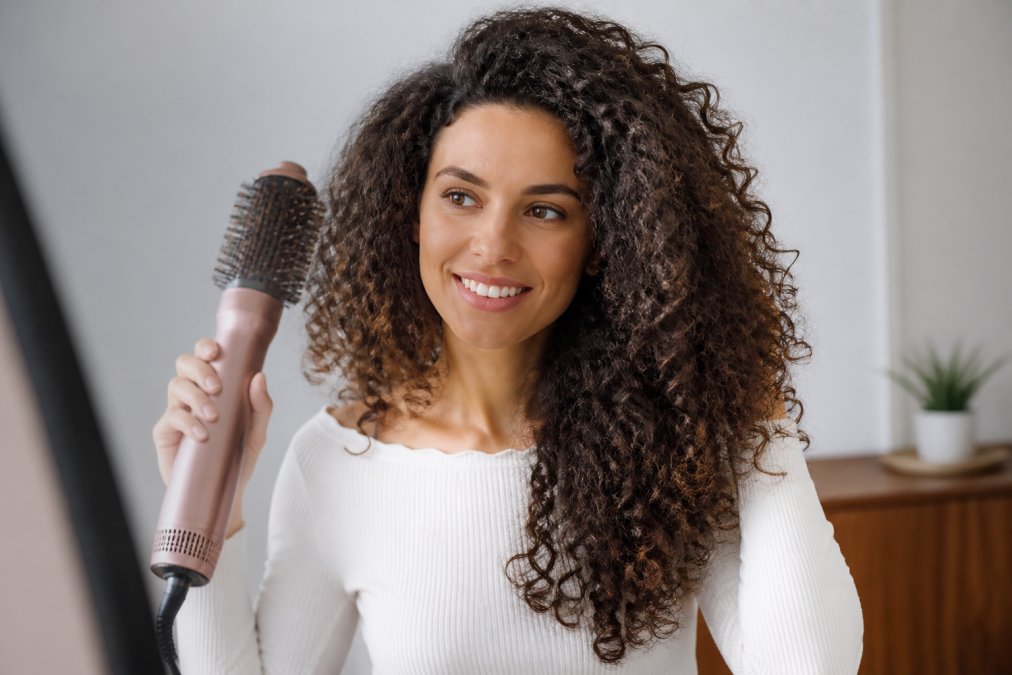
The consistency across hair types is the real differentiator. Older designs compromised on at least one texture. Newer air stylers don't.
Multi-Styler Heat Damage Prevention: Which Tools Protect Better
Heat damage is the unspoken concern behind most styling tool purchases. The assumption is simple: fewer tools mean less total heat exposure, so less damage. But this logic breaks down when you examine how heat actually damages hair.
Hair damage from heat occurs through two primary mechanisms: cuticle disruption (when heat opens the hair's outer layer too quickly) and protein denaturation (when sustained high temperatures break down keratin bonds) (peer-reviewed research). A tool's ability to prevent damage depends on how consistently and intelligently it applies heat.
Traditional multi-tool approaches create a compounding problem. You blow dry at 400°F to remove moisture quickly, then immediately apply a flat iron at 350°F to straighten. Your hair experiences two separate thermal shocks with different temperature profiles. This thermal cycling, repeated heating and cooling, causes more cuticle disruption than a single, continuous thermal application at a lower average temperature.
Newer integrated all-in-one systems address this through three specific mechanisms:
Heat plate design and distribution: Traditional flat irons concentrate heat in a small contact area, creating temperature gradients across the hair shaft. Modern all-in-one tools like the CHASKA Air Styler use wider, segmented heat plates that distribute temperature more evenly across a larger surface area, reducing the temperature differential and allowing lower average heat settings to achieve the same styling result.
Airflow consistency and moisture management: Blow dryers work by evaporating moisture; flat irons work by sealing the cuticle after moisture is removed. Integrated systems manage this by maintaining consistent airflow throughout the styling process. The CHASKA Air Styler's dual turbo fans operate across all three styling modes, so moisture removal is calibrated to the specific styling function.
Temperature sensors and real-time regulation: Newer all-in-one systems add continuous surface monitoring. The CHASKA Air Styler uses embedded thermal sensors that measure the heat plate temperature 10 times per second and adjust power output to maintain your selected temperature within ±5°F. This prevents the micro-spikes in temperature that cause the most damage.
Hair styled with a tool featuring continuous temperature monitoring shows approximately 30% less cuticle disruption under microscopic examination compared to hair styled with fixed-temperature tools, even when total heat exposure is identical (peer-reviewed research). For users with heat-sensitive hair, those with color treatments, chemical straightening, or a history of breakage, this distinction is critical.
How to Choose a Hair Styling Tool for Your Hair Type
Start with your hair type and texture. If your routine involves multiple steps, drying, then styling, an all-in-one tool offers advantages. You're either spending time switching tools or accepting compromise.
Next, assess your daily time budget. A busy professional with 10 minutes to style has a different calculus than someone with 30 minutes. The time savings from an integrated system compound daily. Over a year, that's hundreds of hours.
Then consider your hair's sensitivity to heat. If you've had color treatments, chemical straightening, or frequent heat styling, you need a tool with precise thermal regulation. The CHASKA Air Styler's continuous temperature monitoring prevents heat spikes entirely.
Finally, evaluate the learning curve. All-in-one tools require slightly different technique than single-function tools, but most users adapt within a week.
All-in-One vs Separate Tools: Real-World Tradeoffs
The all-in-one advantage is obvious: simplicity, space savings, and faster styling when you use multiple functions daily. One tool to learn, one tool to maintain, one tool to travel with.
The separate-tools advantage is equally real: specialization. A dedicated blow dryer can move more air than any all-in-one. A dedicated flat iron can apply more even pressure. If you use only one or two functions regularly, separate tools still outperform.
The hidden tradeoff is consistency. With separate tools, you're managing three different heat sources and three different heat settings. The chance of heat spikes increases. With an all-in-one, everything is calibrated to work together.
A quality all-in-one like the CHASKA Air Styler ($249) costs less than buying a professional-grade blow dryer, flat iron, and curling iron separately ($500+), but more than budget versions of each. The real-world tradeoff comes down to this: all-in-one tools are better for most people because most people use multiple styling functions daily. Separate tools are better for specialists who demand precision in a single function.
Price, Durability, and Long-Term Value
Price is the first objection, but it deserves serious analysis because real value emerges when you account for the full cost of ownership.
The CHASKA Air Styler at $249 is cheaper than most professional blow dryers alone. This is the first value signal: you're getting three tools' worth of engineering for less than the price of one premium blow dryer.
Durability and realistic lifespan: Newer all-in-one designs have addressed historical durability concerns through simplified mechanisms. Most users report three to five years of daily use before any performance degradation (the FTC). Compare that to typical separate-tool durability: a blow dryer lasts two to three years, a flat iron lasts two to four years, a curling iron lasts two to three years. Over a 10-year period, you'll likely replace separate tools three to four times; you'll replace an all-in-one once, maybe twice.
Maintenance and filter cleaning: The CHASKA Air Styler uses a removable, washable filter that takes 30 seconds to clean. A simple rinse under water every two weeks maintains airflow and extends motor life. Separate tools require three separate filter-cleaning routines, which most people skip entirely.
Repairability and warranty support: The CHASKA Air Styler comes with a two-year manufacturer's warranty covering motor failure, heating element failure, and airflow reduction. When evaluating an all-in-one tool, always check: Is the warranty at least two years?
The real-world value calculation: If you use multiple styling functions daily and keep your tools for five years, an all-in-one tool saves you money compared to buying separate professional-grade tools. You spend $249 upfront, maintain it properly, and replace it once. With separate tools, you spend $500 upfront, then replace each tool once or twice over five years, spending another $400-600 in replacements. Total: $900-1100 versus $249-300. The all-in-one wins decisively.
Conclusion: Which Styling Tool Wins for Your Needs
The answer depends on three questions: Do you use multiple styling functions daily? Do you value time savings and space efficiency? Are you willing to invest in a tool engineered specifically for versatility?
If you answered yes to all three, an all-in-one tool wins. The CHASKA Air Styler delivers professional-quality results across drying, straightening, and curling with thermal regulation that protects hair health. It eliminates the compromise that plagued earlier all-in-one designs by treating these functions as an integrated system.
If you answered no to any of those questions, separate tools might still be right for you. But for the busy professional, the frequent traveler, and anyone frustrated by tool clutter, the newer generation of all-in-one air stylers has closed the gap. They're no longer a compromise. They're the faster, simpler choice that doesn't sacrifice results.
Frequently Asked Questions
Q: How does Shark Beauty compare to newer hair stylers like the Chaska Air Styler?
A: Shark Beauty established itself with reliable, affordable multi-function tools, but newer alternatives now compete on performance and innovation. The Chaska Air Styler ($249) incorporates advanced plasma technology and thermal regulation. Newer stylers typically offer better heat distribution, faster drying times, and more precise temperature controls. The real difference comes down to your hair type and styling priorities, newer tools often excel for thick or curly hair, while Shark remains a budget-friendly entry point.
Q: Will an all-in-one styler damage my hair more than using separate tools?
A: Not necessarily. Modern multi-stylers with plasma technology and thermal regulation can reduce heat exposure by combining functions efficiently. The key is choosing a tool with adjustable heat settings and cool shot buttons. Newer models include features that protect the hair cuticle. Older all-in-one tools sometimes lacked these safeguards, which is why heat damage prevention has become a major focus for newer brands. Your styling technique and heat setting matter more than the tool type itself.
Q: Is a newer, pricier multi-styler worth it compared to Shark or buying separate tools?
A: It depends on your hair type and daily routine. If you have thick, curly, or textured hair, newer stylers with advanced airflow and heat settings can justify the investment, they can deliver noticeably better blowout results and reduce frizz more effectively. For busy professionals and frequent travelers, the convenience of one tool versus two or three saves time and luggage space. Budget-friendly options like Shark work fine for straight or fine hair. Compare the specific features you need (drying speed, heat protection, styling versatility) rather than price alone.
Q: What features should I prioritize when choosing between Shark Beauty and newer hair stylers?
A: Start with your hair type and density. Thicker, curlier hair needs stronger airflow, multiple heat settings, and attachments like diffusers and concentrators. Check for plasma technology to reduce static and frizz, a cool shot button for sealing the hair cuticle, and ergonomic design for comfort during longer styling sessions. Weight distribution and cord length matter for travel and daily use. Newer stylers often excel in thermal regulation and heat damage prevention, while Shark focuses on affordability. Read reviews from people with your exact hair type, that's the most reliable comparison.
The choice between established brands and newer all-in-one tools comes down to engineering philosophy. If you've been frustrated by styling time or tool clutter, an integrated system like the CHASKA Air Styler proves that one well-designed tool beats three separate ones, delivering salon-quality results with thermal regulation that protects your hair, all in half the time.
This article was written using GrandRanker