


T3 Micro Alternative for Hair Health: 2026 Guide
Table of Contents
- Why Shoppers Look Beyond T3 Micro for Hair Health
- How to Prevent Heat Damage When Styling: Temperature, Technique, and Timing
- Ceramic Technology, Airflow Distribution, and Even Heat: What Protects Hair Integrity
- Benefits of All-in-One Hair Stylers: Fewer Tools, Less Cumulative Heat
- Matching Tools to Hair Texture and Porosity
- The T3 Micro Alternative Built for Hair Health: CHASKA Air Styler
- Long-Term Maintenance, Repairability, and Styling Longevity
- Frequently Asked Questions
Last Updated: September 10, 2026
Why Shoppers Look Beyond T3 Micro for Hair Health
A growing number of shoppers now search for a t3 micro alternative for hair health, and the reason is simple: price and heat exposure both add up. T3 Micro built its reputation on professional-grade styling tools, but many buyers find that owning several single-purpose devices means more cumulative thermal styling, more counter clutter, and a higher total spend than expected. This guide from The Chaska Life breaks down what actually protects hair integrity during styling, and which all-in-one option delivers salon-quality results without the tool collection.
The core tension is straightforward. Most styling damage does not come from one catastrophic session. It accumulates across hundreds of small heat exposures, and each additional tool in your routine adds another opportunity for damage. Fewer, better-controlled tools usually beat a drawer full of specialized ones.
How to Prevent Heat Damage When Styling: Temperature, Technique, and Timing
Preventing heat damage when styling comes down to three variables you control every single time: temperature, technique, and timing. Get all three right and you can style daily without wrecking your hair cuticle.
Temperature. Fine hair generally tolerates lower heat settings than coarse hair. Start lower than you think you need. You can always add heat; you cannot un-singe a strand.
Technique. Keep the tool moving. Holding a hot plate against one section for more than a few seconds concentrates heat in a single spot, which is where breakage starts.
Timing. Style on hair that is at least 80% dry (the American Academy of Dermatology). Styling soaking-wet hair forces the tool to work harder and longer, which multiplies heat exposure.
A common mistake is cranking the dial to maximum because lower settings feel slow. In practice, the difference between a good result and a fried one is usually patience, not power.
Ceramic Technology, Airflow Distribution, and Even Heat: What Protects Hair Integrity
Ceramic technology matters because it changes how heat moves into the hair, not just how hot the tool gets. A ceramic-coated plate or barrel has a lower and more uniform thermal conductivity than bare metal, so the surface reaches its set temperature and holds it instead of spiking. Bare-metal plates and barrels heat unevenly and can overshoot, which is why the same temperature setting on two different tools can produce very different damage profiles.
The mechanism is straightforward. Hair's outer layer, the cuticle, is made of overlapping scales held together by disulfide bonds and moisture. When heat is applied evenly and briefly, water inside the cortex turns to steam and escapes through the cuticle without forcing the scales open. When heat is applied unevenly or for too long, that steam builds pressure under the cuticle, lifts the scales, and leaves the strand rough, dull, and prone to snapping. Even heat distribution is therefore not a comfort feature, it is the variable that determines whether water leaves the strand cleanly or tears the cuticle on the way out.
Airflow distribution works on the same principle from a different direction. Tools that move air consistently dry hair faster at lower temperatures, which shortens the total time any section sits above the temperature at which cuticle damage accelerates. Most practitioners find that the practical threshold sits well below the maximum setting on a typical styling tool, which is why a strong airflow tool at a moderate setting often produces a glossier finish than a weak airflow tool cranked to maximum.
What to look for in the spec sheet:
- A stated temperature range with discrete settings rather than a single "high", variable control lets you match heat to texture instead of guessing
- A ceramic, tourmaline, or titanium-oxide coating named specifically, not just "ceramic technology" as a marketing phrase
- Airflow measured in a real unit (cubic feet per minute or equivalent) rather than described as "powerful"
- A cool-shot or low-heat setting that lets you set the cuticle after styling
The ingredient-tool interaction most guides skip. Heat protectants are not interchangeable across tool types, and the surface of the tool changes how they behave. Silicone-based protectants form a film that bonds well to smooth ceramic and titanium surfaces and distributes evenly under a plate, but that same film can build up on airflow tools and reduce their drying efficiency over time. Water-based and glycerin-heavy protectants work well with airflow stylers because they flash off with the moving air, but they can cause a plate to drag and skip on hair that is not fully dry. Alcohol-based sprays dry fast and suit high-airflow tools, but they can leave low-porosity hair feeling brittle if applied too heavily. The practical rule: match the protectant's base to the tool's primary mechanism, film-formers for contact tools, water-based for airflow tools, and clean the tool's surfaces on the schedule the manufacturer specifies so residue does not degrade heat performance.
For readers who want the underlying science, the U.S. Food and Drug Administration guidance on cosmetic product safety explains how cosmetic and styling products are regulated, which is useful context when evaluating marketing claims about "protective" coatings.
Benefits of All-in-One Hair Stylers: Fewer Tools, Less Cumulative Heat
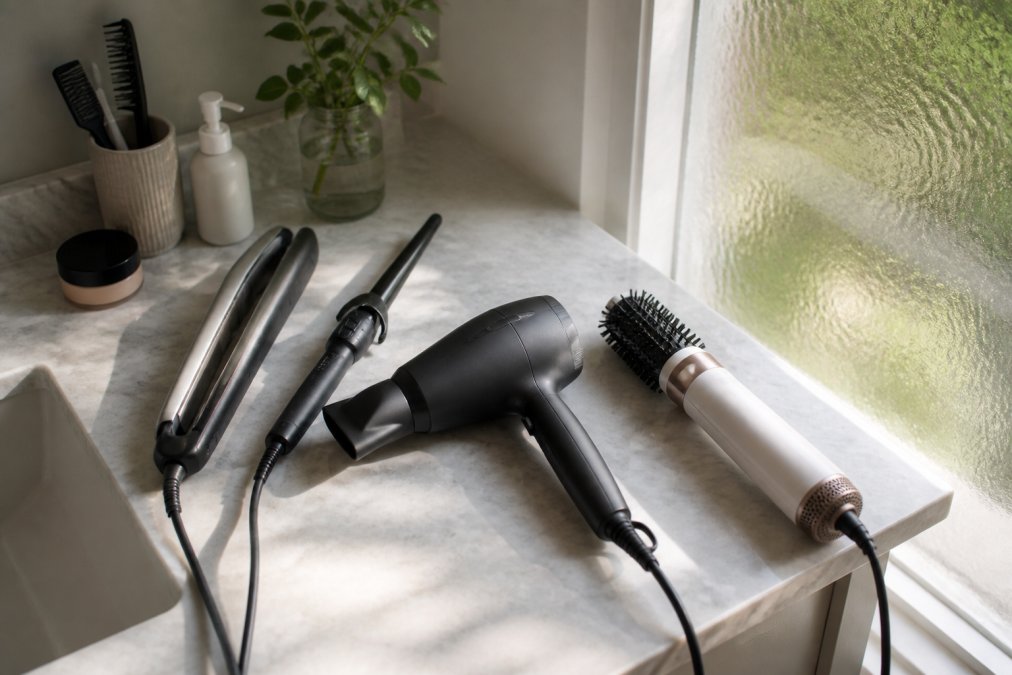
The benefits of all-in-one hair stylers come down to one idea: fewer passes, less damage. Every time you pick up a separate flat iron, curling iron, or blow dry brush, you add another round of heat exposure to hair that has already been styled once.
An all-in-one tool consolidates drying, straightening, and curling into a single session. That means:
- One drying pass instead of a dry-then-flat-iron sequence
- Consistent temperature regulation across every function
- Less handling, which reduces mechanical breakage from brushing and clamping
- A simpler styling routine that busy people actually stick to
| Approach | Tools Used | Heat Passes | Best For |
|---|---|---|---|
| Separate dryer + flat iron + curler | 3 | 3+ | People with unlimited styling time |
| Blow dry brush only | 1 | 1-2 | Quick smoothing, limited curl control |
| All-in-one air styler | 1 | 1 | Fast routines, multiple hair textures |
The trade-off is real: a dedicated flat iron still gives the sharpest, flattest finish for very coarse hair. But for most daily routines, the cumulative heat savings outweigh that edge.

Matching Tools to Hair Texture and Porosity
Hair porosity, not just texture, should drive your tool choice, and most guides skip this entirely. Porosity describes how easily your hair absorbs and retains moisture, and it determines how a given tool's heat and airflow will actually behave on your strand. Two people with identical curl patterns can need completely different settings because their cuticles differ in how tightly they lie.
How to identify your porosity without a lab test. Drop a clean, product-free strand into a glass of room-temperature water. If it sinks within a few minutes, your hair is high porosity, the cuticle is raised and water moves in fast. If it floats for several minutes before sinking, you are low porosity. If it settles somewhere in between, you are medium. This is a rough field test, not a diagnostic, but it reliably separates the two ends of the spectrum that matter most for tool selection.
High-porosity hair. The cuticle is raised, so heat and moisture enter quickly and leave slowly. That combination is the worst case for styling damage: the strand absorbs heat fast, holds it longer than it should, and loses moisture just as fast afterward. High-porosity hair needs lower temperature settings, gentler airflow, and a heat protectant applied before every session, not just on wash day. A tool with fine-grained temperature control matters more here than raw power, because the margin between "styled" and "damaged" is narrow.
Low-porosity hair. The cuticle lies flat and resists moisture, which means heat sits on the surface of the strand rather than penetrating. The visible result is often a dull, coated look and a style that will not hold, because the cuticle never opened enough to accept the shape. Low-porosity hair can tolerate slightly higher heat, but it needs airflow that moves steadily rather than in bursts, and it benefits from lightweight, alcohol-based protectants that will not sit on top of the strand.
Medium porosity. This is the widest tolerance band. Most medium-porosity hair handles a moderate temperature range and either contact or airflow styling without special accommodation, which is why it is the default assumption in most tool marketing.
Texture, layered on top of porosity:
- Fine hair: low heat settings, high airflow, minimal clamping pressure. Fine strands have less cortex to absorb heat, so they reach damage temperature faster than coarse hair at the same setting.
- Coarse hair: medium-to-high heat, but keep the tool moving to avoid hot spots. Coarse strands can take more heat before damage, but they also take longer to style, which increases cumulative exposure.
- Curly and coily hair: lower heat combined with higher airflow, and section smaller than you think you need. Curl patterns concentrate heat at the bends, which are the first places to break.
Why this matters for tool choice. A single-purpose flat iron gives you precise temperature control but no airflow, which suits low-porosity hair that needs surface heat and a flat finish. A blow dry brush gives you airflow but limited temperature range, which suits medium-porosity hair in a hurry. An all-in-one air styler with both a heat plate and internal fans lets you dial the two mechanisms independently, which is the only configuration that genuinely covers high- and low-porosity hair with the same device. If you are choosing one tool for a household with mixed porosity, that independent control is the feature worth paying for, not the number of attachments in the box.
The T3 Micro Alternative Built for Hair Health: CHASKA Air Styler
The strongest T3 Micro alternative for hair health is the CHASKA Air Styler, a 3-in-1 tool that dries, straightens, and curls in one pass. At $249, it replaces three separate devices with a single device engineered for all hair types.
What separates it from typical multi-stylers is the patented heat plate paired with Twin Turbo fans mounted inside the plates. That design doubles drying power while keeping airflow consistent, so you spend less time per section and expose hair to less sustained heat. The result is a glossy finish with fewer passes, which is exactly what hair integrity depends on.
Long-Term Maintenance, Repairability, and Styling Longevity
Long-term maintenance and repairability rarely appear in styling tool reviews, yet they determine whether a tool lasts two years or ten. A device with a sealed heating element and replaceable components outlives one designed to be thrown away.
Styling longevity depends on the same factors. Tools that hold consistent temperature keep results predictable over time, while tools that drift hotter as they age slowly damage hair with every use. Clean your plates regularly, store the tool away from moisture, and check the cord for wear. Those three habits extend service life more than any warranty.
For broader context on product safety and durability standards, the U.S. Consumer Product Safety Commission publishes guidance on household electrical products.
Choosing a styling tool is really a decision about how much heat your hair absorbs over months and years, not just how it looks on day one. If you want to cut cumulative heat exposure without giving up salon-quality results, The Chaska Life built the CHASKA Air Styler to dry, straighten, and curl in a single pass, with a patented heat plate and Twin Turbo airflow that work for all hair types. Get started with The Chaska Life and simplify your routine into one tool that protects your hair while it styles.
Frequently Asked Questions
Are there affordable T3 Micro alternatives that protect hair health?
Yes. The CHASKA Air Styler ($249) combines drying, straightening, and curling with patented heat plates and Twin Turbo fans. Instead of switching between a blow dryer, flat iron, and curling iron, you use one tool at controlled temperatures. Fewer passes and lower sustained heat reduce cumulative thermal exposure. When comparing options, look for adjustable heat settings, ceramic or plasma-coated plates, and airflow that dries hair quickly so you spend less time with heat applied.
What features should I look for in a hair-healthy styling tool?
Prioritize adjustable temperature control, even heat distribution, and ionic or plasma technology that helps smooth the hair cuticle and lock in moisture retention. Ceramic plates heat evenly, which means fewer hot spots that scorch strands. Airflow distribution matters too: strong, consistent airflow dries hair faster so you can lower the temperature. A multi-styler like the CHASKA Air Styler reduces the number of tools touching your hair, which limits total heat exposure per styling session.
Do ionic hair tools actually improve hair health?
Ionic and plasma technologies emit negative ions that help neutralize static and smooth the hair cuticle. The practical result is less frizz, more shine, and hair that holds a style longer without needing extra passes with a hot tool. That reduced friction and re-styling is where the real hair health benefit comes from. The CHASKA Air Styler uses plasma technology, which works similarly by helping hair look glossier and feel softer after styling.
Is it worth investing in a premium hair styler for long-term hair health?
A premium tool with precise temperature regulation and even heat distribution can reduce the damage caused by repeated high-heat styling. If you style daily, the cumulative effect of better heat control adds up. The CHASKA Air Styler at $249 replaces multiple tools, which can offset the cost of buying a separate blow dryer, flat iron, and curling iron. Long-term, fewer tools and lower heat per session support hair integrity and styling longevity.