


7 Benefits of Ionic Travel Hair Dryers for Frizz-Free Hair
Last Updated: October 29, 2026
Quick Summary
An ionic travel hair dryer uses negative ions to neutralize the positive static charge on wet hair, which reduces frizz and flyaways while drying on the move. It delivers a smoother, shinier finish in a compact body, though faster drying is a maybe rather than a reliable win.
- Negative ions cancel the positive static charge that makes strands repel into flyaways as they dry.
- Testers found ionic dryers did not save much time, though they did help add sheen.
- Fine hair needs ionic output plus low heat, since high ion output on cool can leave it limp.
- Thick, coarse hair needs the highest wattage you can find in a compact body.
- Confirm the voltage label reads dual voltage, like 120V/240V, before you pack.
Table of Contents
- Why an Ionic Travel Hair Dryer Earns Its Space in Your Bag
- How Ionic Hair Dryers Work: Negative Ions, Static, and Frizz
- The 7 Benefits of Ionic Travel Hair Dryers, Ranked by What You Notice
- Ionic vs. Regular Hair Dryer: What Actually Changes in Your Hand
- Ionic vs. Ceramic Hair Dryer: Two Different Jobs
- Matching the Benefits to Your Hair Type and Styling Goal
- Travel Voltage, Plug Safety, and What to Check Before You Pack
- What to Look For in the Best Ionic Travel Hair Dryer
- Frequently Asked Questions
Why an Ionic Travel Hair Dryer Earns Its Space in Your Bag
An ionic travel hair dryer is a compact, dual-purpose styling tool that uses negative ion output to reduce static and frizz while drying hair on the move.
Here's what most travel-dryer guides get wrong. They treat "compact" and "effective" as opposites, then hand you a folding handle and call it a day.
Below, we break down how ionic dryers work, the seven benefits you'll actually notice, and the voltage details that decide whether your dryer survives the trip.
How Ionic Hair Dryers Work: Negative Ions, Static, and Frizz
Ionic hair dryers work by generating a stream of negative ions that can neutralize the positive static charge on hair. That's the mechanism in one sentence.
What Negative Ions Do to Wet Hair
Wet hair carries a positive static charge, and that charge makes strands repel each other into flyaways as they dry. Negative ions pair up with that charge and cancel it. With the static gone, cuticles close more evenly and the surface reflects light instead of scattering it. For a deeper walkthrough of the styling side, see our steps for preventing frizz when heat styling curls.
Where the Marketing Outruns the Evidence
Here's the honest part. A Physics Forums discussion on ionic dryer claims reports that testers found ionic dryers did not save much time, though they did help add sheen. So treat faster drying as a maybe and smoother finish as the reliable win. We'd rather you buy the tool for the benefit it delivers than the one on the box.
The 7 Benefits of Ionic Travel Hair Dryers, Ranked by What You Notice
Common benefits of ionic travel hair dryers include:
- Frizz and flyaway control on first drying.
- A smoother finish for many hair types.
- Less static in dry air.
- Portability that keeps a styling routine in one bag.
Number seven is where design matters most. A TSA guide to carrying personal care devices confirms corded hair dryers belong in carry-on or checked bags, so size and voltage, not security rules, decide whether yours travels well.
Ionic vs. Regular Hair Dryer: What Actually Changes in Your Hand
The difference between an ionic and a regular hair dryer comes down to ion output and how the air moves. A conventional hair dryer pushes hot air and leaves static in place.
In your hand, that means fewer second passes with a brush to chase flyaways. Ion output can vary by brand. Check the product specifications for an explicit ion generator before you pay for the label.
Ionic vs. Ceramic Hair Dryer: Two Different Jobs
Ceramic and ionic are not rivals. Ceramic refers to the heating element, which warms evenly and holds temperature steadily. Ionic refers to the ion output. A dryer can be both, one, or neither.
So when you compare ionic vs. ceramic hair dryers, you're comparing a frizz-control feature against a heat-distribution feature. For travel, we'd prioritize ionic output and dual voltage first, then look for ceramic heating as a bonus that keeps heat consistent on lower wattage.
Matching the Benefits to Your Hair Type and Styling Goal
Ionic benefits are not one-size-fits-all. The same negative-ion stream that smooths coarse hair can flatten fine hair, and the airflow that speeds up a thick-hair blow-dry can tangle curls if you point it the wrong way. Use this section as a decision guide, not a sales pitch.
Fine hair
Fine hair shows shine and flyaway control quickly, but it also loses volume fast. Ionic output plus low heat is the right combination; high ion output on a cool setting can leave fine hair looking limp. Keep the concentrator nozzle on and dry roots first, then finish ends on the lowest heat setting. If volume matters more to you than smoothness, a conventional dryer on medium heat with a round brush may serve you better than an ionic model.
Medium hair
Medium hair is the easiest match. You get the shine and static control ionic dryers are known for without the flatness risk that fine hair carries. A compact ionic travel dryer with a concentrator nozzle is usually enough for a smooth blowout in a hotel room.
Thick and coarse hair
Thick, coarse hair shows the biggest drop in frizz and the smoothest finish from ionic drying, but it also needs airflow and heat to dry through. Look for a travel model with the highest wattage you can find in a compact body, lower-wattage travel dryers will leave thick hair damp in the middle and frizzy on the surface. Section the hair and dry in layers rather than blasting the whole head at once.
Curly and coily hair
Curly and coily hair benefits most from a diffuser attachment and low air speed. Ionic output helps reduce the static that makes curls cling and frizz, but direct airflow disrupts curl clumps. Use the diffuser on low speed and medium heat, and keep the dryer moving. If your travel dryer did not come with a diffuser, check whether the brand sells one that fits before you pack, universal diffusers often do not seal well on compact barrels.
CHASKA Air Styler - 3-in-1 Hair Dryer Straightener & Curler with Plasma →
Damaged and color-treated hair
Damaged and color-treated hair is where ionic marketing most often outruns the evidence. Negative ions can help the cuticle lie flatter and reduce the static that makes damage look worse, but they do not repair bonds or replace heat protection. A common pattern is that color-treated hair feels smoother after ionic drying, but the color still fades from heat exposure. Pair any ionic dryer with a heat protectant and keep the heat setting at medium or below.
When ionic drying may not be the best fit
Ionic drying is not the right choice for everyone. If you want maximum volume on fine hair, if you air-dry most of the time and only use a dryer for rough-drying, or if you are shopping at the lowest price tier where ion generators are often nominal, a conventional compact dryer may deliver more value. The honest test is simple: if your main complaint is frizz and static, ionic helps; if your main complaint is flatness or price, it may not.
If frizz is your main battle, our guide to the best multi-styler for frizz-prone hair narrows the field by hair type. The throughline: match the tool to your texture, not to the marketing.
Travel Voltage, Plug Safety, and What to Check Before You Pack
Voltage is where travel dryers fail, and it is the one topic most travel-dryer guides gloss over. A dryer that works perfectly at home can burn out its motor or trip a hotel breaker the first time you plug it in somewhere else. Choosing a dryer with the right voltage protects the motor, while understanding how humidity affects frizz helps explain why the right settings matter too, as Honeymoon Professional notes.
Read the voltage label, not the marketing copy
Every dryer has a label or stamp, usually on the handle or near the cord, that lists its rated input. Look for two numbers separated by a slash, for example, "120V/240V", which indicates dual voltage. A single number, such as "120V," means the dryer is single-voltage and is not designed for outlets that supply a different voltage. "Dual voltage" on the box is not enough; confirm the label matches.
Automatic switching vs. manual switching
Dual-voltage dryers come in two types. Automatic voltage switching means the dryer senses the outlet and adjusts internally, nothing to do but plug it in. Manual switching means there is a small switch or dial, often on the handle, that you must set to the correct voltage before plugging in. Manual-switch models are common on compact travel dryers, and forgetting to flip the switch is one of the most common ways travelers destroy a dryer. If your model has a manual switch, set it before you leave the room, not after you plug in.
Plug adapters vs. voltage converters
These are not the same thing, and confusing them is expensive. A plug adapter only changes the shape of the prongs so the plug fits the outlet; it does not change voltage. A voltage converter (sometimes called a transformer) changes the voltage itself, and converters sized for hair dryers are bulky, heavy, and often cost more than a compact travel dryer. For a dual-voltage dryer, you need only a plug adapter. For a single-voltage dryer, a plug adapter alone will not protect it, and a converter adds bulk and heat to your bag.
Check the outlet before you plug in
Hotel outlets vary, and some bathrooms have shaver-only outlets that will not power a hair dryer at all. Check the outlet rating before plugging in, and if the outlet looks unusual or the dryer hums louder than normal, unplug it immediately. A common pattern is that dryers fail on the first use abroad, not the tenth, because the voltage mismatch happens immediately.
What to pack
A dual-voltage dryer with automatic switching, a plug adapter for the outlets you will encounter, and a pouch to keep the cord from tangling. If your dryer has a manual switch, tape a note to the handle reminding you to set it. Leave the voltage converter at home unless you are committed to a single-voltage dryer.
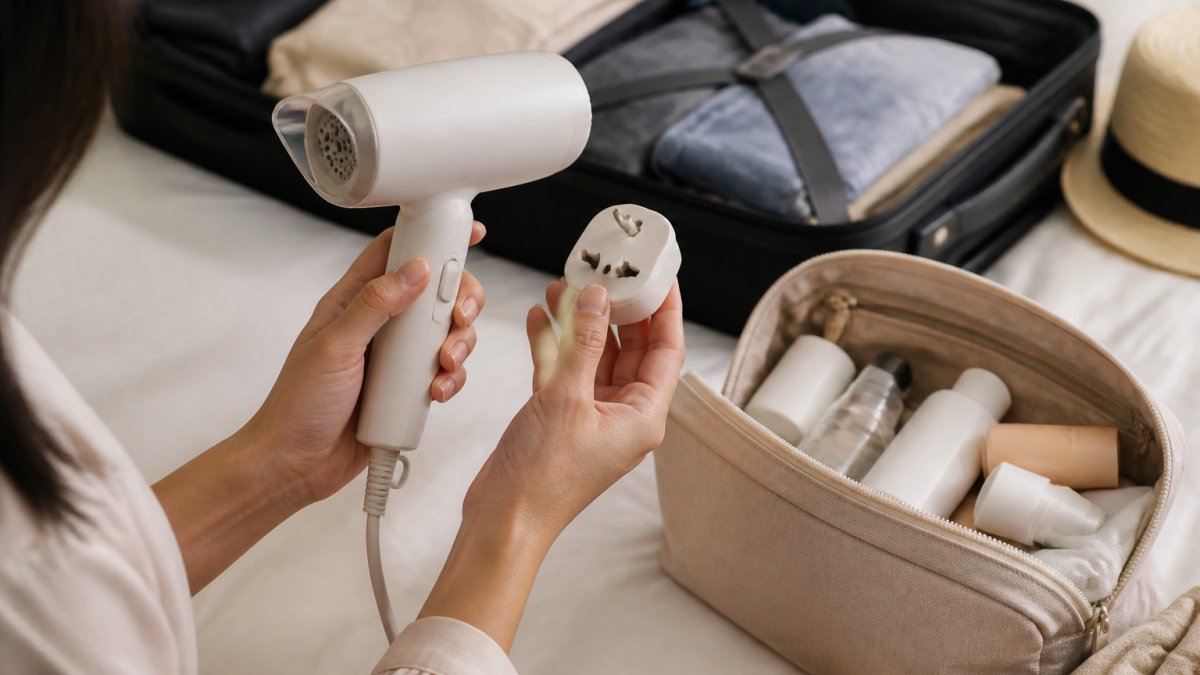
Read up on what dual voltage means for hair tools and how to use universal plug adapters safely with hair tools so a hotel outlet doesn't end your trip with a dead dryer.
What to Look For in the Best Ionic Travel Hair Dryer
The best ionic travel hair dryer combines three things: confirmed dual voltage with automatic switching, a compact lightweight body with a foldable handle, and a real ion generator named in the specs. Add a concentrator nozzle for smooth blowouts and a diffuser attachment if you have curls.
Wattage matters too. Lower-wattage travel models can dry more slowly, so sectioned drying helps. When you're ready to compare travel-ready tools, our roundup of the best compact hair tools for travel covers dual-voltage picks by hair type.
The CHASKA Air Styler is a 3-in-1 tool that dries, straightens, and curls, so one device can replace a separate dryer, flat iron, and curler in your bag. Pair it with our Moisture Rich Heat Protectant for smoother styling on the road.

| Benefit | What You Notice | Best For |
|---|---|---|
| Frizz control | Fewer flyaways on first dry | Thick, coarse hair |
| Shine | Smoother light reflection | Fine to medium hair |
| Less static | No cling in dry air | All hair types |
| Moisture retention | Less parched feel | Color-treated hair |
| Portability | One tool, one bag | Frequent travelers |
Frequently Asked Questions
Do ionic hair dryers really reduce frizz?
They can, and the mechanism is straightforward. Drying hair builds up static charge, and that charge makes strands repel each other into flyaways. Negative ions neutralize the charge, so hair lies closer together and looks smoother. Results can vary by hair texture and humidity.
What should I look for in a travel hair dryer?
Check four things before buying. First, dual voltage with automatic switching, so the tool adjusts to 120V or 240V without a converter. Second, wattage: lower-wattage travel dryers dry slower, so match it to your hair thickness. Third, attachments, since a concentrator nozzle and diffuser change results more than extra speed settings. Fourth, a foldable handle and lightweight body for packing. An ionic travel hair dryer adds negative-ion output to that list.
Are ionic hair dryers better for fine or thick hair?
Results depend on hair texture and thickness. If your hair is coarse, prioritize airflow and wattage alongside ion output. Pairing the dryer with a heat protectant is a sensible step either way.
Can an ionic travel hair dryer help prevent heat damage?
Keeping the dryer moving, using the lowest heat setting that gets the job done, and applying a heat protectant first are the practical steps for limiting heat exposure.
Travel hair tools ask a hard question: can one compact device actually replace the dryer, flat iron, and curler you'd normally pack? We think it can, and we built the CHASKA Air Styler to prove it. It dries, straightens, and curls with plasma ion technology and direct airflow from twin turbo fans, and it works on all hair types. Get started with The Chaska Life and pack one tool instead of three.
