


Best 3-in-1 Hair Styler for International Travel
Table of Contents
- Why a 3-in-1 Hair Styler Makes Sense for Travel
- Dual-Voltage Hair Styler for Travel: What You Actually Need
- Hair Tool Plug Adapter vs. Voltage Converter: Which One Works
- What to Look for in the Best Travel Hair Dryer
- The Chaska Air Styler: Engineering for All Hair Types
- Travel Hair Styling Tips for Professional Results on the Go
- Common Mistakes That Damage Hair While Traveling
- Frequently Asked Questions
Last Updated: October 13, 2026
Why a 3-in-1 Hair Styler Makes Sense for Travel
Traveling with a full hair tool collection defeats the purpose. You're already managing luggage weight, packing space, and security rules. The best 3-in-1 hair styler for international travel combines drying, straightening, and curling into one device designed for travel.

A dedicated 3-in-1 hair styler for international travel also reduces heat exposure, since you're not switching between multiple tools.
Travel also exposes your hair to different humidity, water quality, and climate. Travel-focused multi-function tools typically include dual-voltage compatibility and ionic technology to manage frizz, built in from the start, not afterthoughts.
Dual-Voltage Hair Styler for Travel: What You Actually Need
A dual-voltage hair styler operates on both 110-120V (North America) and 220-240V (international). Plugging a 110V-only device into a 220V outlet will destroy it instantly, so you need genuine dual voltage.
Dual voltage means an internal transformer automatically detects and adjusts to the supplied voltage, via a switch or auto-detection, so it works safely on both systems.
The Chaska Air Styler operates on dual voltage, eliminating the need for a separate voltage converter internationally, a critical feature, since converters add bulk, weight, and another item to manage.
Check your destination's voltage before packing. Canada and Mexico use 110-120V like the United States. International voltage standards guide provides detailed voltage information by country if you're unsure.
Hair Tool Plug Adapter vs. Voltage Converter: Which One Works
Most travelers confuse these two items, and that confusion costs money, luggage space, and occasionally a fried hair tool.
A plug adapter changes shape only. It reconfigures your prongs to fit a foreign outlet but does not touch voltage or current.
A voltage converter transforms current. It steps 220-240V down to 110-120V, is heavier and bulkier, and typically runs $30-$60. Many budget units top out around 50-200W, useless for a hair tool pulling 1,200-1,800W.
The practical rule: if your styler is genuinely dual voltage (look for '100-240V' or '110-240V' on the label, not '120V'), you need only a plug adapter.
Which plug type goes where
Plug shapes vary by region; a universal adapter covers the common ones:
- Type A, two flat parallel prongs. Used in the U.S., Canada, Mexico, and Japan.
- Type B, two flat prongs plus a round grounding pin. U.S., Canada, Mexico.
- Type C, two round prongs. Widely used across Europe, South America, and parts of Asia.
- Type G, three rectangular prongs in a triangle. United Kingdom, Ireland, Hong Kong, Singapore, UAE.
- Type I, two flat prongs angled in a V, sometimes with a grounding pin. Australia, New Zealand, China, Argentina.
- Type H, three round pins in a triangle. Israel.
A universal adapter listing Types A, B, C, G, H, and I covers the overwhelming majority of destinations. Expect $10-$25 for a reputable one; cheap versions with loose pins cause arcing.
Voltage by region, at a glance
- 110-120V regions: United States, Canada, Mexico, Japan, Taiwan, parts of the Caribbean and Central America.
- 220-240V regions: essentially all of Europe, the U.K., Australia, New Zealand, most of Asia, Africa, the Middle East, and South America.
Japan is the outlier: it runs 100V with Type A/B plugs, so a dual-voltage tool works fine, while a 120V-only tool runs slightly underpowered rather than overvolted.
What to actually pack
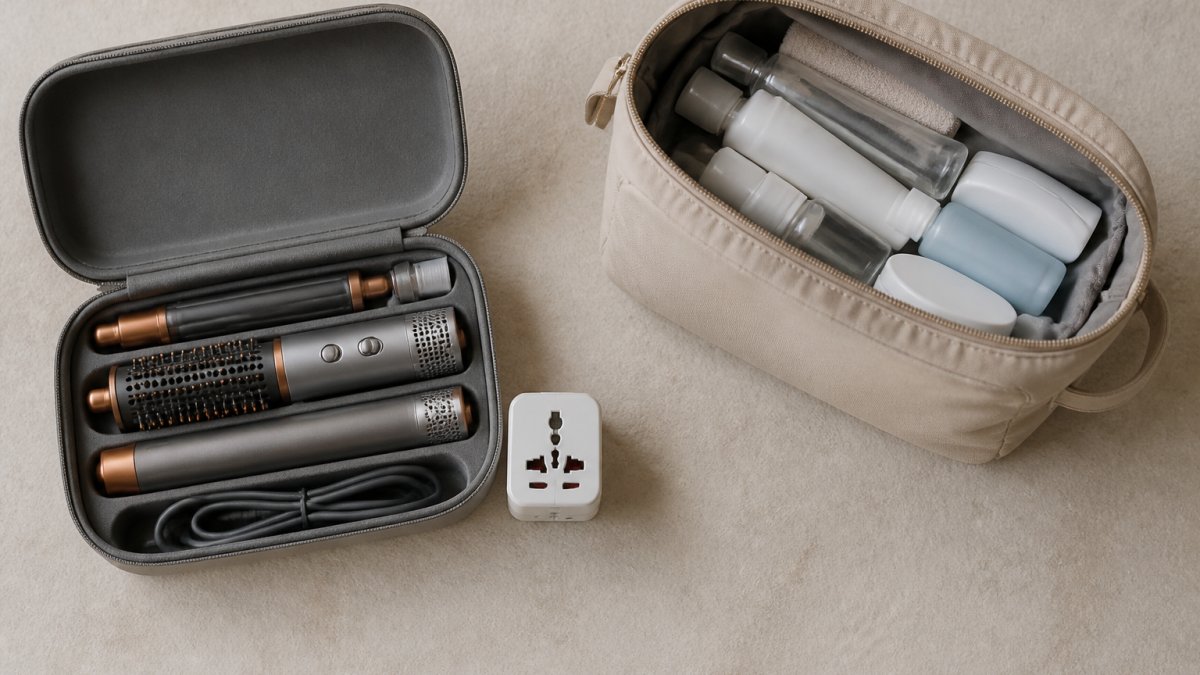
For a dual-voltage 3-in-1 styler, the kit is light: the tool, its travel case, and one universal adapter (under 4 ounces). For a single-voltage tool, you need a step-down converter weighing 1-3 pounds and costing more than a budget styler, exactly why travel-focused tools are built dual voltage.
Never plug a 120V-only hair tool into a 220-240V outlet through an adapter alone. The adapter will not protect the device, and the result is a burned-out tool at best and a fire risk at worst. Verify the voltage rating on the label before you pack.
Plug and outlet types by country
What to Look for in the Best Travel Hair Dryer
When evaluating the best 3-in-1 hair styler for international travel, the spec sheet tells you less than the packed reality. Here's what separates a tool that earns its luggage space from a hotel-drawer orphan.
The 3-in-1, defined
A true 3-in-1 combines three functions in one barrel or plate system:
- Drying, airflow through or around the styling surface, so you can go from damp to styled without a separate dryer.
- Straightening, flat heated plates that smooth sections with tension.
- Curling, a rounded barrel or plate edge that wraps sections into waves or curls.
Wattage and drying power
Travel stylers typically run 1,200-1,800W. Higher wattage dries faster but draws more current, relevant with a converter abroad. Thick or curly hair needs 1,500W+; fine hair is served at 1,200-1,400W. Internal airflow moves more air at lower wattage, an efficiency gain on a 220V circuit.
Heat settings and temperature range
Look for at least three heat levels and a stated range: roughly 250°F for fine or color-treated hair up to about 400°F for thick, coarse, or tightly curled hair. Fewer than three settings forces a choice between too hot and not hot enough.
Barrel and plate size
For travel, barrels in the 1-1.5 inch range are the sweet spot: they curl, wave, and straighten without demanding large sections. Narrower plates (under 1 inch) reach roots and short layers; wider plates cover more hair per pass but struggle on bangs.
Weight, packed dimensions, and accessories
A travel styler should weigh under about 1.5 pounds and fit a standard quart-size toiletry bag or dedicated travel case. Ask three questions before buying:
- What is the packed length, width, and depth, including the case? A tool that is 11 inches long may not fit a small carry-on's internal pocket.
- Does the case hold the attachments, or just the tool? Loose barrels and diffusers get lost or bent.
- Is there a cord wrap or swivel cord? A 6-8 foot swivel cord prevents tangling and reaches awkward hotel outlets.
Cord length and outlet reality
Hotel bathrooms frequently place outlets behind mirrors, under counters, or across the room. A 6-8 foot cord is the practical minimum; a swivel base reduces cord twist during curling.
Dual voltage, verified
Confirm the label reads a range like 100-240V, not a single voltage. Auto-detecting dual voltage is the most convenient configuration, no switch to flip. If the tool requires a manual voltage switch, set it before you plug in, every time.
CHASKA Air Styler - 3-in-1 Hair Dryer Straightener & Curler with Plasma →
Safety and shutoff
Automatic shutoff after a set idle period is a genuine travel feature, it protects against leaving a hot tool on a hotel vanity. Cool-down time matters too: a tool packable in 5-10 minutes beats one that stays hot for half an hour.
What the Chaska Air Styler delivers against this checklist
The Chaska Air Styler is built as a true 3-in-1 rather than three functions grafted onto one body. Its Twin Turbo fans sit inside the styling plates, pushing air directly onto the section being styled, raising drying efficiency without pushing wattage into the range that strains foreign circuits. It runs dual voltage, offers multiple heat settings, and ships with a protective travel case. At $249.00, it replaces a dryer, flat iron, and curling iron in one packed item.
Before you buy, measure the internal pocket of your carry-on and your toiletry bag. Then compare those numbers against the tool's packed dimensions with the case on. A styler that fits the bag but not the pocket still ends up loose in your luggage.
The Chaska Air Styler: Engineering for All Hair Types
The Chaska Air Styler prioritizes results across all hair types: its patented heat plate design includes direct airflow technology, Twin Turbo fans positioned within the plates, doubling drying power versus traditional designs.
The plasma technology generates negatively charged ions that penetrate the hair cuticle, sealing moisture while eliminating frizz.
For thick, curly hair, the tool straightens because the heat plate design concentrates heat efficiently without excessive temperature. For fine hair, lower settings work without damage.
The device costs $249.00 and includes dual-voltage compatibility, multiple heat settings, and a protective travel case, competitive when you're replacing three separate tools with one device.
When styling while traveling, start with lower heat settings and work up if needed. Hotel water often contains minerals that make hair more resistant to styling, but jumping straight to high heat risks damage. Test your approach on the first day to dial in the right settings for that location's water.
Travel Hair Styling Tips for Professional Results on the Go
Salon-quality results while traveling require understanding how location affects your hair and adjusting your technique.
Account for water quality: Hotel water often has different mineral levels than home water, affecting how hair responds to heat and products.
Prep your hair properly: Damp hair (not soaking wet, not completely dry) responds best to all three functions.
Section your hair strategically: Divide hair into four sections with clips and work from the bottom up.
Use lower heat initially: Travel stress, different water, and environmental changes make hair more fragile.
Manage humidity: In humid destinations, apply an anti-frizz serum or lightweight oil after styling to create a protective layer without weighing hair down.
Common Mistakes That Damage Hair While Traveling
Travel conditions expose hair to stress that home styling doesn't. Knowing what damages hair helps you avoid costly mistakes.
Mistake 1: Skipping heat protectant. Heat protectant isn't optional, it creates a barrier that reduces direct heat exposure to the hair shaft.
Mistake 3: Running the tool through the same section repeatedly. Once a section is straightened or curled, move on, re-styling causes cumulative heat damage.
Mistake 5: Packing a tool that doesn't fit your luggage. This leads to cramming, bent cords, and damage to the device or bag.
Mistake 6: Not testing your tool before departure. Use your new tool several times at home before traveling.
Traveling with the right hair tool simplifies your routine and delivers professional results wherever you go. Get started with the Chaska Air Styler and transform how you style your hair on the road.
Frequently Asked Questions
Do I really need a dual-voltage hair styler for international travel?
If you're traveling to countries with different electrical standards (Europe uses 220-240V, most of North America uses 110-120V), a dual-voltage hair styler eliminates the need for a voltage converter, which can be bulky and damage some electronics. A dual-voltage tool plugs directly into any outlet worldwide with just a simple plug adapter, making it the safest and most practical choice for frequent travelers.
What's the difference between a plug adapter and a voltage converter for a hair tool?
A plug adapter changes only the physical shape of the plug to fit different outlet types, it does NOT change the voltage. A voltage converter actually transforms the electrical current from one voltage to another. Hair tools require voltage conversion, not just adapters. A dual-voltage hair styler handles both automatically, so you only need a cheap plug adapter ($5-15) instead of a converter ($30-80).
Can a 3-in-1 styler really replace separate tools, or does it compromise on performance?
A well-engineered 3-in-1 tool like the Chaska Air Styler uses patented technology (plasma ion system and twin turbo fans) to deliver results in a single device. The key is the engineering: premium designs maintain heat distribution, airflow, and styling precision across all three functions. The Chaska Air Styler's direct airflow design and plasma technology address the common complaint that multi-tools do everything just okay.
What hair type works best with a 3-in-1 travel hair styler?
The best travel hair stylers are designed for all hair types, fine, thick, curly, and coily, but the tool's heat settings and technology matter. Tools with adjustable temperature control and ion technology (which reduces frizz) work across hair types. Thick, curly hair benefits most from lower heat settings and longer styling time, while fine hair needs lower temperatures to avoid damage. Choose a styler with at least 3-5 heat settings to match your specific hair needs.