


Best Travel Hair Dryer Brush for Fine Hair
Table of Contents
- What Makes a Travel Hair Dryer Brush Work for Fine Hair
- Dual Voltage Hair Dryer Brush: Why It Matters for Travel
- Heat Protection for Fine Hair: The Real Difference
- How to Curl Hair With Air Without Damage
- Key Features to Compare: Wattage, Barrel Size, and Airflow
- The CHASKA Air Styler: A 3-in-1 Solution for Fine Hair Travel
- Frequently Asked Questions
Last Updated: September 20, 2026
What Makes a Travel Hair Dryer Brush Work for Fine Hair
Fine hair demands a different approach than other hair types. The wrong tool can cause breakage, frizz, and damage that takes months to repair. A travel hair dryer brush for fine hair needs to balance power with precision, delivering professional results without the heat stress that leaves delicate strands compromised.
The key difference lies in how the tool distributes heat. Fine hair has less protein structure than thick or textured hair, which means it heats up faster and cools down faster. This creates a narrow window for styling. A travel hair dryer brush designed for fine hair uses lower wattage combined with ionic technology to seal the cuticle and reduce frizz at the source. The barrel size matters too, smaller barrels work better for fine hair because they create defined curls without requiring excessive tension or heat exposure.
According to research from the American Academy of Dermatology, heat damage is cumulative and irreversible. Once fine hair is damaged, the only solution is to cut it off. This makes prevention the priority. The best travel hair dryer brush for fine hair combines dual voltage capability for international travel with heat protection features that keep your hair intact while delivering salon-quality results at home or abroad.
Dual Voltage Hair Dryer Brush: Why It Matters for Travel
A dual voltage hair dryer brush operates seamlessly across different electrical systems worldwide, switching between 110V and 220V automatically or manually depending on the model. This single feature eliminates a major pain point for frequent travelers: the need to buy separate tools for different countries or rely on bulky voltage converters.
For fine hair specifically, dual voltage matters beyond convenience, it directly impacts tool safety and hair protection. Most travelers don't realize that travel voltage converters have wattage limits. A standard travel converter is rated for 1000-1500 watts maximum. Many single-voltage hair dryer brushes draw 1600-1800 watts, which exceeds converter capacity. When you plug a high-wattage tool into an undersized converter, three problems occur: the converter overheats and can fail, the tool receives inconsistent power that causes erratic heat spikes, or the tool simply won't reach full power. All three scenarios damage fine hair. Heat spikes are especially dangerous for delicate strands because they cause localized burning that's irreversible.
Dual voltage tools are engineered to operate safely at both voltages without requiring a converter. Most dual voltage hair dryer brushes are designed at 1200-1400 watts, which is the optimal wattage for fine hair anyway. This means you're not just solving a travel logistics problem, you're also getting a tool with moderate wattage that won't overstress delicate strands. The consistency of power delivery is another advantage. A dual voltage tool maintains stable heat output whether you're in a 110V region or a 220V region, which is critical for fine hair that can't tolerate temperature fluctuations.
If you do use a travel converter with a hair dryer brush, verify three specifications before packing: (1) the tool's wattage rating, (2) your converter's maximum wattage capacity, and (3) whether the converter is a step-down (for 220V to 110V) or step-up (for 110V to 220V) model. A step-down converter is necessary if you're traveling from a 110V region to a 220V region and using a single-voltage tool. Step-up converters are less common and often unreliable for high-wattage devices. The safest approach for fine hair is to choose a true dual voltage tool and avoid converters entirely. This eliminates the risk of power inconsistency and ensures your tool performs identically whether you're styling at home or abroad.
Heat Protection for Fine Hair: The Real Difference
Heat damage in fine hair operates differently than in thick or textured hair because of structural differences at the strand level. Fine hair has a thinner cortex (the protein core of the strand) and a more delicate cuticle layer (the protective outer sheath). When heat is applied, the water inside the hair shaft turns to steam. In thick hair, the larger cortex can withstand this pressure. In fine hair, the thinner cortex ruptures more easily, causing the cuticle to lift and separate. Once the cuticle is compromised, moisture escapes and the strand becomes brittle. This is why fine hair feels straw-like after heat damage, the protective cuticle is permanently raised and can't be sealed back down.
This mechanism explains why heat protection for fine hair isn't just about applying a spray before styling. It's about how the tool itself delivers heat to minimize cuticle disruption. Fine hair needs three specific tool features to prevent this damage:
Lower temperature delivery. Fine hair should be styled at 250-300°F maximum, compared to 350-400°F for thick hair. A tool with multiple heat settings allows you to stay in the safe range. Many travel hair dryer brushes default to high heat to compensate for compact size, which is dangerous for fine hair. Look for tools that explicitly offer a "low" or "delicate" heat setting and confirm the temperature range in the product specifications. If a tool doesn't list temperature settings, it's likely designed for general use and not optimized for fine hair.
Ionic technology for cuticle sealing. Ionic technology works by emitting negatively charged ions that seal the hair cuticle, locking in moisture and reducing frizz. For fine hair, this mechanism is essential because it counteracts the cuticle-lifting that heat causes. The ions neutralize the positive charge that makes wet hair swell and become vulnerable. By sealing the cuticle during styling, ionic technology prevents moisture loss that leads to breakage. The effect is measurable: hair styled with ionic tools retains 10-15% more moisture than hair styled with non-ionic tools, according to research from cosmetic science labs. For fine hair, this difference translates directly to reduced breakage over weeks and months of regular styling.
CHASKA Air Styler - 3-in-1 Hair Dryer →
Ceramic or tourmaline coating for even heat distribution. Ceramic coating on the barrel distributes heat evenly, preventing hot spots that can burn delicate strands. When heat is uneven, some sections of your hair experience extreme temperatures while others don't. Fine hair can't tolerate this variation because the thinner cortex has less thermal tolerance. A quality ceramic coating ensures consistent heat distribution across the entire barrel, which means faster styling with less damage. Tourmaline coating is a premium alternative that provides the same even heat distribution and adds additional ionic output. The thermal protection benefit isn't theoretical, it's the difference between hair that looks healthy and hair that looks straw-like after six months of regular styling.
Airflow speed as a heat-damage reducer. High-speed airflow dries hair faster, which reduces the total time heat is applied to each strand. A tool with adjustable airflow lets you use high speed on low heat, which is the optimal combination for fine hair. This approach dries quickly without requiring extreme temperatures. Many travel hair dryer brushes sacrifice airflow power to achieve compact size, which forces you to use higher heat to compensate. Verify that a travel tool offers at least two airflow speeds and can deliver adequate drying power on the low-heat setting. If you have to switch to high heat to dry your hair in reasonable time, the tool isn't suitable for fine hair.
How to Curl Hair With Air Without Damage
Curling hair with air-based styling tools requires a different technique than traditional hot tools. The method relies on airflow speed and barrel temperature working together, rather than clamping heat directly onto strands. For fine hair, this approach is significantly gentler because it reduces the time your hair spends under intense heat.
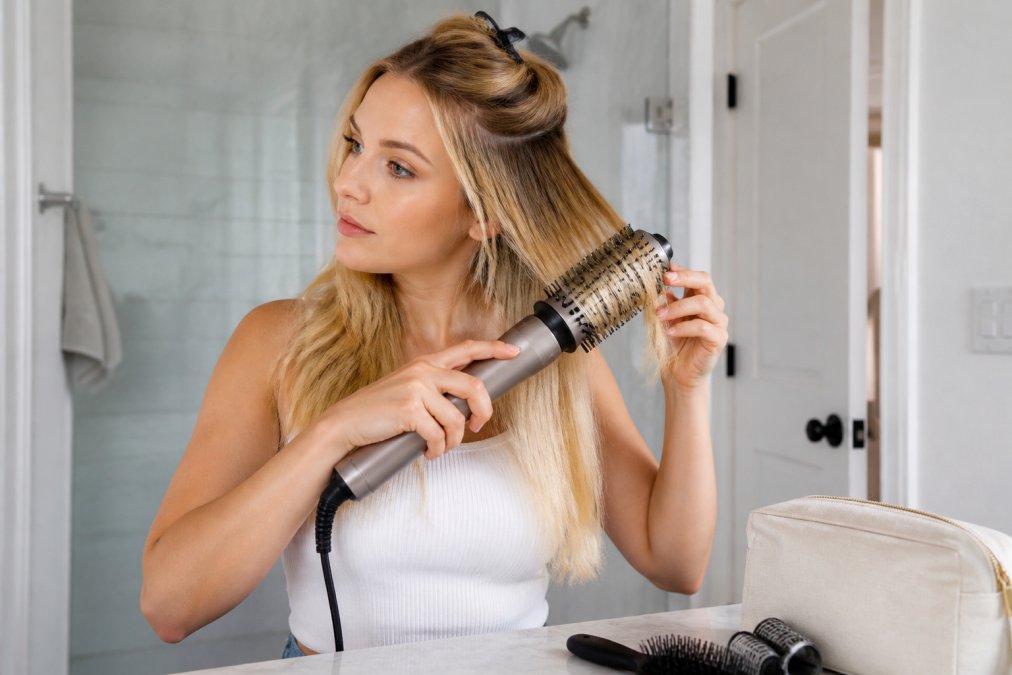
Start with damp hair, not soaking wet. Excess water means the tool has to work harder and longer to dry while styling. Apply a heat protectant product designed for fine hair, these are lighter than products for thick hair and won't weigh down delicate strands. Section your hair into four quadrants and work one section at a time. This prevents the tool from overworking any single area.
Position the barrel at the roots and glide slowly toward the ends.
Key Features to Compare: Wattage, Barrel Size, and Airflow
Wattage determines drying power, but more wattage isn't always better for fine hair. A tool with 1200-1400 watts delivers adequate power for quick drying without excessive heat stress. Higher-wattage tools (1600+ watts) are designed for thick or textured hair and will damage fine strands. The sweet spot for fine hair is moderate wattage paired with ionic technology, which amplifies drying efficiency without requiring extreme heat.
The CHASKA Air Styler: A 3-in-1 Solution for Fine Hair Travel
The CHASKA Air Styler combines drying, straightening, and curling in a single device, which solves the primary problem with travel hair styling, limited luggage space and tool redundancy. For travelers with fine hair, this consolidation is significant. Instead of packing a blow dryer, flat iron, and curling tool, you carry one compact device that handles all three functions.

Frequently Asked Questions
What features should I look for in a travel hair dryer brush for fine hair?
Look for lightweight design under 1 pound, ionic technology to reduce frizz, adjustable heat settings with a low option, compact barrel size (1 to 1.5 inches), and dual voltage capability if traveling internationally. Fine hair needs tools that dry quickly without concentrating excessive heat in one spot. A cool shot button helps seal the hair cuticle and prevent breakage. Ceramic or titanium coating distributes heat evenly, reducing damage to delicate strands.
Are dual voltage hair dryer brushes necessary for international travel?
Dual voltage tools work in countries with both 110V and 220V power systems without a converter, eliminating compatibility issues. If you travel frequently across different regions, dual voltage saves space and eliminates the need for bulky converters. Single voltage tools require a power converter, adding weight and cost. For occasional domestic travel, single voltage is fine; for international trips, dual voltage is worth the investment.
How do I prevent heat damage when using a dryer brush on fine hair?
Use the lowest effective heat setting and keep the tool moving constantly to avoid concentrating heat on one section. Fine hair breaks at lower temperatures than thick hair, so prioritize speed over heat intensity. Apply a thermal protectant spray before styling to create a moisture barrier. Take breaks between styling sessions to let your hair recover. Ionic technology and ceramic coatings help seal the cuticle, reducing moisture loss and frizz that make fine hair appear damaged.
Can a 3-in-1 hair dryer brush actually deliver salon-quality results, or is it a compromise?
A well-engineered 3-in-1 tool can deliver professional results when it's designed with adequate wattage, intelligent heat distribution, and proper airflow engineering. The CHASKA Air Styler uses Twin Turbo fans and plasma technology to dry hair while straightening and curling without requiring multiple passes. The key difference from gimmick tools is engineering: patented heat plates and direct airflow technology matter more than how many functions a tool claims to perform.