


Buy Professional Hair Styler Online 2026: Top Picks
Table of Contents
- Why 2026 Is the Year to Buy a Professional Hair Styler Online
- Best 2026 All in One Stylers: Top Picks for Every Hair Type
- How to Use an Air Styler for Salon Results
- Professional Hair Styling Tools for Home Use: What to Look For
- Heat Damage Prevention: The Science Behind Safe Styling
- Ergonomics and Weight: Why They Matter for Daily Styling
- Sustainability and Repairability in Professional Hair Stylers
- Conclusion: Your Next Steps to Buy a Professional Hair Styler Online
- Frequently Asked Questions
Last Updated: September 16, 2026
Why 2026 Is the Year to Buy a Professional Hair Styler Online
Shopping for a professional hair styler online has shifted from a niche habit to the default. Between rising salon prices and genuinely better at-home technology, more people are consolidating their tools into one device that does the work of two or three. This guide from The Chaska Life breaks down what actually matters when you buy professional hair styler online 2026, from heat control to weight to how a tool holds up over years of daily use.
Here's the tension most buying guides skip: the best tool for you isn't the one with the longest feature list. It's the one that matches your hair texture, your routine, and your tolerance for heat damage. Get that match right and a single device replaces a drawer full of clutter. Get it wrong and you've spent money on something that sits unused.
Below, we cover the top all-in-one picks, how to use an air styler for salon results, what separates professional-grade tools from consumer models, and the science behind styling without frying your hair.

Best 2026 All in One Stylers: Top Picks for Every Hair Type
The best all-in-one styler for most people is one that dries, straightens, and curls without forcing you to switch tools mid-routine. Multi-styler functionality has matured enough that a single device can now handle all three tasks for a range of hair textures.
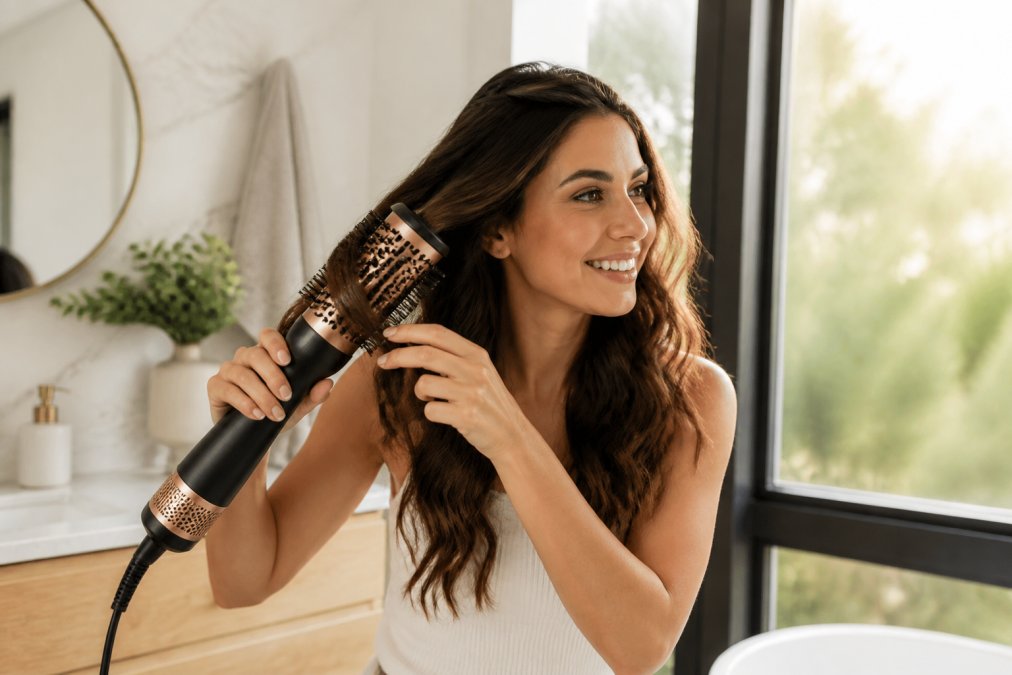
Our top pick is the CHASKA Air Styler - 3-in-1 Hair Dryer Straightener & Curler with Plasma Technology at $249.00. It combines a patented heat plate with Twin Turbo fans built directly into the plates, which doubles drying power and makes it one of the few tools with direct airflow. Its Advanced Plasma Ion System generates negatively charged ions that help seal the hair cuticle, which supports frizz reduction and shine enhancement. It's suitable for all hair types.
| Feature | What It Means for You | Best For |
|---|---|---|
| 3-in-1 function | Dry, straighten, curl in one pass | Reducing tool clutter |
| Twin Turbo fans | Faster drying via direct airflow | Thick, hard-to-manage hair |
| Plasma ion system | Cuticle sealing, less frizz | Frizz-prone or textured hair |
| $249.00 price | One tool replaces several | Budgeting for long-term value |
A common mistake is assuming every all-in-one tool is a compromise. The real difference between a gimmick and a genuine multi-styler comes down to airflow engineering and heat distribution, not the number of attachments in the box.
How to Use an Air Styler for Salon Results
Getting salon-quality results from an air styler comes down to sectioning, tension, and heat control, not technique memorization. You don't need years of practice to make an air styler work.
- Start on damp, not soaking, hair. Towel-dry first so the airflow does the drying, not the plates.
- Section your hair. Clip up the top layers and work from the bottom up.
- Apply thermal protection before any heat touches your hair.
- Use tension. Pull each section taut as you glide the styler down for smoother results.
- Finish with a cool shot to set the shape and lock in shine.
The cool shot button is the most underused feature on any styler. A blast of cool air closes the cuticle and sets the style so it holds longer. If your curls fall flat by lunch, you're likely skipping this step.
Professional Hair Styling Tools for Home Use: What to Look For
Professional hair styling tools for home use should prioritize variable heat settings, consistent heat distribution, and durable construction over flashy extras. But the real question is what actually separates a professional-grade tool from a consumer model, and the answer is measurable, not marketing.
The three engineering gaps that matter
- Heat recovery time. Consumer tools often drop 30-60°F after a single pass through thick hair and take several seconds to climb back. Professional-grade tools use higher-wattage heating elements and thicker plate mass so recovery happens in under two seconds. Fast recovery means fewer passes, and fewer passes means less cumulative heat exposure.
- Plate coating and thermal conductivity. Bare metal and thin ceramic coatings create hot spots. Tourmaline, titanium, and true ceramic plates distribute heat more evenly and hold temperature across the full plate surface. A simple test: run the tool across a section of hair and check whether the ends and roots feel equally smooth, uneven results usually trace back to uneven plates.
- Build and motor quality. Professional tools use brushless motors (in air stylers) and reinforced hinges (in flat irons) rated for thousands of open-close cycles. Consumer tools typically use brushed motors that lose torque within a year of daily use.
Specs worth checking before you buy
- Variable heat range: Look for a range that starts at 250°F or lower for fine or color-treated hair and reaches at least 400°F for coarse textures. A single high setting is a red flag.
- Heat recovery spec: If the brand doesn't publish it, that's a signal. Tools that recover in under two seconds usually advertise it.
- Plate material: Ceramic, tourmaline, or titanium, each has trade-offs. Ceramic heats evenly but is slower; titanium heats fast but can run hotter; tourmaline is a ceramic variant that generates negative ions.
- Swivel cord and auto-shutoff: A 360-degree swivel cord reduces tangling during daily use. Auto-shutoff after 30-60 minutes is a safety baseline, not a premium feature.
- Voltage compatibility: Dual-voltage (100-240V) matters if you travel; single-voltage tools can fail or underperform on the wrong current.
- Warranty length: A two-year warranty signals confidence in the build. One-year warranties are the consumer-tool norm.
Texture-specific matching
Most buying guides treat hair type as an afterthought. It shouldn't be. Fine hair responds best to lower heat (250-300°F) and lighter plate pressure; coarse or curly hair needs higher heat (350-400°F) and more plate mass to smooth the cuticle in one pass. Damaged or chemically treated hair should stay under 300°F regardless of texture.
The unique angle most guides skip: repairability and lifecycle
CHASKA Air Styler - 3-in-1 Hair Dryer →
Heat Damage Prevention: The Science Behind Safe Styling
What actually happens to hair under heat
Three thresholds matter:
- Around 140-160°F, water inside the hair shaft begins to evaporate rapidly. If you're styling soaking-wet hair, that flash-off creates steam pressure inside the cortex, which can cause bubbling and structural weakness. This is why towel-drying before styling isn't just a time-saver, it's damage prevention.
- Around 300-350°F, the glass transition temperature of keratin, the protein structure softens enough to reshape. This is the effective styling window for most hair types.
- Above 400°F, keratin begins to denature, the protein unfolds permanently. This is where you get the characteristic "fried" smell, brittleness, and split ends that no product can reverse. Once denatured, the damage is cumulative and irreversible.
Why exposure time matters as much as temperature
How ionic and infrared technology reduce damage
The one-tool advantage
Thermal protection: what it actually does
The American Academy of Dermatology's guidance on hair care notes that excessive heat styling is a common cause of hair breakage, which is why limiting passes and using thermal protection matter more than chasing the highest temperature setting.
Ergonomics and Weight: Why They Matter for Daily Styling
Ergonomics and weight decide whether you actually use a tool or dread it. A styler that feels heavy after ten minutes turns a five-minute routine into a chore, especially if you're styling long or thick hair.
Sustainability and Repairability in Professional Hair Stylers
Sustainability in hair tools comes down to two things: how long a device lasts and whether it can be repaired rather than replaced. A styler that survives five years of daily use has a far smaller footprint than three cheap tools that fail in eighteen months.
Conclusion: Your Next Steps to Buy a Professional Hair Styler Online
The hardest part of buying a styler online is trusting that a tool you can't hold will actually work for your hair. Read the specs that matter, match the tool to your texture, and prioritize heat control and weight over feature count.
Frequently Asked Questions
What are the best hair tools for 2026?
In 2026, the best hair tools are all-in-one stylers that combine drying, straightening, and curling. Look for models with plasma or ionic technology for frizz reduction, variable heat settings, and ergonomic designs. The CHASKA Air Styler ($249) is a top choice, offering a patented heat plate and twin turbo fans for fast, salon-quality results on all hair types.
How do I choose a professional-grade hair styler for home use?
Focus on heat control, airflow, and build quality. Professional-grade stylers offer variable heat settings, ionic technology, and durable materials. Consider your hair texture: fine hair needs lower heat, while thick hair requires higher wattage. The CHASKA Air Styler includes plasma technology and works on all hair types, making it a versatile option for home use.
Is an all-in-one styler better for my hair than using separate tools?
An all-in-one styler can be better because it reduces the number of heat passes. Instead of drying, then straightening, then curling with three tools, you use one. The CHASKA Air Styler uses plasma technology to seal moisture and cut frizz. This means less cumulative heat exposure, which helps prevent damage. However, always use a heat protectant and keep the tool moving.
Can I get salon results with an air styler if I have no styling skills?
Yes. Air stylers are designed for ease of use. Start with clean, detangled hair. The CHASKA Air Styler has a swivel cord and ergonomic design for easy handling. Practice on low heat first.