


Dyson Airwrap Alternative for Curly Hair: 2026 Guide
Table of Contents
- Why Curly Hair Needs a Different Air Styler
- Quick Comparison: Top Airwrap Alternatives for Curly Hair
- How to Style Curly Hair with an Air Styler
- Dyson Airwrap vs The Chaska Life Air Styler
- Best Multi-Styler for Curly Hair: What to Look For
- Heat Damage, Durability, and Product Compatibility
- Conclusion
- Frequently Asked Questions
Last Updated: September 16, 2026
Why Curly Hair Needs a Different Air Styler
Curly and coily hair loses moisture faster than straight hair, and the concentrated heat of a standard air styler can leave curls brittle and undefined. This guide explains what to look for in a Dyson Airwrap alternative for curly hair.

Quick Comparison: Top Airwrap Alternatives for Curly Hair
The best airwrap alternative for curly hair combines adjustable heat, a diffuser or wide airflow attachment, and enough sustained power to dry thick sections without repeated passes. The table below compares the two stylers we get asked about most.
| Feature | Dyson Airwrap | The Chaska Life Air Styler |
|---|---|---|
| Core technology | Coanda airflow wrap | Twin Turbo fans in the plates |
| Drying approach | Air-driven wrap and set | Direct airflow through heated plates |
| Functions | Dry, curl, smooth with attachments | Dry, straighten, curl in one tool |
| Heat control | Multiple heat and speed settings | Patented heat plate system |
| Ionic technology | Yes | Plasma ion system |
| Price | Premium tier | $249.00 |
| Best for | Fine to medium hair seeking volume | Thick, curly, and coily hair |
How to Style Curly Hair with an Air Styler
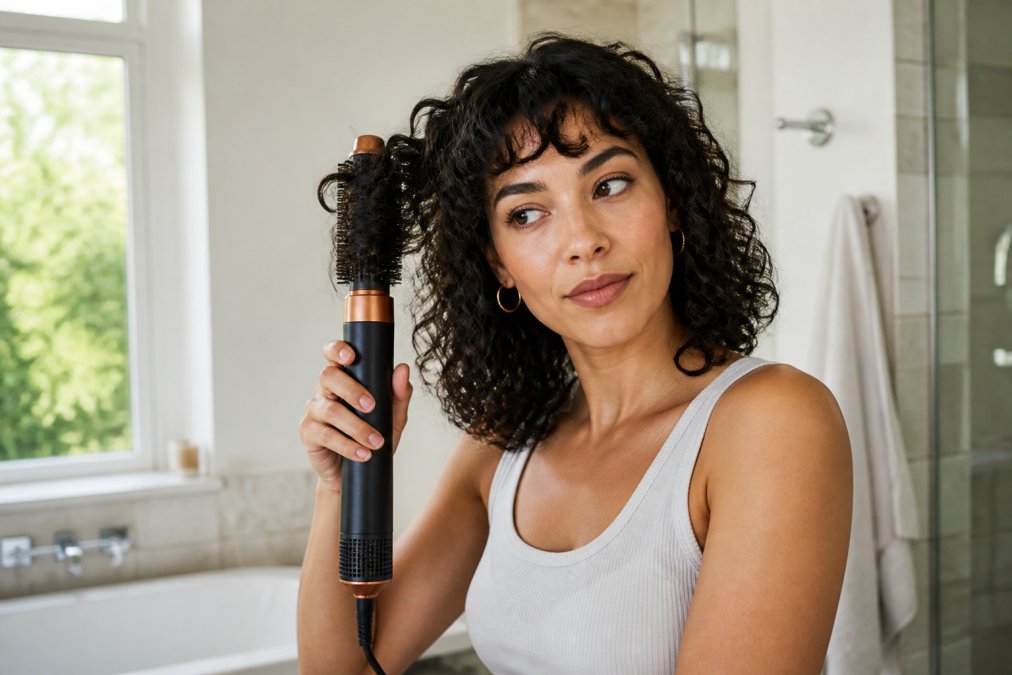
Styling curls with an air styler comes down to five steps: section, dry to roughly 80 percent, switch to a shaping attachment, work in small sections, and finish with a cool shot. Rushing any step causes frizz.
- Start on damp, not soaking, hair. Towel-dry gently. Wet curls stretch and break when pulled through a barrel.
- Section in four. Clip the top two-thirds up and work from the bottom. Large sections stay damp in the middle and force you to reapply heat.
- Dry to about 80 percent on the lowest heat setting. You are removing water, not setting shape yet.
- Switch to your shaping attachment. For curl definition, use a diffuser or a wide barrel. For a smoother blowout, use a round brush attachment.
- Finish each section with the cool shot button. Cool air closes the hair cuticle, which is what holds the curl in place and adds shine.
Dyson Airwrap vs The Chaska Life Air Styler
For curly hair specifically, The Chaska Life Air Styler is the stronger choice because its direct-airflow design handles dense sections in fewer passes, while the Dyson Airwrap remains excellent for fine to medium hair that wraps easily.
The core mechanical difference
Dyson's Coanda system uses airflow to attract and wrap hair around the barrel, so you get a curl without clamping. On smooth, medium-texture hair the result is fast and consistent; on tight curls the wrap is uneven, and the finished curl looks inconsistent from one section to the next.
Performance on different curl types
- 3A-3B: Both tools perform well. Dyson's wrap-and-set motion is genuinely hard to beat for loose, defined spirals, and the Chaska Life styler handles them comfortably on its lower settings.
- 3C: The gap starts to show. Dyson requires smaller sections and more passes to get an even wrap; the Chaska Life styler's direct airflow dries the interior of the section faster, which means fewer passes overall.
- 4A-4C: The Chaska Life styler is the clear choice. Coanda wrapping is unreliable on very tight coils, and the repeated passes needed to compensate add cumulative heat exposure. Direct airflow through the plates reaches dense sections without that penalty.
Ease of use and ergonomics
The Chaska Life styler carries more weight in the head because of the fan placement, but the handle geometry keeps the wrist neutral while drying.
Attachment variety
The Chaska Life styler covers the essentials, drying, straightening, and curling, in one tool. For curly hair, the attachments that matter most are a diffuser and a wide-airflow option, and both tools cover that ground.
Longevity and maintenance
Both tools need their intake filters kept clear, and both lose airflow before they lose heat if the filter is neglected. The Chaska Life styler's sealed heating element holds temperature consistently for more even drying. Treat filter cleaning as the single habit that extends either tool's life.
Price and what you are actually buying
The Chaska Life Air Styler is $249.00 for a single tool that covers drying, straightening, and curling. If you currently buy a dryer, a flat iron, and a curling wand separately, that math changes quickly, and for curly hair, the value is in not juggling three devices that each add their own heat exposure.
Best Multi-Styler for Curly Hair: What to Look For
The best multi-styler for curly hair has four things: adjustable heat settings that go low enough for fine curls, a diffuser or wide-airflow attachment, ionic or plasma technology for frizz control, and a weight balance that lets you hold it overhead for ten minutes.
CHASKA Air Styler - 3-in-1 Hair Dryer →
Here is what to check before you buy:
- Heat settings and temperature control. You need a genuine low setting, not just a "low" label on a hot tool. Curls set best in the moderate range.
- Attachment variety. A diffuser, a concentrator, and a round brush cover most curl needs. A paddle brush helps if you straighten.
- Airflow technology. Direct airflow through the head beats a narrow nozzle for thick hair.
- Weight and balance. A heavy tool held at an angle for a full head is a genuine ergonomic problem.
- Cord length. Anything under six feet limits where you can stand in front of a mirror.
- Travel case. If you travel, a case protects attachments and keeps the tool compact.
Heat Damage, Durability, and Product Compatibility
Heat damage on curly hair is cumulative, not immediate. Every high-heat pass lifts the cuticle slightly, and once it stays raised, moisture escapes and the curl pattern loosens permanently. The goal with any air styler is the lowest sustained temperature that still moves enough air to dry the section, more airflow at moderate heat beats short bursts of high heat.
Match the heat setting to your curl type
Generic guides treat "curly hair" as one category. It is not. The right setting depends on where your pattern falls on the 3A-4C scale, and the difference between adjacent types is bigger than most buyers expect.
- 3A-3B (loose, defined waves and spirals): These patterns dry fastest and frizz fastest. Stay on the lowest heat setting and medium speed, you are mostly drying, not shaping. A diffuser on low, cup held still against the scalp, does more for definition than any barrel.
- 3C (springy, densely packed corkscrews): The risk here is under-drying the interior. Use low-to-medium heat with higher airflow, and dry in smaller sections than feels necessary. If the middle of a section is still cool to the touch, it is not dry.
- 4A-4B (tight coils, sharper zigzag pattern): Coils shrink as they dry, so a section that looks dry outside can still be damp at the root. Work in thin sections, keep heat low, and spend more time on airflow than temperature.
- 4C (very tight, minimal visible definition): This is the type most air stylers fail. The cuticle is tightly packed and resists moisture loss, so high heat scorches the surface while the core stays wet. Low heat, maximum airflow, and a diffuser that spreads air wide, not a narrow concentrator, is the only combination that works without repeated passes.
Durability: what actually wears out first
A styler used four or five times a week takes real punishment, and the parts that fail are predictable.
- The motor and fan bearings. This is the first thing to degrade on any air styler. A drop in airflow that you notice before a heat change is the early warning sign. Keep the intake filter clear, a clogged filter forces the motor to work harder and is the most common cause of premature failure.
- The filter itself. Most manufacturers recommend cleaning or replacing the intake filter on a regular schedule, and skipping it shortens motor life. Check it monthly if you style daily.
- The attachments. Look for attachments that lock in place rather than snap on loosely. Loose attachments rattle, leak airflow, and eventually stop seating correctly, so you compensate by turning the heat up, which is exactly the wrong fix.
- The heating element. A sealed element holds temperature more consistently over time. An unsealed one develops hot spots that show up as patchy drying long before the tool stops working entirely.
Product compatibility: what to use and what to avoid
This is the part almost no guide covers, and it matters more than most buyers expect. The wrong product can undo everything the tool does right.
- Heavy oils and butters coat the heating plate and the hair surface, causing uneven heat transfer and patchy drying, some sections over-dried, others still damp. If you use them, apply sparingly and only to the ends.
- Lighter leave-in conditioners and curl creams work better with air stylers because they absorb into the strand rather than sitting on top of it, giving the airflow something to set against.
- Mousses are the best match for definition on 3A-3C hair. They add hold without weight and dry clear under airflow.
- Heat protectants are non-negotiable on any setting above the lowest. Apply to damp hair, not dry, and give it a minute to settle, product applied to dry hair sits on the surface and does not distribute.
- Setting sprays belong at the end, after the cool shot, not before. Applying them mid-style traps moisture you are trying to remove.
Conclusion
The hardest part of styling curly hair is not technique, it is finding a tool designed with your hair type in mind instead of adapted to it. Most stylers optimize for smooth, medium-texture hair, which is why so many curl owners cycle through three or four tools before finding one that works. Achieving a natural bounce requires a shift in approach, especially when styling thick hair that tends to lose its shape under the weight of heavy products.
Frequently Asked Questions
What is a good substitute for Dyson Airwrap for curly hair?
The CHASKA Air Styler is a strong airwrap alternative for curly hair. Its twin turbo fans push air directly through the plates, which cuts drying time and helps set curls without extreme heat. The plasma ion system reduces frizz and seals the cuticle, so curls stay defined. At $249, it costs less than many premium multi-stylers while offering three functions: dry, straighten, and curl.
Do air stylers work on natural curls without causing heat damage?
Air stylers use moving air rather than direct contact heat, so they tend to be gentler on curls than flat irons or traditional curling wands. The key is temperature control. Look for adjustable heat settings and ionic technology, which helps hair retain moisture. Always use a thermal protection spray and keep the tool moving. The CHASKA Air Styler's plasma technology generates negative ions that help seal the cuticle and reduce moisture loss.
How do affordable air stylers compare to the Dyson for curly hair maintenance?
The CHASKA Air Styler focuses on core functions: drying, straightening, and curling with airflow. For curly hair, a smaller barrel (1 to 1.5 inches) gives tighter definition, while a larger barrel creates looser waves. The CHASKA model uses direct airflow through heated plates, which some users find speeds up styling on thick curls.
Which multi-styler attachments are best for curly hair?
For curly hair, a diffuser is essential for drying without disrupting curl pattern. A concentrator helps direct airflow for smoothing, while a round brush attachment adds volume at the roots. Smaller barrels (1 to 1.25 inches) create defined spirals. The CHASKA Air Styler includes a paddle brush and round brush designed for smoothing and volumizing, plus curling barrels for shaping. Choose attachments based on whether you want definition, volume, or a blowout look.